Sweet Bonanza and Sweet Bonanza 1000: A Complete, Evidence-Based Guide to RTP, Volatility, Demo Play and Risk

Last updated: February 2026 | Reading time: ~18 minutes | 18+ only

Quick summary. Sweet Bonanza is a 6×5 scatter-pays pokie from Pragmatic Play (released October 2019) with a tumble mechanic, free spins triggered by 4 or more lollipop scatters, and in-feature multipliers up to 100×. Sweet Bonanza 1000 (June 2024) keeps the same skeleton but lifts multipliers to 1,000×, raises the win cap to 25,000× and adds a Super Bonus Buy for 500× the stake. Both titles ship with multiple RTP versions, and the version your casino installs can shrink your bankroll roughly 40% faster. Demo play is a legitimate way to learn the maths, though the research evidence shows simulated gambling is consistently associated with later real-money gambling. So treat "free play" as a risk factor, not a safety net.

Disclaimer. This material is general information and does not replace advice from a qualified specialist. Gambling involves the risk of financial loss, and no strategy can change a slot's built-in house edge. If gambling is causing you or someone you know harm, contact a professional support service. In Australia, the National Gambling Helpline (1800 858 858) operates 24/7.

Provider

Pragmatic Play

RTP

96.53%

Volatility

High

Min bet

€0.20

Max bet

€125

Max win

25,000x

Sweet Bonanza and Sweet Bonanza 1000

Quick comparison: Sweet Bonanza vs Sweet Bonanza 1000

If you only read one table, read this one. It answers the single most common pre-play question: which version am I actually looking at, and what does that change?

ParameterSweet Bonanza (original, 2019)Sweet Bonanza 1000 (2024)
Grid / pay mechanic6×5, Scatter Pays (8+ anywhere)6×5, Scatter Pays (8+ anywhere)
Maximum in-feature multiplier×100×1,000
Maximum win21,100× the bet (widely quoted; some sources list 21,175×)25,000× the bet
Max-win probabilityNot published; widely regarded as theoretical rather than practically reachable1 in 71,428,571 spins
Default RTP96.48% to 96.51%96.53%
Documented lower RTP versions94.51%, 92.34%, 90.17%, 87.49%, 84.54% (adjustable range)95.52%, 94.51%
VolatilityMedium-highHigh (5/5)
Hit frequency (any win)Comparable, frequent small wins1 in 2.33 spins
Free spins frequency~1 in 450 spins1 in 450 spins
Feature buy optionsBonus Buy 100×Bonus Buy 100× / Super Bonus Buy 500×
Ante Bet+25% stake, roughly doubles scatter chance (verify in-game; some help files quote +50%)+25% stake, roughly doubles scatter chance
Bet rangeA$0.20 to A$125 (operator-dependent)A$0.20 to A$240 (operator-dependent)
Wild symbolsNoneNone
Demo modeYesYes

Two practical takeaways. First, the win cap barely moved (21,100× to 25,000×), yet the route to it changed completely: the original's ×100 ceiling made the cap effectively unreachable, while the 1000 version's ×1,000 bombs make it mathematically attainable, at odds of roughly one in 71.4 million spins. Second, the "1000" badge is not a generosity upgrade. It is a variance upgrade.

1. Scope, context and research landscape

This guide combines three separate bodies of information that are usually published in isolation: the provider's technical specification, independent simulation and community-tracked return data, and the peer-reviewed and government-linked behavioural literature on simulated (demo) gambling. The aim is a single reference that survives fact-checking rather than a promotional review of yet another popular online slot.

1.1. Why focus on Sweet Bonanza

1.1. Why focus on Sweet Bonanza and demo play?

Sweet Bonanza is one of the most-played pokie titles in the world and, crucially, one of the most-played in demo form. It is the default "try before you deposit" game across thousands of lobbies, which makes it a useful case study for discussing both technical slot characteristics and behavioural evidence. Its scatter-pays and tumble architecture is also the template for a whole generation of candy-themed releases, so understanding it transfers directly to Sugar Rush, Sweet Bonanza Xmas, Sweet Bonanza Super Scatter and Sweet Bonanza 1000 Dice. Readers who want to compare where the title is actually available can review our online casino reviews, which track operator licensing, payment rails and feature availability.

1.2. How we checked the figures in this guide

Every number below came from one of four places, and we have tried to label them as we go: Pragmatic Play's own game rules and maths-model sheets; large-sample independent simulations; community session-tracking datasets; and published behavioural research. Where two sources disagree, both values appear in the text with a note. Where a figure is a hand-played test sample rather than an audited simulation, we say so. That is a slower way to write a slot guide, but it is the only way a reader can audit us back.

1.3. Types of evidence available and

1.3. Types of evidence available (and gaps)

Four evidence types matter here, and they are not equally strong:

  1. Provider specification. Pragmatic Play publishes default RTP, grid, multiplier ranges and free-spins rules. This is authoritative for design, but it does not tell you which RTP build your casino installed.
  2. Independent simulation and audit. Large-sample simulations reproduce RTP and volatility indices. Reliable for long-run behaviour, useless for predicting a single session.
  3. Community-tracked data. Aggregated real-session logs show what players actually experienced. Excellent for expectation-setting, though the samples are self-selected.
  4. Behavioural research. Cross-sectional and longitudinal studies on simulated gambling. Cross-sectional work consistently reports positive correlations between simulated gambling engagement and monetary gambling participation.

«All cross-sectional studies of adolescents and adults found an association between simulated gambling and monetary gambling participation; however, causation has not been demonstrated.» Hing et al., government-linked review (2025).

Similarly, studies looking specifically at social-casino and demo products report elevated rates of gambling problems among their players.

«Social casino gamers were more likely to gamble for money and displayed more indicators of problem gambling than non-players.» Groseman et al., analysis of gambling-like activities (2023).

The gaps are real and worth naming. No published dataset isolates Sweet Bonanza demo play specifically as a predictor of later monetary gambling; the literature addresses simulated gambling as a category. No regulator publishes which RTP build each operator deploys. And no source demonstrates causation from demo to deposit, only association, sometimes strong.

2. Sweet Bonanza from Pragmatic Play: the slot and its maker

2.1. Pragmatic Play and the slot's design pedigree

Pragmatic Play is a Malta-headquartered supplier licensed in multiple regulated jurisdictions, including the Malta Gaming Authority and the UK Gambling Commission. Sweet Bonanza launched on 22 October 2019 and became the anchor of the studio's "Bonanza" line. The mathematical signature of the original is medium-high volatility with a very high raw hit rate, reflecting relatively infrequent but potentially large payouts, especially during the free-spins round when multipliers up to 100× can land.

«A one-million-spin simulation reproduced a base RTP of 96.5% and a volatility index of σ = 1.39, with measured RTP deviating by about –0.01%.» Way2Win.ai, one-million-spin simulation. https://way2win.ai

Engagement has not faded. Sweet Bonanza has sustained high traffic since launch, with over 1.3 million tracked spins in SlotTracker's community sample. That figure is worth reading with care, because it reflects a self-selected community of trackers rather than a random sample of players.

«Community statistics for Sweet Bonanza are built from 1,337,065 tracked spins contributed by users running live session tracking.» SlotTracker, community dataset. https://slottracker.com

Sweet Bonanza 1000 arrived on 2 June 2024. Visually it is near-identical. Mathematically it is a different animal, rated high volatility (5/5) with multipliers reaching ×1,000.

2.2. Grid, symbols and the tumble

2.2. Grid, symbols and the tumble mechanic

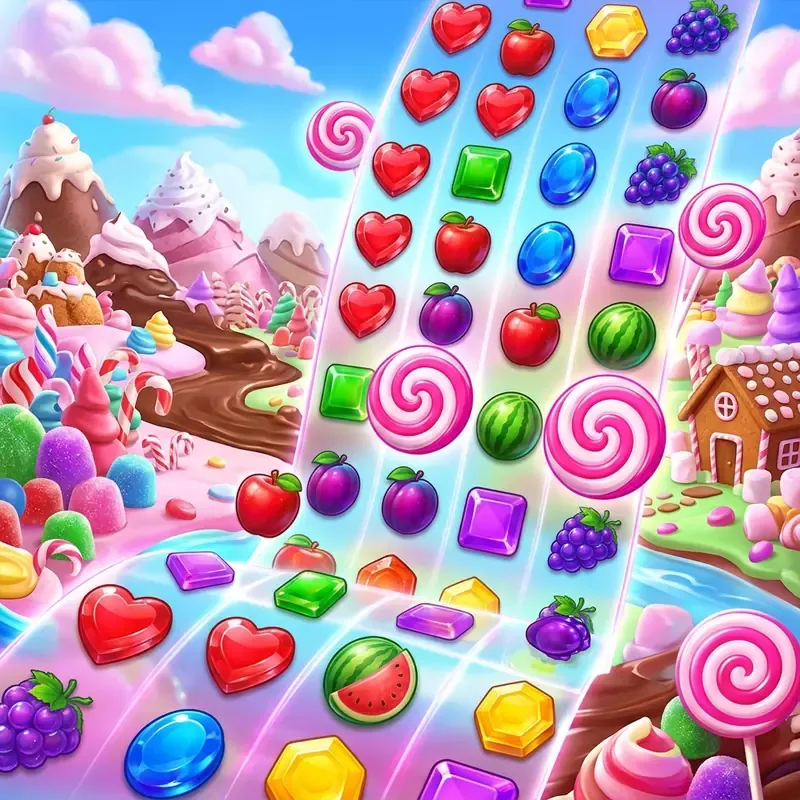
There are no paylines. Wins form when eight or more identical symbols appear anywhere on the 6×5 grid, a "pay anywhere" or group-pay system that yields 8,100 possible winning configurations. When a win is paid, the tumble mechanic removes the winning symbols and drops replacements from above. If a new win forms, the tumble repeats, indefinitely, until a non-winning arrangement lands. All tumbles inside one spin belong to one continuous round.

Round logic, step by step:

  1. Stake set: bet level × coin value fixes the risk before anything spins.
  2. Spin: the RNG resolves the initial symbol layout.
  3. Win evaluation: 8 or more matching symbols anywhere triggers a payout.
  4. Tumble: winning symbols are removed, gaps refill, evaluation repeats.
  5. Multipliers: in free spins only, candy-bomb values stay on screen through the tumble chain.
  6. Settlement: at the end of the chain, all visible multipliers are summed and applied once to the round's total win.

That final step is the detail most players get wrong: multipliers add, they do not multiply each other. Four bombs of ×10, ×25, ×3 and ×2 produce a ×40 total, not ×1,500.

2.3. Symbols and payout coefficients. Payouts

2.3. Symbols and payout coefficients

Payouts are awarded for counts of identical symbols anywhere on the grid, from eight upward. Values below are multiples of the total bet:
  • Red heart candy:8–9 = 10× | 10–11 = 25× | 12+ = 50×
  • Purple candy:12+ = 25×
  • Green candy:12+ = 15×
  • Blue candy:12+ = 12×
  • Apple:12+ = 10×
  • Plum:12+ = 8×
  • Watermelon:12+ = 5×
  • Grapes:12+ = 4×
  • Banana:12+ = 2×

Low-tier fruit at the 8–9 band pays from as little as 0.25× the bet, which is why a "win" frequently returns less than the spin cost.

Special symbols:

22Aud heading-banner
  • Scatter (lollipop):lands on all reels. 4 scatters = 3× plus 10 free spins; 5 scatters = 5× plus 10 free spins; 6 scatters = 100× plus 10 free spins. Three or more scatters during the feature award +5 free spins.
  • Multiplier (candy bomb):appears only during free spins. Values ×2 to ×100 in the original; ×2 to ×1,000 in Sweet Bonanza 1000.
  • Wilds:none, in either version, in any phase.
2.4. From bet to payout how

2.4. From bet to payout: how to play Sweet Bonanza in practice

The interface is deliberately plain, and that is part of the appeal. You set the stake with the plus and minus controls or the bet menu, press the round spin button, and the six reels drop. There is no line selection to worry about, no "ways" toggle, nothing to misconfigure. Autoplay lets you queue 10 to 1,000 spins with optional stop-on-win and loss-limit conditions, and turbo spin shortens the animation.

Three controls deserve a look before your first real-money round. The bet menu, because stake sizing decides how long your session lasts. The Ante Bet switch, because it silently raises the cost of every spin by a quarter. And the info panel, because that is where the theoretical RTP of your particular build is written down. Two taps, maybe five seconds. Worth it.

3. The mathematics: RTP, volatility and max win

3.1. RTP ranges, or how not to lose 40% of your deposit faster

Important. Pragmatic Play ships Sweet Bonanza 1000 in three RTP builds: 96.53%, 95.52% and 94.51%. The original Sweet Bonanza has an even wider adjustable range documented at 96.51%, 94.51%, 92.34%, 90.17%, 87.49% and 84.54%. The casino chooses which build to install.

What that does to your balance (A$100 deposit, A$1 spins):

  • 96.53% build (house edge 3.47%): A$100 ÷ 0.0347 = ~2,882 spins, roughly 2.5 hours at 3 seconds per spin.
  • 94.51% build (house edge 5.49%): A$100 ÷ 0.0549 = ~1,821 spins, roughly 1.5 hours.

Playing the reduced-RTP build burns your deposit more than 40% faster for identical stakes and identical entertainment.

The reason this matters more than

The reason this matters more than the raw percentage is that expected loss is driven by the house edge, not the RTP figure. A 2.02-percentage-point RTP cut sounds trivial. Expressed as edge, 3.47% versus 5.49% is a 58% increase in the rate at which the game takes your money.

A useful analogy: RTP ranges are to pokies what house rules are to blackjack. At one venue a dealer-player tie on 18 returns your stake; at another the dealer wins ties. Same game name, materially different maths. At the blackjack table the rule is printed on the felt. In a pokie, the difference hides behind identical artwork, which is exactly why you have to check it yourself.

How to verify which RTP version your casino runs:

  1. Log in to your casino account. Demo and logged-out play almost always display the maximum RTP (96.53%), so this check is invalid in fun mode.
  2. Open Sweet Bonanza or Sweet Bonanza 1000 in real-money mode.
  3. Open the info menu: the "i" icon, paytable, or Help / Game Rules panel.
  4. Find the line labelled "Theoretical RTP" or "Return to Player" in the rules text.
  5. Read the number. 96.53% means the good build; 95.52% or 94.51% means a reduced build. You may also see separate RTP values for the buy features. Those sit close to the base figure and are normal.

If an operator will not display this, or displays it only in demo, treat that as a transparency red flag rather than a technical quirk.

3.2. Independent audits and community RTP

SlotTracker's live statistics for Sweet Bonanza, based on 1,337,065 tracked spins, report a community RTP of 87.99%.

«Based on 1,337,065 tracked spins, community RTP for Sweet Bonanza measured 87.99%, well below the official 96.48% figure.» SlotTracker, community dataset. https://slottracker.com

This is not evidence of rigging, and it is important to say so plainly. High-variance games converge on their theoretical RTP over sample sizes far larger than 1.3 million spins, because a handful of extreme free-spins outcomes carries a disproportionate share of total return. What the number does prove is that a realistic multi-session player experience sits well below 96.48%, and that "96.48% RTP" should never be read as "you will get 96.48% back".

3.3. Volatility, hit frequency and confidence

3.3. Volatility, hit frequency and confidence intervals

The published maths model for Sweet Bonanza 1000 gives three numbers that explain the entire feel of the game:

  • Hit frequency: 1 in 2.33 spins. You win something on roughly 43% of spins. Most of those "wins" are below stake.
  • Free spins frequency: 1 in 450 spins. At 10 spins per minute that is one natural bonus every 45 minutes.
  • Volatility: High (5/5), with a simulated volatility index of σ = 1.39 for the original.

Short sessions are therefore statistically almost meaningless. A 100-spin sample on a game of this dispersion has an enormous confidence interval: a player could finish anywhere between losing three-quarters of all stakes and doubling them.

«The 95% confidence interval over 100 spins of Sweet Bonanza Super Scatter runs from –75% to +200% of total stakes, reflecting extremely high dispersion.» Independent technical audit, Sweet Bonanza Super Scatter analysis.

Qualitative testing matches the numbers. Independent testers describe the experience vividly, noting "dry runs" in base play and "snowballing wins" when several multiplier bombs land early in a free-spins round, producing recorded wins as high as 1,850× the stake during test sessions.

«Base-game play produced extended dry runs, while free spins with early multiplier clusters snowballed to a recorded 1,850× the stake in test sessions.» Independent slot testing report, Sweet Bonanza feature analysis.

Methodological caveat: these test sessions are hand-played samples in the hundreds-to-thousands of spins, not audited million-spin simulations. Treat them as illustrations of shape, not as expected values.

3.4. Maximum win potential and realistic

3.4. Maximum win potential and realistic expectations

The headline numbers, 21,100× on the original and 25,000× on the 1000 version, are marketing ceilings. The honest framing is the probability attached to them: 1 in 71,428,571 spins for the Sweet Bonanza 1000 cap. At 10 spins per minute, eight hours a day, seven days a week, that is roughly 41 years of continuous play for one expected max-win event. On the original, with a ×100 multiplier ceiling, the cap is generally regarded as not practically achievable at all.

What the bonus round actually pays is far more useful. Bonus-round analysis based on 50 or more test rounds reports median free-spins outcomes of roughly 35–45× the stake and mean outcomes around 80–120×.

«Across 50+ tested bonus rounds, median free-spins outcomes were 35–45× the stake and means were 80–120×, with the mean inflated by rare large hits.» Independent bonus-feature analysis.

Read those two numbers together. The median is what a typical bonus delivers; the mean is dragged upward by rare outliers. A player who buys features expecting the mean will, more than half the time, receive less than half of it.

Fact-check note. RTP, volatility, max win and feature availability all need to be verified twice: once against Pragmatic Play's official documentation, and once inside the game's own info panel at the casino you are using. Marketing pages describe the best-case build. Your lobby may not be running it.

4. Free spins and multipliers in

  1. Free spins and multipliers in detail

The feature is the game. Everything in base play is a funnel toward it.
  • Trigger:4, 5 or 6 lollipop scatters anywhere award 10 free spins plus 3×, 5× or 100× the bet respectively. Natural frequency is roughly 1 in 450 spins.
  • Retrigger:3 or more scatters during the feature add 5 free spins. There is no published cap on retriggers.
  • Multipliers:candy bombs appear only inside free spins. Each carries a random value, ×2 to ×100 in the original or ×2 to ×1,000 in Sweet Bonanza 1000. They persist on screen for the duration of a tumble sequence, are summed at the end of that sequence, and are applied to the sequence's total win. If the sequence produced no win, visible multipliers pay nothing. That single rule is responsible for most of the disappointment players report about the feature: bombs landing on dead sequences are simply lost.

Worth remembering when a ×500 bomb sits there doing nothing. It is not a glitch. It is the rule.

5. Sweet Bonanza demo: playing free, what it teaches and what it hides

5.1. What the demo genuinely teaches

Free play is the cheapest way to internalise mechanics that text explains badly. Load the Sweet Bonanza demo, set 100 autospins, and within a few minutes you will have observed the hit-frequency rhythm, seen how low-tier fruit wins fall below stake, watched at least one tumble chain, and understood how multiplier summation works. Testing a Bonus Buy in the free slot version also gives you a felt sense of how often a 100× purchase returns less than 100×.

Demo play is available without registration at most lobbies, and it uses play money only. No deposit, no payout, no verification.

5.2. What the demo cannot tell you

Three things, all of them important:

  1. The RTP build. Demo mode virtually always serves the maximum RTP version. Your real-money session may be running 94.51%.
  2. Your own risk behaviour. Play money removes loss aversion entirely, and that is the psychological variable that most changes decision-making with real funds.
  3. Feature availability. Bonus Buy is blocked in several regulated markets and disabled voluntarily by some operators, so a demo with a buy button does not guarantee a real-money buy button.

5.3. Demo mode as a psychological and behavioural risk

This is the section most reviews omit, and it is the one with the strongest research base behind it.

Data from an Australian-context analysis of demo casino play found a rapid pathway from simulated to funded play, illustrating the transition from free games to monetary gambling in a short time frame.

«27% of players who used a demo for less than 30 minutes made a deposit to play for real money within 48 hours.» Analysis of online casino demo play in an Australian context (2023).

Longitudinal evidence in adolescents points the same direction. Adolescents who played social casino games at ages 16–17 had a 40% higher probability of participating in monetary gambling as young adults aged 18–19.

«Adolescents who played social casino games at 16–17 were 40% more likely to gamble for money at 18–19.» Hing et al., government-linked review (2025).

Broader survey work on gambling-like activities in video games reports very high co-occurrence: 75.3% of respondents had engaged in simulated gambling and 60.4% in monetary gambling in the past year.

«Hierarchical multiple regression showed that gambling-like activities significantly predicted monetary gambling participation.» Groseman et al., analysis of gambling-like activities (2023).

How to read this honestly. None

How to read this honestly. None of these studies establishes that playing a Sweet Bonanza demo causes gambling harm. Cross-sectional designs cannot separate cause from selection: people already inclined to gamble are more likely to open demos. But the association is consistent across adolescent and adult samples, across countries and across study designs, and the 48-hour deposit figure suggests demo play frequently functions as an on-ramp rather than a substitute. Practical implication: if you use demo play, decide in advance whether it is research or entertainment, and set your deposit decision rule before you open the game rather than after a good demo run.

6. Paid features: stake sizing, Ante Bet and the two buys

6.1. Setting your stake

Total stake is bet level multiplied by coin value. Ranges are operator-dependent but typically A$0.20 to A$125 on the original and A$0.20 to A$240 on Sweet Bonanza 1000. Because the free-spins trigger sits around 1 in 450 spins, stake sizing should be derived from bankroll ÷ expected spins, not from a target win. A A$200 bankroll at A$1 per spin buys roughly 450 to 600 spins on a mid-RTP build, which is about one expected natural bonus.

6.2. Ante Bet: trading higher stakes for more frequent bonuses

Ante Bet increases the cost of each spin by 25% (an A$1.00 stake becomes A$1.25) and adds extra scatter symbols to the reels, roughly doubling the natural bonus rate from about 1 in 450 to around 1 in 225 spins. At a pace of 10 spins per minute that works out to roughly 4.8 bonuses per hour with Ante Bet on, against about 3.4 per hour without it. Ante Bet RTP is 96.50%, and Bonus Buy is disabled while Ante Bet is active.

«With Ante Bet OFF the expected loss is A$3.52 per A$100 wagered; with Ante Bet ON it is A$3.49, an RTP improvement of 0.03 percentage points.» Ante Bet explainer, Sweet Bonanza Xmas variant analysis.

The trade is therefore almost RTP-neutral but not bankroll-neutral: you pay 25% more per spin, so your session length shortens by roughly a fifth in exchange for roughly double the bonus frequency. That is a variance decision, not a value decision.

Documentation note: most current specifications for Sweet Bonanza and Sweet Bonanza 1000 list Ante Bet at +25%. Some provider help files for the original title have quoted +50%. Check the figure in the game's own info panel before committing, since the multiplier applied to your stake is what actually leaves your balance.

6.3. Sweet Bonanza Bonus Buy cost

6.3. Sweet Bonanza Bonus Buy: cost, RTP and practical risk

For 100× the bet, the free-spins round starts immediately with a minimum of 4 scatters and 10 free spins. Buy RTP is stated at 96.52%, marginally above the base build, which is the source of persistent forum claims that buying is "better value".

Corrected framing: some hand-played demo test samples have recorded average returns in the 110–130× range on a 100× purchase, but this does not represent long-run mathematical expectation and is inconsistent with the published RTP figures. At 96.52% RTP, the expected return on a 100× purchase is approximately 96.5×, a structural loss of about 3.5× the bet per buy. Test samples above 100× reflect small-sample variance or specific test conditions, not an exploitable edge. Recall from section 3.4 that the median bonus outcome is 35–45× the stake: more than half of 100× purchases return well under half their cost, with the average rescued only by rare large hits.

Practical risk: at A$1 stakes, ten consecutive buys cost A$1,000 and, at median outcomes, return roughly A$350 to A$450.

Bonus Buy compresses hours of variance into minutes. It does not change the house edge; it accelerates your exposure to it.

Availability is a separate question. The buy button is switched off entirely in some regulated markets, and a handful of operators disable it by policy, so check your own lobby rather than assuming.

6.4. Super Bonus Buy Sweet Bonanza

6.4. Super Bonus Buy (Sweet Bonanza 1000 only)

For 500× the bet, Super Bonus Buy launches a free-spins round in which every candy-bomb multiplier that lands carries a guaranteed value of no less than ×20. Stated RTP is 96.55%, the highest of any mode in the game, and still a losing proposition at approximately 483× expected return on a 500× outlay.

This is the highest-variance purchase in the title. At A$0.20 minimum stake a Super Bonus Buy costs A$100; at A$1 it costs A$500. It is the single fastest way to empty a bankroll in either version of Sweet Bonanza, and it should only be considered by players who have already decided they can afford to lose the full purchase price several times consecutively.

Summary of paid modes:

ModeCostStated RTPEffect
Base gameStandard stake96.48% to 96.53% (build-dependent)Bonus ~1 in 450 spins
Ante Bet+25% stake96.50%Bonus ~1 in 225 spins; buys disabled
Bonus Buy100× bet96.52%10 free spins, min. 4 scatters
Super Bonus Buy (1000 only)500× bet96.55%10 free spins, all multipliers ≥ ×20

7. Where to play Sweet Bonanza online for real money

Online gambling law differs sharply by jurisdiction, and it is your responsibility to confirm the rules that apply where you live before wagering. Some markets prohibit feature-buy mechanics outright; others mandate RTP disclosure; others restrict online casino play entirely. Pragmatic Play itself holds licences in multiple regulated jurisdictions, including the Malta Gaming Authority and the UK Gambling Commission, but a supplier's licence says nothing about the legality of any particular operator serving you.

7.2. Evaluating casinos: RTP transparency, demo access and feature availability

Given how much the RTP build matters, a casino that offers full-RTP slots and discloses this openly is generally preferable from a fairness standpoint. Our guide to choosing an online casino compares operators on exactly these criteria: licence status, disclosed RTP builds, payment options relevant to Australian players such as PayID, Neosurf and crypto, KYC requirements and withdrawal timelines.

A verification checklist before you deposit:

22Aud heading-banner
  • Licence:regulator named, licence number published and verifiable on the regulator's register.
  • Software authenticity:the game loads from Pragmatic Play's official platform, with the provider name shown in the game info panel, not an unbranded clone or mirror.
  • RTP disclosure:"Theoretical RTP" visible in real-money mode, ideally documented site-wide.
  • Demo access:a working Sweet Bonanza demo available before registration, clearly labelled as play money.
  • Feature availability:whether Bonus Buy and Super Bonus Buy are enabled, since both are restricted in some markets.
  • KYC and payouts:identity verification requirements stated up front, with published withdrawal processing times.
  • Responsible gambling tools:deposit, loss and session limits; reality checks; self-exclusion.

An operator that clearly separates play-money from real-money environments demonstrates more trustworthiness than one that blurs the two.

«Social casino gamers displayed more indicators of problem gambling than non-players, which is precisely why platform-level responsible gambling tools matter.» Groseman et al., analysis of gambling-like activities (2023).

7.3. Comparing bonuses and Sweet Bonanza

7.3. Comparing bonuses and Sweet Bonanza eligibility

Bonus offers do most of the work in attracting players to online casinos, and the terms attached to them decide whether an offer has any value at all. Published operator terms vary and are rarely comparable across brands, so the only reliable approach is to read the specific T&Cs. Four checks catch most bad offers:

  1. Wagering multiplier. Keep it at or under 30×. Above 30×, the expected value of the bonus is usually negative even before other restrictions.
  2. Deposit plus bonus wagering. Some operators require you to turn over both, effectively doubling the playthrough. Confirm which base applies.
  3. Game weighting. Pokies typically contribute 100% toward wagering, and Sweet Bonanza usually qualifies, but confirm whether the specific title is excluded, and whether feature buys are excluded from wagering contribution, which is an increasingly common clause.
  4. Max bet during wagering. Frequently capped around A$5. A single 100× Bonus Buy at A$1 stakes is a A$100 wager and can void a bonus instantly on a max-bet breach.

Be sceptical, too, of "no wagering" offers with big headline amounts, and of any bonus where the withdrawable portion is capped far below the advertised figure. As a general rule with casino promotions: the more attractive the offer looks, the more carefully the terms deserve reading.

8. Sweet Bonanza mobile: launching the slot on a smartphone

Sweet Bonanza is built on HTML5, which makes it fully compatible with iOS, Android and Windows devices. Graphics scale automatically to mobile resolutions, and the touch interface maps directly to the desktop controls: a single tap on the spin button, with autoplay and bet configuration available from the same menu. For smooth performance, use a recent version of Chrome or Safari with WebGL support. The game runs both in-browser and inside operator apps, and no separate download is required for browser play.

Practical notes for phone play. The paytable and info panel, where the RTP figure lives, sit behind the menu icon and are easy to miss on a small screen, so open them deliberately. Battery-saver modes and aggressive tab-suspension on iOS can interrupt long autoplay sequences; a dropped connection mid-round is resolved server-side, and the round completes when you reconnect. The mobile demo behaves identically to the desktop one, which makes a phone a perfectly reasonable place to test the mechanics before you decide anything.

9. Who Sweet Bonanza is not

  1. Who Sweet Bonanza is not for, and what to play instead

Reviews rarely say this, so here it is directly. Avoid this game if:

  • You dislike long unrewarded stretches. With a natural bonus every ~450 spins, base play can feel flat for extended periods despite the 1-in-2.33 hit rate.
  • You are playing a short session with a small bankroll. High dispersion plus a rare feature is the worst possible combination for 100-spin sessions.
  • You are tempted by feature buys. A 500× Super Bonus Buy is a five-hundred-spin bankroll spent in one click.
  • You want steady, low-variance entertainment. Look at lower-volatility titles instead.

Closest alternatives:

22Aud heading-banner
  • Sweet Bonanza Xmas:near-identical maths, seasonal skin, Ante Bet documented.
  • Sweet Bonanza Super Scatter:same family, different scatter economy, and the source of the –75% / +200% 100-spin confidence interval cited above.
  • Sweet Bonanza 1000 Dice:dice-themed reskin of the 1000 model.
  • Sugar Rush:cluster-pays with a multiplier grid, and more frequent feature engagement.
  • Gates of Olympus:the same scatter-pays and multiplier architecture in a mythology theme, with comparable volatility.
  • Cluster and scatter-pay online slots from other studios,including Play'n GO releases, if you want the same shape of maths with a different feel.
10. Bankroll approach what actually works

  1. Bankroll approach: what actually works, and what doesn't

A widely repeated claim deserves direct correction: "the best strategy is to make small bets and keep playing until you hit a winning combination" is false. Sweet Bonanza runs on a certified random number generator. Every spin is independent of every prior spin. Smaller stakes extend session length and reduce the size of each expected loss, but they cannot change the mathematical expectation, cannot make a bonus "due", and cannot convert a negative-edge game into a positive one. There is no bet-timing, stake-laddering or "hot slot" system that alters the house edge. Anyone selling one is selling nothing.

What does work, in the narrow sense of controlling harm rather than generating profit:

  • Verify the RTP build before you play. This is the only decision that measurably changes your expected loss, up to 40% faster bankroll depletion between builds.
  • Set the loss limit before the first spin, using the casino's own deposit and loss tools rather than willpower.
  • Size stakes from spin count, not from win targets. Bankroll ÷ desired spins = stake.
  • Decide your position on feature buys in advance. Buys are entertainment purchases with a known negative expectation, not investments.
  • Treat demo play as reconnaissance with a defined endpoint, given the 48-hour deposit findings in section 5.3.
11. Pre-play verification checklist. - I

  1. Pre-play verification checklist

  • I know which title I'm playing: original (×100, 21,100× cap) or 1000 (×1,000, 25,000× cap).
  • I have checked "Theoretical RTP" in real-money mode, not demo.
  • The RTP shown is 96.48% to 96.53%, not a reduced build.
  • The operator's licence number is published and verifiable.
  • The game loads from Pragmatic Play's official platform.
  • A Sweet Bonanza demo is available and clearly labelled as play money.
  • I know whether Bonus Buy and Super Bonus Buy are enabled in my market.
  • If I'm using a bonus: wagering ≤30×, applied to bonus only, max bet checked, feature-buy contribution checked.
  • Deposit and loss limits are set.
  • I understand the median bonus returns 35–45× the stake, not the 25,000× headline.

  1. Sweet Bonanza FAQ

Appendix A superseded and corrected statements

Appendix A: superseded and corrected statements

For transparency, the following formulations appeared in earlier versions of this guide and have been revised:
  • Superseded:"Demo-focused bonus analyses claim that expected return on a 100× stake Bonus Buy falls roughly in the 110–130× range across long samples, implying a favourable expectation compared with cost, but this claim appears inconsistent with the general RTP figures and may reflect specific test conditions or misinterpretation."
  • Corrected (section 6.3):small test samples have recorded 110–130× returns, but this does not reflect long-run expectation. At a stated 96.52% RTP the expected return on a 100× buy is approximately 96.5×, and the median bonus outcome is 35–45× the stake. There is no favourable expectation on any buy mode.
  • Superseded (third-party claim, not endorsed):"The best way to increase your chances of winning is to stick with smaller bets and keep playing until you hit a winning combo."
  • Corrected (section 10):the game uses a certified RNG with independent spins; stake size affects session length and loss rate, not expectation. No staking pattern alters the house edge.
  • Flagged for in-game verification:Ante Bet stake uplift. Current specifications for both titles state +25%; some legacy provider help files state +50%. Verify in the game's info panel.
  • Data limitations we are explicit about:no dataset isolates Sweet Bonanza demo play as a causal predictor of monetary gambling; regulators do not publish per-operator RTP builds; and hand-played test-session figures (1,850× recorded wins, 50 or more bonus rounds) are illustrative samples, not audited simulations.
About this guide. Compiled by the

About this guide. Compiled by the research desk behind our iGaming coverage, combining Pragmatic Play's published specifications, independent simulation and community-tracked return data, and the peer-reviewed and government-linked literature on simulated gambling. Figures were checked against provider documentation and independent maths-model publications at the date of last update. Where sources disagree, both values are shown and flagged.

Responsible gambling. 18+ only. Gambling is entertainment with a guaranteed long-run cost, not a way to make money. Only stake funds you can afford to lose. Use deposit, loss and time limits. If gambling is affecting your finances, relationships or wellbeing, contact the National Gambling Helpline on 1800 858 858 (Australia, 24/7) or an equivalent service in your jurisdiction. Online gambling is prohibited in some jurisdictions, so verify your local law before playing.