Lucky Penny Slot (3 Oaks Gaming): RTP 95.64%, Hold & Win Jackpots, Demo Play and the Australian Evidence Base

Reviewed by: iGaming editorial and compliance team · Last updated: February 2026 · Reading time: ~22 minutes Our experience: our team documents slot mathematics, operator terms and harm-minimisation frameworks as part of our ongoing iGaming research practice.

18+ only. Gambling involves risk. This article is educational and does not encourage gambling. If gambling is causing harm, contact Gambling Help Online on 1800 858 858 (Australia, 24/7).

Provider

3 Oaks Gaming

RTP

95.64%

Volatility

High

Min bet

$0.10

Max bet

$1.25

Max win

20,000x bet

Lucky Penny Slot 3 Oaks Gaming
the short verdict

the short verdict

  • What it is:Lucky Penny is a five-reel, three-row video pokie by 3 Oaks Gaming (the studio formerly trading as Booongo) with 25 fixed paylines, Hold and Win respins and four fixed jackpot tiers (Mini, Minor, Major, Grand). It is not a crash-betting game, a factual error repeated by several app-landing pages.
  • Maths:advertised RTP 95.64%, high volatility, house edge 4.36%. A $100 balance staked at $1 a spin lasts roughly 2,294 spins (~2 hours) on average, before variance is taken into account.
  • Bonus frequency:free spins land approximately once every 120 spins; the Hold and Win respin round roughly once every 300 spins. Plan a bankroll of at least 100× your base stake, and preferably 300×.
  • Where it sits legally in Australia:under the Interactive Gambling Act 2001, it is unlawful for operators to supply real-money online casino games (including online pokies) to people in Australia. Free demo play is a different category. Read the legal section before depositing anywhere.
  • Sequel:Lucky Penny 2 (released 28 August 2025) is a different engine: 6×5 grid, Scatter Pays from 8 matching symbols, cascading reels and a Mystery Multiplier.
  • Harm context:Australian research consistently links long sessions, loss-chasing and advertising exposure with higher risk. Self-exclusion via BetStop covers licensed Australian wagering services; 40,121 Australians had registered by 31 March 2025.
What this review answers. Most people

What this review answers

Most people who search for a lucky penny slot want four things, and they want them in this order: what the game actually is, what it costs to play, whether the free demo tells you anything useful, and whether real-money play is even lawful where they live. So that is the order we work in.

Along the way we answer the practical questions readers send us most often. How much of the return sits behind the bonus rounds? What bankroll do you need before the Hold and Win round is statistically reachable? Is lucky penny bonus buy worth the price it asks? Does a phone browser run the game properly, or do you need an operator app? And what do Australian regulators, researchers and self-exclusion data say about products built this way?

We also publish what we could not confirm. There is no supplier maths sheet in our hands for this title, so every figure below is labelled either as calculated by us or as source-convergent. That distinction matters more than a tidy verdict.

1. Translating the "Lucky Penny" topic into a defined scope

In two sentences: "Lucky Penny" is used online to describe at least four different things, and conflating them is the main reason players encounter contradictory RTP and mechanic claims. This section fixes the scope so every number that follows refers to one identifiable product.

1.1 Defining the term. The phrase

1.1 Defining the term

The phrase lucky penny carries three separate meanings that collide in search results:

  1. A folk superstition. A found coin, kept for luck, the cultural motif that gives the pokie its theme of coins, horseshoes and four-leaf clovers.
  2. A "penny slot" category. Historically, machines accepting one-cent denominations. Online, the penny slot label survives as shorthand for low-minimum-stake games rather than a literal one-cent bet.
  3. A specific game title. Lucky Penny, a 5×3 video pokie by 3 Oaks Gaming, and its 2025 sequel Lucky Penny 2.

Because the folk meaning and the category meaning both attach to the same words, generic "lucky penny slots" pages frequently mix specifications from unrelated titles. Several aggregator pages also still list the game under Booongo, the studio's earlier brand. To avoid confusion we use the formulation: developer, 3 Oaks Gaming (formerly Booongo).

1.2 Scope of this review. This

1.2 Scope of this review

This article addresses:

  • the base game structure (grid, paylines, stake range, symbol values);
  • the bonus architecture (scatter-triggered free spins, symbol-triggered Hold and Win, four fixed jackpot tiers);
  • the mathematical model (RTP, house edge, volatility, trigger frequency, bankroll implications);
  • lucky penny demo play and the bonus buy option, including jurisdictional restrictions;
  • mobile delivery (HTML5, device requirements, interface behaviour);
  • real-money considerations for Australian readers, including the legal position, operator-selection criteria, KYC and bonus terms; and
  • the Australian research and regulatory evidence that gives this kind of product its public-health context.
1.3 A correction that matters this

1.3 A correction that matters: this is not a crash game

At least one prominent mobile-app landing page describes Lucky Penny as delivering a "crash betting experience", complete with a rising multiplier gauge and a crash-history feed. That description is wrong for this title. Lucky Penny by 3 Oaks Gaming is a reel-based pokie whose signature feature is Hold and Win, meaning locked coin symbols and respins, not a cash-out-before-the-crash mechanic. The same page quotes an RTP of 96%, which does not match the 95.64% figure published for the 3 Oaks reel game.

Practical consequence: if a site tells you Lucky Penny is a crash game, treat every other number on that page as unverified. Strategy advice built on crash mechanics (cash-out timing, auto-cashout multipliers) has no application to a Hold and Win pokie.

1.4 Theme, visuals and the game

1.4 Theme, visuals and the game interface

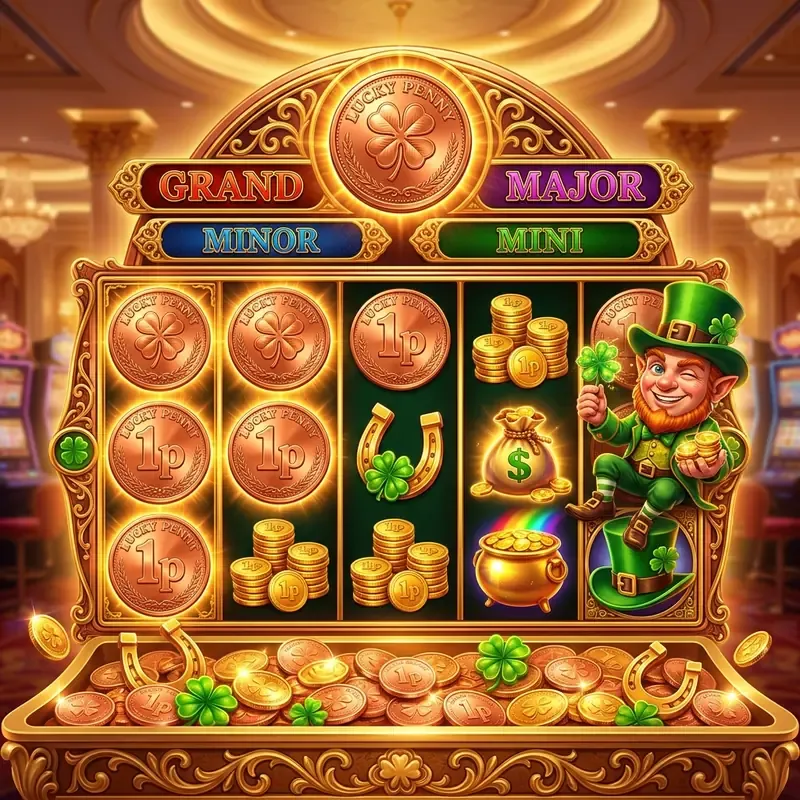
The theme is deliberately old-fashioned luck symbolism: copper coins, a gold pot, a horseshoe, a four-leaf clover and playing-card ranks on a warm, low-contrast backdrop. Nothing about the presentation is trying to be clever. That is not a criticism; a simple visual language makes the coin symbols easy to spot during a respin round, which matters when the Hold and Win feature is running at speed.

The interface follows the standard 3 Oaks layout. A stake selector sits beside the spin button, with autoplay and turbo controls nearby and an information panel behind a small "i" icon.

That panel is the part most players skip and the part we care about most: it carries the paytable, the feature rules and the RTP figure for the build your operator hosts. Open it once, before your first spin, and you have done more due diligence than most.

One small quirk worth naming. Because the Penny Bonus coins carry printed cash values, the screen can look busy during a full respin round, and it is easy to misread a modest total as a jackpot hit. Read the round summary rather than the reels.

2. Technical specifications compared with the market

In two sentences: Lucky Penny pairs an above-average RTP for its volatility class with a deliberately narrow stake ceiling. The table below benchmarks each parameter against typical modern video pokies so you can see where the game is generous and where it is restrictive.

Lucky Penny at a glance (3 Oaks Gaming)

ParameterLucky PennyTypical industry range
Developer3 Oaks Gaming (formerly Booongo)n/a
Game typeVideo pokie, Hold and Win respinsn/a
RTP (return to player)95.64%94.5% to 95.5% (high-volatility titles)
House edge4.36%3.2% to 5.5%
VolatilityHighMedium to medium-high
Grid / paylines5×3 / 25 fixed paylines5×3 / 10 to 25 lines
Minimum / maximum stake$0.10 / $1.25 (varies by operator and currency, including crypto denominations)$0.20 / $100
Maximum win potentialUp to 12,500× stake (see verification note)2,500× to 5,000×
Top single-symbol payout500× stake (5 × Wild)250× to 1,000×
Free spins frequency≈ 1 in 120 spins≈ 1 in 180 spins
Hold and Win frequency≈ 1 in 300 spins1 in 250 to 1 in 400
Jackpot tiers4 fixed (Mini, Minor, Major, Grand)0 to 4
Base-game hit cadenceSmall wins roughly every 8 to 12 spinsEvery 3 to 5 spins (low volatility)
Share of return from features≈ 75% of total RTP50% to 70%
TechnologyHTML5 / JavaScript, browser-basedHTML5
Bonus buyAvailable at some operators; prohibited in several jurisdictionsIncreasingly restricted
How to read this table. Three

How to read this table

Three entries deserve emphasis.

First, the stake ceiling. A maximum of $1.25 per spin is unusually low for a game marketed with four jackpot tiers. It caps both risk and reward: you cannot escalate stakes rapidly, which is protective, but the "Grand" jackpot is correspondingly modest in absolute dollars compared with progressive networks. For genuine penny slot players, though, the $0.10 floor is the more relevant number.

Second, the feature-weighted return. With roughly three-quarters of the theoretical return delivered through free spins and Hold and Win, base-game play is expected to be loss-making over time by design. That is the mathematical definition of high volatility in this title: you are effectively funding an option on a bonus round.

Third, RTP is not universal. Many suppliers ship multiple RTP configurations, and operators choose which build to host. Always open the in-game information panel and confirm the RTP displayed to your account before staking real money.

The studio behind the game

3 Oaks Gaming is a business-to-business content supplier rather than a casino brand, which is why you will never register with it directly. It builds HTML5 slots for desktop and mobile browsers, tests its random number generation through independent laboratories and licenses its catalogue to operators and aggregators. We appraise the corporate profile in more detail in section 10.9, including what we could and could not verify.

3. Symbols and the complete paytable

In two sentences: The symbol hierarchy is compressed at the low end and steep at the top, which produces frequent tiny wins and rare large ones. Knowing the exact multipliers lets you calculate what a "good" base-game hit actually returns relative to your stake.

3.1 Payout coefficients (multiples of total stake)

Symbol5 of a kind4 of a kind3 of a kindFunction
Lucky Penny (Wild)500×100×25×Substitutes for all paying symbols except Scatter and Bonus; can expand to cover a full reel
Gold Pot (Scatter)Triggers free spinsTriggers free spinsTriggers free spins3 or more anywhere awards 8 free spins
Lucky Horseshoe200×50×12×Top-paying standard symbol
Four-Leaf Clover150×40×10×Second standard symbol
Ace (A)75×20×5×Card symbol
King (K)60×15×4×Card symbol
Queen / Jack (Q, J)50×12×3×Lowest card symbols
Penny Bonus (coin)Triggers Hold and WinCarries cash value plus respinsCarries cash value6 or more anywhere starts the respin round
3.2 What the numbers imply

3.2 What the numbers imply

  • The Wild carries the game. At 500× for five of a kind, the Wild is worth 2.5 times the top standard symbol. Combined with reel-wide expansion, a single well-placed Wild can complete several of the 25 paylines simultaneously.
  • Card symbols are filler. Three-of-a-kind card wins pay 3× to 5× the stake. At a $1 stake, a "win" of $3 after several dead spins is a net loss in context, a pattern behavioural researchers call a loss disguised as a win. Recognising it is one of the more useful literacy skills a pokie player can develop.
  • Bonus coins pay twice. Penny Bonus symbols carry cash values that are independent of payline wins, which is why the Hold and Win round can produce a large result even without reaching a jackpot tier.
  • Wilds do not substitute for feature symbols. No amount of Wilds will manufacture a bonus trigger; features are gated strictly by Scatter and Bonus counts.

3.3 A worked example

Suppose you stake $0.50 and land five Four-Leaf Clovers on one payline: 150 × $0.50 = $75. Now suppose you land three Queens: 3 × $0.50 = $1.50. Both are "wins", but the first is 150 spins of stake recovered and the second is three. The distance between those two outcomes is precisely what high volatility feels like in practice.

3.4 Stakes, spin controls and where

3.4 Stakes, spin controls and where to check the rules

The basic loop is short. Choose a stake between $0.10 and $1.25, press spin, and 25 fixed lines are evaluated from the leftmost reel rightwards. Wins pay once per line; the highest combination on each line counts. There is no line selector to fiddle with, which removes one of the classic sources of accidental over-betting.

A practical order of operations before you play Lucky Penny for real money:

  1. Open the information panel and note the RTP, volatility rating and maximum win stated for that build.
  2. Set your stake deliberately, not by tapping the maximum button out of habit.
  3. Decide in advance how many spins the session gets, then check that number against your bankroll from section 4.4.
  4. Leave autoplay and turbo off, at least for the first hundred spins, so you can actually see the hit cadence.

That fourth point sounds fussy. It is also the single easiest way to notice that a "steady" run of small card wins is quietly costing you money.

4. Bonus features: free spins, Hold and Win, four jackpots

In two sentences: Lucky Penny runs two independent feature paths, one scatter-triggered and one symbol-count-triggered. Because roughly three-quarters of the theoretical return sits inside those features, understanding their exact entry conditions is the difference between informed play and guesswork.

4.1 Free spins (Gold Pot Scatters)

  1. Land three or more Gold Pot Scatters anywhere on the reels in a single spin.
  2. You receive 8 free spins, with no additional wagering requirement.
  3. Additional Scatters during the round retrigger the feature.
  4. Expanding Wilds appear more frequently during free spins than in the base game.

Expected frequency: approximately once every 120 spins.

4.2 Hold and Win respins (Penny Bonus coins)

  1. Land six or more Penny Bonus symbols anywhere on the 15-position grid.
  2. All triggering coins lock in place.
  3. You are awarded three respins.
  4. Every new Penny Bonus symbol resets the respin counter back to three.
  5. The round ends when three consecutive respins add no new coin.
  6. Cash values on all locked coins are paid, plus any jackpot achieved.

Expected frequency: approximately once every 300 spins.

4.3 The four fixed jackpot tiers

TierRequirementNotes
Mini6 to 8 Penny Bonus symbols collectedMost common outcome of a triggered round
Minor9 to 11 symbolsRequires the respin counter to reset at least once
Major12 to 14 symbolsUncommon
GrandAll 15 grid positions filledThe headline prize; extremely rare
Two clarifications that generic reviews omit

Two clarifications that generic reviews omit:

  • These are fixed jackpots expressed as multiples of stake, not network progressives. Your stake at the moment of triggering determines the dollar value, which is why raising your stake specifically "for the jackpot" is a common but expensive misconception: the probability does not change, only the exposure.
  • Because the counter resets on every new coin, the round has a self-extending structure. That design maximises anticipation and is worth naming explicitly: the near-miss of two blank respins followed by a coin is engineered arousal, not evidence that the grid is "about to fill".

4.4 Bankroll implications of trigger frequency

Planning block: feature-aware bankroll If Hold and Win averages 1 in 300 spins, then a bankroll sized to a handful of spins is mathematically incapable of reaching the feature you are paying for. A minimum of 100× your base stake is the floor; 300× is a more honest figure if your objective is to experience the bonus round at least once.

Base stakeTurnover over 300 spinsTheoretical cost at 4.36% house edgeFloor bankroll (100×)Feature-aware bankroll (300×)
$0.10$30≈ $1.31$10$30
$0.25$75≈ $3.27$25$75
$0.50$150≈ $6.54$50$150
$1.00$300≈ $13.08$100$300
$1.25$375≈ $16.35$125$375

The "theoretical cost" column is the average expected loss. In a high-volatility game, actual outcomes over 300 spins deviate from that average dramatically in both directions, which is exactly why the recommended bankroll is many times the expected cost.

5. What RTP 95.64% actually means: house edge and session length

In two sentences: RTP is a long-run average, not a session promise; the more useful figure is the house edge, because it converts a percentage into expected dollars and minutes. Here is the full calculation, including the assumptions most reviews leave out.

5.1 From RTP to house edge

House edge = 100% − RTP
House edge = 100% − 95.64% = 4.36%

Interpretation: over a very large number of spins, the game is expected to retain 4.36 cents of every dollar wagered, not 4.36% of your deposit, but 4.36% of total turnover, which is a much larger number once you recycle winnings.

For context, a 96.82% RTP title carries a house edge of 3.18%. On paper the RTP gap looks like one percentage point. In edge terms it is a 37% higher cost per dollar wagered on Lucky Penny. That is the practical reason RTP differences matter far more than they appear.

5.2 Simulated session length on a $100 balance

Expected spins ≈ deposit ÷ (stake × house edge)
$100 ÷ ($1.00 × 0.0436) ≈ 2,294 spins
2,294 spins × 3 seconds ≈ 6,882 seconds ≈ 1.9 hours
DepositStake per spinExpected spinsApprox. play time at 3 s/spin
$100$1.25≈ 1,835≈ 1.5 hours
$100$1.00≈ 2,294≈ 1.9 hours
$100$0.50≈ 4,587≈ 3.8 hours
$100$0.25≈ 9,174≈ 7.6 hours
$100$0.10≈ 22,936≈ 19.1 hours
$50$0.50≈ 2,294≈ 1.9 hours
$200$1.00≈ 4,587≈ 3.8 hours

For comparison, the same $100 at $1 a spin on a 96.82% RTP game yields roughly 3,145 spins (~2.5 hours), about 37% more play for the same money.

5.3 The assumptions you must keep

5.3 The assumptions you must keep in mind

This calculation is an expected-value approximation, and it is important to state its limits, something competitor pages present as if it were a guarantee:

  • It assumes you keep recycling winnings until the balance is exhausted. If you withdraw part-way, the model no longer applies.
  • It ignores variance entirely. In a high-volatility game, a 2,294-spin expectation routinely resolves as 400 spins on a bad run or 6,000 spins on a good one.
  • Turbo and autoplay compress the timeline. At 1.5 seconds per spin rather than 3, that 1.9-hour session becomes under an hour of clock time at identical financial exposure. Speed does not change the maths; it changes how quickly the maths reaches you.
  • The house edge is a long-run property of the game, not a per-spin deduction. No individual spin "owes" you 95.64%.

5.4 Volatility risk profile by player type

Player profileSuggested stakeRationale
Cautious / first session$0.10 to $0.25Maximises spin count and probability of reaching a feature on a small budget
Moderate$0.50Balances session length against meaningful feature payouts
Experienced high-variance playerUp to $1.25Full jackpot exposure; requires a 300×+ bankroll and firm loss limits

Expect 200 to 400 spins between significant wins. Short sessions in a high-volatility game are dominated by variance, not by RTP; the theoretical return only asserts itself across sample sizes far larger than any single sitting.

6. Lucky Penny demo, bonus buy and what we could not verify

In two sentences: Free-play mode is the cheapest way to learn a paytable and feature cadence, and it costs nothing but time. It also has documented limitations that deserve honest treatment rather than promotional framing.

6.1 How demo play works. Demo

6.1 How demo play works

Demo (or "fun") mode runs on virtual, non-withdrawable credits. No registration, deposit or identity verification is required in most implementations, and no result, however large, converts to money. The value is diagnostic: 100 automatic spins in lucky penny demo mode will teach you the base-game hit cadence, the visual language of the Penny Bonus coins and the pacing of the Hold and Win round faster than any written guide.

A practical demo protocol:

  1. Launch the game and open the information panel first. Record the stated RTP, maximum win and volatility rating.
  2. Set 100 autospins at the minimum stake and watch how often anything lands at all.
  3. Count how many spins pass before your first free-spins trigger. Compare it to the ~1-in-120 expectation.
  4. Note the dollar size of typical base-game wins relative to stake. This is where loss-disguised-as-win patterns become visible.
  5. If bonus buy is available, purchase one round to see the feature, then calculate whether its cost is proportionate to the outcome you observed.

Where can you find a free version? Most operator lobbies expose a "play for fun" toggle on the game tile, and many aggregator pages host the same build. If a page asks for card details before letting you spin lucky penny free credits, that is not a demo.

6.2 Demo mode an important caveat

6.2 Demo mode: an important caveat

Demo builds are, in principle, capable of being configured differently from the real-money build, a concern that has surfaced in regulatory discussion of free-play products generally. We were unable to verify, from primary supplier documentation, whether the Lucky Penny demo build is mathematically identical to its real-money counterpart. We flag this as an open question requiring supplier confirmation rather than asserting either position. Treat demo results as a guide to mechanics, not as evidence of payout behaviour.

The related literature on free-play and simulated gambling products in Australia is more developed. A Senate committee examination of gaming micro-transactions found that a substantial share of products with randomised reward mechanics functionally resemble gambling:

"More than one in five products examined met the cash-out criterion, making them functionally similar to gambling." Senate Standing Committee on Environment and Communications, Chapter 3: Gaming micro-transactions and loot boxes, Parliament of Australia (2023). https://www.aph.gov.au/Parliamentary_Business/Committees/Senate/Environment_and_Communications/Onlinegambling/Report/chapter-3

The relevance to demo pokies is structural: free products that reproduce gambling's reinforcement schedule without its financial consequences may still shape expectations that later transfer to paid play.

6.3 Lucky penny bonus buy: mechanics and restrictions

Some operators offer a bonus buy (feature buy) option that purchases immediate entry to the bonus round for a fixed multiple of the base stake, bypassing the base game entirely.

Important: bonus buy is not universally available. Individual operators choose whether to enable it, and several jurisdictions have prohibited it outright, including the United Kingdom under Gambling Commission rules and a number of European licensing regimes. If you see bonus buy advertised, confirm it exists in the build available to your account and jurisdiction before planning around it.

The mathematical honesty point that promotional pages skip: a bonus buy does not improve your expected return. It concentrates the same (or a slightly different) expected value into a much smaller number of transactions. That raises variance sharply and shortens the time between financial decisions, which is precisely the combination associated with escalating expenditure in the harm-minimisation literature.

Fact check note: feature availability is version-specific. Bonus buy, the exact free-spins count, the jackpot tier thresholds and the RTP build all need confirming in the game rules at the licensed operator you use, because supplier configurations differ between markets. If the rules screen and the marketing copy disagree, trust the rules screen.

6.4 Behavioural evidence: free spins can shorten sessions

There is Australian experimental evidence that the timing of free spins influences how long people play. An online electronic gaming machine study found:

"Participants who received early free spins placed significantly fewer bets than the control group." Charles Sturt University, Free-spins spur gamblers to quit EGMs early: An online EGM study (2023). https://researchoutput.csu.edu.au/en/publications/free-spins-spur-gamblers-to-quit-egms-early-an-online-egm-study

This is a genuinely interesting finding for a feature-driven title like Lucky Penny, where roughly 75% of the theoretical return is locked behind features. It suggests that receiving the feature early may satisfy the motivation that keeps players spinning, an effect with obvious relevance to how bonus rounds are scheduled and marketed.

7. Lucky Penny versus Lucky Penny 2

In two sentences: Lucky Penny 2 is not an incremental update but a different mathematical engine on a larger grid. If you liked the original for its Hold and Win respins, the sequel's cluster-pays structure will feel unfamiliar.

Lucky Penny 2 launched on 28 August 2025, returning the leprechaun to the Irish hills with a 6×5 grid, cascading reels and the reappearance of Penny Coin Multipliers, plus a new Mystery Multiplier at the end of the rainbow.

CharacteristicLucky Penny (original)Lucky Penny 2
Release202428 August 2025
Developer3 Oaks Gaming (formerly Booongo)3 Oaks Gaming
Grid5×36×5
Win mechanic25 fixed paylinesScatter Pays, 8 or more matching symbols anywhere
Cascading reelsNoYes, winning symbols are removed and replaced, chaining multiple wins per spin
Signature featureHold and Win respins, 4 fixed jackpotsPenny Coin Multipliers, Mystery Multiplier
Bonus trigger3+ Gold Pot Scatters (free spins); 6+ Penny Bonus coins (Hold and Win)4+ scatters unlock bonus spins
Bonus spins structure8 free spins with retriggersMultipliers from winning spins accumulate into a progressive total multiplier
ThemeCoins, horseshoes, cloversIrish hills, leprechaun, rainbow
What changes for the player

What changes for the player

  • Cluster pays alter the rhythm. Requiring eight matching symbols anywhere removes payline geometry from the equation. Wins feel less frequent but arrive in cascading chains rather than as single events.
  • The progressive multiplier changes where value sits. In the original, value concentrates in the Hold and Win grid fill. In the sequel, it concentrates in accumulating multipliers across the bonus round, meaning a long bonus round matters more than a lucky single spin.
  • Distribution is expanding. Through late 2025 and into 2026, the 3 Oaks portfolio including Lucky Penny 2 was integrated into additional aggregation platforms and operator networks, which means the sequel is increasingly the version you will encounter first in a lobby. If you specifically want the original Hold and Win mechanic, check the title carefully.

8. Lucky penny mobile: phones, tablets and digital environments

In two sentences: Lucky Penny is a browser-delivered HTML5 game, so no native download is technically required. Understanding how mobile delivery changes the behavioural environment matters more than the technical specifications.

8.1 Technical requirements

ItemDetail
TechnologyHTML5 plus JavaScript; runs in mobile browsers without third-party software
Approximate cached size≈ 9.4 MB (comparable operator app wrappers range 11 to 14 MB)
Operating systemsAndroid 8.0+ / iOS 11.0+
OrientationPortrait and landscape supported; interface scales to device resolution
ConnectivityPlayable on 3G; full graphical fidelity on 4G, 5G and Wi-Fi
Delivery routesMobile browser (most common), progressive web app shortcut, or operator app wrapper
8.2 Browser, PWA or app wrapper

8.2 Browser, PWA or app wrapper?

  • Mobile browser. Nothing to install, always the current build, no sideloading risk. This is the default and, for most players, the correct choice.
  • Progressive web app (PWA). Add the operator page to your home screen for app-like launching without an installation package.
  • Operator app wrapper. The game itself is not distributed as a standalone consumer app; where "lucky penny mobile app" downloads are advertised, what is actually being installed is an operator casino application that contains the game in its lobby. Android sideloading of APK files requires enabling installation from unknown sources, and iOS configuration-profile installations require trusting a device-management profile. Both steps reduce your device's default security posture. Treat any page that presents itself as an official standalone Lucky Penny app with scepticism, particularly if it also describes the game as crash betting.
8.3 How mobile changes the experience

8.3 How mobile changes the experience

Mobile play differs from desktop in ways that are not purely cosmetic. Touch controls sit directly under the thumb, autoplay and turbo settings are one tap away, and the game is available in contexts that desktop play never occupied: commuting, in bed, during ad breaks.

It is often claimed that touch interfaces increase spin frequency and session intensity. That claim is plausible but not something we can evidence from the sources available to us, and we flag it as requiring dedicated data rather than presenting it as established. What is documented is the regulatory expectation that follows from smartphone growth:

"As smartphone betting grows, consumer protection tools must be prominent and easily accessed within mobile betting apps." Senate Standing Committee on Environment and Communications, Report on reducing harm from online gambling, Parliament of Australia (2023). https://www.aph.gov.au/Parliamentary_Business/Committees/Senate/Environment_and_Communications/Onlinegambling/Report

Practical translation: before you play a feature-driven pokie on a phone, locate the deposit limit, loss limit, session timer and self-exclusion controls. If you cannot find them within two taps, that is information about the operator.

8.4 AI, personalisation and recommendation systems

8.4 AI, personalisation and recommendation systems

Modern gambling platforms increasingly deploy machine learning across game recommendation, promotional targeting and player-risk detection. It is reasonable to hypothesise that a recommendation system trained on a player's engagement with high-volatility, Irish-themed or Hold and Win pokies might surface titles such as Lucky Penny. We present that as an inference about how such systems generally operate, not as documented behaviour of any specific operator's model; we have no primary data on individual recommendation pipelines.

The two-sided nature of this technology is worth stating plainly:

  • Risk side: personalisation optimises for engagement by default. Recommendations, timed bonus notifications and re-activation offers can extend sessions and reduce the natural friction that would otherwise end play.
  • Protection side: the same behavioural signals, such as escalating stake size, session-length growth, deposit velocity, late-night play and cancelled withdrawals, are the inputs to early harm-detection models and can trigger intervention rather than inducement.

Which of those uses dominates at a given operator is a governance question, not a technical one. Transparency about how behavioural data is used is a legitimate criterion when assessing where to play.

9. Lucky penny real money: casino choice and Australian regulation

In two sentences: The legal position for Australians is materially different from that in the UK or Europe, and it is the single most important thing to understand before depositing. This section sets out the framework, then gives a checklist for evaluating an operator.

9.2 Choosing where to play

Playing Lucky Penny at a properly licensed online casino materially increases the likelihood that the RTP displayed is accurate, that the build is the genuine supplier version and that payout terms are enforceable. Because Lucky Penny has a fixed RTP (subject to the multi-configuration caveat in section 2), there is no point hunting for a "higher-RTP casino" for this specific title. The sensible objective is reliability, not RTP shopping.

Operator verification checklist

CheckWhat "verified" looks likeCommon red flag
LicenceNamed regulator, licence number and jurisdiction published; licensee entity matches the trading nameVague "internationally licensed" claim, no number
Genuine game buildGame loads from the official 3 Oaks Gaming integration; title, provider name and information-panel RTP match supplier dataUnbranded clone, altered RTP, missing info panel
Game availabilityLucky Penny and Lucky Penny 2 searchable in the lobby, with a working demo toggleTitle advertised in marketing but absent from the lobby
RTP transparencyRTP visible in-game before you stakeRTP only in marketing copy, or absent
Withdrawal termsStated minimums, maximums, processing times and fees"Withdrawals processed at management discretion"
KYC processDocumented identity verification requirements, disclosed up frontVerification demanded only at withdrawal
Bonus termsWagering multiple, maximum bet during wagering, eligible games, expiry, maximum cash-out, all stated numerically"Bonus terms apply" with no figures
Payment methodsMethods relevant to your region, with stated limitsCrypto-only with no fiat fallback and no named entity
Responsible gambling toolsDeposit, loss and session limits; reality checks; self-exclusion, reachable in two tapsBuried, or a single link to an external helpline
Complaint pathwayNamed ADR body or regulator escalation routeSupport email only
Ownership transparencyIdentifiable corporate entity and managementAnonymous operator, no registered address
Payments and verification practical notes. Payment

Payments and verification: practical notes

Payment infrastructure varies by market. Australian-facing services commonly reference PayID, bank transfer, Neosurf vouchers, cards and, at crypto-focused platforms, Bitcoin, Ethereum and stablecoins. Crypto rails settle fastest but reverse least: there is no chargeback mechanism, which shifts the entire counterparty risk onto you.

KYC (know your customer) verification typically requires photo identification, proof of address and, for some methods, proof of payment ownership. Two practical rules:

  1. Verify before you deposit, not after you win. Operators that delay verification until a withdrawal request create a structural point of friction at exactly the moment your money is at stake.
  2. Match names exactly. Withdrawals to a payment instrument in a different name are refused almost universally, and untangling it is slow.
Reading a bonus offer properly. Bonus

Reading a bonus offer properly

Bonus terms are where advertised generosity meets arithmetic. A worked example using a typical structure:

  • Offer: 100% match up to $100, wagering 35× the bonus, maximum bet $5 during wagering, 7-day expiry, maximum cash-out 10× the bonus.
  • Deposit $100, receive $100 bonus.
  • Wagering requirement: 35 × $100 = $3,500 in turnover.
  • At Lucky Penny's 4.36% house edge, the theoretical cost of that turnover is 3,500 × 0.0436 ≈ $153, more than the bonus is worth.
  • Even a favourable outcome is capped at 10 × $100 = $1,000.

Add the maximum bet clause: a single spin above $5 during wagering can void the entire bonus and any winnings derived from it. Given Lucky Penny's $1.25 ceiling, that specific clause is unlikely to bite here, but it routinely does elsewhere, and it is the most common cause of forfeited bonus winnings.

Bonus red flags: wagering above 40×, wagering calculated on deposit plus bonus, expiry under seven days, maximum cash-out below 10× the bonus, and game-weighting tables that exclude the title you intend to play.

9.3 Self-exclusion and the national register

Australia operates a national self-exclusion register for licensed wagering services, BetStop, administered under ACMA oversight. Its uptake indicates meaningful demand for structural self-protection:

"As at 31 March 2025, 40,121 Australians had registered with BetStop, of whom 27,763 held an active self-exclusion." ACMA, BetStop, The National Self-Exclusion Register: Q3 2024 to 2025 statistics (2025). https://www.acma.gov.au/betstop-national-self-exclusion-registertm

Two points of scope: registration covers licensed Australian wagering services, so it cannot reach offshore casino sites; and exclusion periods are irrevocable for their duration, which is the feature that makes the tool effective rather than a limitation to be worked around.

10. Overview and methodological appraisal of the Australian evidence

In two sentences: A game review that stops at mechanics ignores the reason pokie mathematics is a public-health topic in Australia. This section appraises the main evidence sources, including their methods and limits, so readers can weigh them properly.

10.1 State-level prevalence surveys

The NSW gambling survey programme provides jurisdiction-level prevalence and harm estimates using population sampling, and remains one of the more granular Australian sources. Methodological strengths include large samples and repeated measurement across waves. Limits are the standard ones for self-report prevalence work: recall error on expenditure, under-reporting of stigmatised behaviour, and the difficulty of covering the heaviest-spending minority, who are typically the hardest respondents to reach.

10.2 ANU longitudinal work on participation

The ANU research programme tracks gambling participation over time and profiles online gamblers specifically. Its value lies in repeated observation of the same population framework, which enables statements about change rather than level.

10.3 National interactive gambling research

National interactive gambling studies focus on online-specific participation, product mix and harm indicators. Their contribution is establishing that online gambling is not a smaller version of land-based gambling but a distinct exposure profile: continuously available, individually mediated and heavily advertised.

The Australian Institute of Family Studies produces the National Gambling Trends Study snapshots, which combine population data with behaviour-level analysis of session characteristics. This is the most directly relevant Australian source for a pokie-focused article because it examines within-session behaviour rather than participation alone.

10.5 Experimental behavioural research

The Charles Sturt online EGM study cited in section 6 belongs to a smaller but valuable category: controlled experiments on machine features. Sample sizes are typically modest and laboratory conditions differ from real play, but experimental designs establish causal direction in a way surveys cannot.

10.6 Grattan Institute policy analysis

The Grattan Institute's 2024 report is a policy-economics analysis rather than primary data collection. Its distinctive contribution is aggregating expenditure and harm distribution to show where policy leverage sits. Key numerical indicators in the report include estimates of total gambling expenditure, its distribution across products, and the concentration of losses:

"A small group of intense gamblers bears a disproportionate share of gambling losses and harm." Grattan Institute, A better bet: How Australia should prevent gambling harm, Sathanapally, Griffiths & Baldwin (2024). https://grattan.edu.au/report/a-better-bet/

That concentration finding is the analytical core of the modern harm-minimisation argument: because a minority of intensive players generate a majority of revenue, product design and marketing that intensify engagement are not neutral commercial choices.

10.7 ACMA and BetStop administrative data

Regulator statistics such as registration counts, blocking actions and complaint volumes are administrative rather than survey data. They are accurate for what they measure and silent on what they do not: BetStop counts registrations, not the harm that went unaddressed offshore.

10.8 Parliamentary inquiry material

Parliamentary committee reports synthesise submissions, expert testimony and existing research. They are secondary sources, and their strength is comprehensiveness of stakeholder input; their limit is that submissions are advocacy documents. The 2023 online gambling inquiry and its loot-box chapter are used in this article for their synthesis of evidence and their statements of regulatory expectation.

10.9 An honest note on primary-source

10.9 An honest note on primary-source availability for this title

During preparation we attempted to locate primary supplier documentation for Lucky Penny, meaning an official 3 Oaks Gaming specification sheet, rules PDF or certification statement confirming RTP, volatility band, hit frequency and maximum win. We were unable to retrieve such a document. The technical figures reproduced in this article are drawn from operator and industry sources that consistently report the same values (RTP 95.64%, 5×3, 25 lines, four fixed jackpots, $0.10 to $1.25 range, roughly 1-in-120 and 1-in-300 feature frequencies). We regard this convergence as strong but not equivalent to a supplier document, and we say so rather than implying certainty we do not have. Where sources conflict, notably on maximum win and on the 96% RTP figure appearing on app-landing pages, the conflict is recorded in Appendix A.

At the corporate level, 3 Oaks Gaming presents itself as a B2B iGaming content supplier specialising in video slots, delivered as HTML5 titles for desktop and mobile browsers, with certified RNG and independent fairness testing, and licensing in regulated European markets. Notable catalogue titles include the Sun of Egypt series, Coin Volcano 2 and 3 Clover Pots Extra.

11. Patterns of gambling participation

In two sentences: Understanding who plays, how they play and what shifts risk upward is what turns a paytable into meaningful context. The Australian data points in one consistent direction on all three questions.

11.1 National and state-level participation

Australia has among the highest per-capita gambling expenditure in the world, with electronic gaming machines historically the largest single contributor to reported harm. Across recent survey waves, the clearest structural change is not the overall participation rate but the channel shift towards online products. The ANU summary emphasises a long-term shift in gambling behaviour, with more people taking up online gambling:

"ANU data for 2019 to 2024 records a sustained shift towards online betting, while overall participation stabilised after the 2023 peak." Australian National University, Gambling participation in Australia 2024: Trends over time, and profiles associated with online gambling (2024). https://www.anu.edu.au/news/all-news/australians-gambling-habits-revealed

The interpretive point is that a stable participation rate can conceal rising risk if the mode of participation becomes more continuous, more private and more accessible.

11.2 Behavioural patterns in pokies sessions

The AIFS National Gambling Trends Study examined which session characteristics predict elevated risk. Longer sessions, higher expenditure, and behaviours such as chasing losses or playing multiple machines simultaneously were associated with higher risk of harm:

"Longer sessions, higher expenditure and chasing losses are associated with higher risk of harm among regular pokies players." Australian Institute of Family Studies, National Gambling Trends Study 2023: What characteristics of pokies gambling sessions are associated with higher risk gambling? (2023). https://aifs.gov.au/resources/research-snapshots/what-characteristics-pokies-gambling-sessions-are-associated-higher-risk

Mapping that onto Lucky Penny specifically

Mapping that onto Lucky Penny specifically:

  • High volatility structurally encourages long sessions. When 75% of the return sits behind features that arrive every 120 and 300 spins, "just a bit longer" is the rational-feeling response to a dry run, and it is also the behaviour most associated with harm.
  • Turbo and autoplay compress sessions in time, not in exposure. More spins per minute means more turnover per minute at the same 4.36% edge.
  • Loss-chasing has a natural entry point here. Raising stakes after a dry run "to make it back on the bonus" is the specific behaviour the AIFS analysis flags, and the fixed-jackpot structure makes it feel strategic. It is not: the trigger probability is stake-independent.

11.3 Regular online bettors: motivations, harms and tools

AIFS also profiled regular online bettors. Their motivations include both entertainment and the hope of financial gain, sometimes influenced by advertising and inducements:

"Many regular online bettors are exposed to intensive advertising and inducements that can exacerbate gambling harm." Australian Institute of Family Studies, National Gambling Trends Study 2023: Regular online bettors in Australia (2023). https://aifs.gov.au/resources/research-snapshots/regular-online-bettors-australia-2023

Inducements deserve particular attention in a

Inducements deserve particular attention in a slot context because the promotional vehicle is usually free spins or deposit-match bonuses on specific titles. That means the marketing mechanism and the game feature are the same object: the free-spins round is simultaneously the product's core reward schedule and its principal acquisition tool. The behavioural literature on both sides of that equation, the Charles Sturt finding on free-spin timing and the AIFS finding on inducement exposure, is what makes bonus-term literacy (section 9.2) a harm-minimisation skill rather than a value-optimisation exercise.

11.4 Digital products, loot boxes and continuity of risk

The Senate loot-box chapter is relevant here because it establishes that gambling-like reinforcement now appears well outside licensed gambling products. Nearly half of the reviewed games met all the psychological criteria for gambling, and more than one in five met the cash-out criterion. For a reader assessing a pokie, the implication is about cumulative exposure: risk assessment should consider all randomised-reward spending, not gambling products in isolation.

12. Responsible gambling, harm indicators and practical implications

In two sentences: Every number in sections 2 to 5 exists to support one conclusion, namely that a high-volatility, feature-gated pokie is entertainment with a known cost, not an income strategy. This section sets out how to keep it in that category and what to do if it has stopped being one.

12.1 Framing the product correctly. The

12.1 Framing the product correctly

The single most protective belief a player can hold is that the 4.36% house edge is the price of the entertainment, in the same way a ticket price is the cost of a film. On that framing, the $100-at-$1 session in section 5.2 costs roughly $100 for about two hours: expensive, but comprehensible, and with the genuine possibility of finishing ahead.

The alternative framing, that a jackpot tier is a realistic financial objective, is unsupported by the mathematics. The Grand jackpot requires all 15 grid positions to fill inside a round that itself arrives about once in 300 spins. No stake size, timing pattern, autoplay configuration or "hot machine" reasoning alters that.

12.2 Practical pre-commitment measures. Australian and

12.2 Practical pre-commitment measures

Australian and international responsible-gambling frameworks converge on pre-commitment, meaning decisions made before play, when judgement is unaffected by the session:

  1. Set a loss limit in dollars before your first spin, and set it at the operator level so it is enforced rather than remembered.
  2. Set a session time limit and use a reality-check notification. Feature-driven pokies are specifically effective at dissolving time awareness.
  3. Size the bankroll to the feature frequency. Use the section 4.4 table: 100× stake as a floor, 300× if you intend to reach Hold and Win.
  4. Never redeposit inside a session. The redeposit decision is where planned expenditure becomes unplanned expenditure.
  5. Avoid turbo and autoplay. Both remove the natural pauses that let you notice what you are spending.
  6. Keep a written record. A simple journal of deposits, withdrawals, wins and losses is the most reliable corrective to the memory bias that inflates recalled wins and discounts losses.
  7. Never gamble with borrowed money, credit, or funds allocated to bills.
  8. Do not gamble to manage stress, grief, boredom or low mood. Gambling used as emotional regulation is one of the more reliable precursors to escalation.
12.3 Recognising and managing risks. Indicators

12.3 Recognising and managing risks

Indicators that warrant attention, in yourself or someone close to you:

  • Gambling for longer than intended, or with more money than intended, repeatedly.
  • Increasing stakes to recover losses, or redepositing immediately after a loss.
  • Concealing gambling from family, partners or friends, or lying about how much time or money is involved.
  • Borrowing, selling possessions, or using bill money to fund play.
  • Preoccupation: planning the next session, replaying the last one.
  • Restlessness or irritability when unable to play.
  • Gambling to escape difficult feelings rather than for entertainment.
  • Missing work, study or family obligations because of gambling.
  • Cancelling withdrawals to keep playing.

Cumulative exposure across randomised-reward products is also relevant. Reporting to the Senate committee recorded a dose-type relationship between gambling problems and loot-box expenditure:

"The more severe a person's gambling disorder, the more they spend on loot boxes, a difference of roughly $10 to $15 a month." Zendle & Cairns, cited in Senate Standing Committee on Environment and Communications, Parliament of Australia (2023). https://www.aph.gov.au/Parliamentary_Business/Committees/Senate/Environment_and_Communications/Onlinegambling/Report/chapter-3

The dollar amounts are small; the pattern is the point. Randomised-reward spending outside licensed gambling belongs in any honest self-assessment.

12.4 Where to get help in Australia

ServiceContactWhat it offers
Gambling Help Online1800 858 858 (24/7) · gamblinghelponline.org.auFree counselling by phone, web chat and email; support for family members
BetStopbetstop.gov.auNational self-exclusion register for licensed Australian wagering services
Lifeline13 11 1424-hour crisis support
Financial counselling, National Debt Helpline1800 007 007Free, independent financial counselling
Beyond Blue1300 22 4636Mental health support, including co-occurring depression and anxiety
Operator toolsIn-account settingsDeposit, loss and session limits; cooling-off; account closure

Disclaimer: If gambling is causing harm to you or someone close to you, seek professional help. The information in this article is educational and is not a substitute for advice from a qualified addiction, health or financial professional.

12.5 Who should skip this game entirely

  • Anyone who has previously self-excluded from any gambling service.
  • Anyone currently in financial difficulty, or gambling with credit or borrowed funds.
  • Anyone who cannot comfortably lose the amount they intend to stake.
  • Anyone who finds it difficult to stop once a session has started, or who is drawn to bonus-buy purchases to accelerate outcomes.
  • Anyone using gambling to cope with stress, loss or low mood.
  • Anyone under 18.

  1. FAQ: Lucky Penny questions answered

14. Conclusion. Lucky Penny by 3

  1. Conclusion

Lucky Penny by 3 Oaks Gaming is a competently built, high-volatility 5×3 pokie whose interest lies almost entirely in its bonus architecture: scatter-triggered free spins at roughly 1 in 120 spins, Hold and Win respins at roughly 1 in 300, and four fixed jackpot tiers culminating in a full-grid Grand prize. Its 95.64% RTP is respectable for its volatility class but converts to a 4.36% house edge, a real, quantifiable cost of about $100 for two hours of $1 spins, and roughly 37% more expensive per dollar wagered than a 96.82% title.

Three things distinguish an informed player of this game from an uninformed one. First, knowing that 75% of the return is locked behind features and sizing the bankroll accordingly: 100× stake as a floor, 300× to realistically reach Hold and Win. Second, knowing that stake size changes exposure, not probability, which disarms the most common loss-chasing rationalisation. Third, knowing that the free-spins round is simultaneously the product's reward schedule and its marketing instrument, which is why bonus terms deserve the same arithmetic scrutiny as the paytable.

The Australian evidence base gives that arithmetic its weight. Grattan's finding that a small group of intensive gamblers bears a disproportionate share of losses and harm, AIFS's identification of long sessions and loss-chasing as risk markers, ANU's documentation of the shift towards online play, and the Senate committee's expectation that consumer-protection tools be prominent in mobile apps all point the same way: product design is not neutral, and pre-commitment is the player's most effective counter-measure.

Play the demo first. Read the information panel. Set your limits before your first spin. Treat the 4.36% as the ticket price, and if it ever stops feeling like entertainment, stop, and call 1800 858 858.

Appendix A: corrections, discrepancies and verification log

Claim in circulationStatusOur position
RTP 95.64%, 5×3 grid, 25 paylines, Hold and Win, four fixed jackpotsConsistently reported across independent sourcesUsed throughout this article, with the caveat that suppliers may ship multiple RTP builds and operators choose which to host
House edge 4.36%; $100 ÷ 4.36% ≈ 2,294 spinsArithmetically correct ($100 ÷ 0.0436 = 2,293.6)Used, with assumptions stated explicitly in section 5.3
Trigger frequencies of ~1 in 120 (free spins) and ~1 in 300 (Hold and Win)Reported consistently; not confirmed against a supplier maths sheetUsed as planning figures, labelled as approximate
Maximum win 12,500× stakeReported, not verified against primary documentationReported with an explicit caveat; the verified top symbol combination is 500× (five Wilds)
Lucky Penny is a "crash betting" game with a rising multiplier gaugeIncorrectCorrected in section 1.3. The game is a reel-based Hold and Win pokie. Crash-derived strategy advice has no application
RTP 96%Contradicts the 95.64% figure; appears on the same pages as the crash-game errorNot used. Verify RTP in the in-game panel
Provider "Booongo"Historical brandStated throughout as "3 Oaks Gaming (formerly Booongo)" to prevent confusion
Volatility "medium"Contradicted by the broader source setWe report high volatility, consistent with the 200 to 400 spin gap between significant wins and the 75% feature-weighted return
Lucky Penny 2: 6×5 grid, Scatter Pays from 8 symbols, cascading reels, released 28 August 2025Consistently reportedUsed in section 7
App size ≈ 9.4 MB; Android 8.0+ / iOS 11.0+; HTML5Consistently reportedUsed in section 8, with the clarification that these figures describe operator app wrappers and cached browser delivery, not a standalone consumer app for the game
Bonus buy availabilityOperator- and jurisdiction-dependentReported with restriction note in section 6.3
Primary supplier specification sheet for Lucky PennyNot retrievable during preparationDisclosed in section 10.9. All technical figures are presented as source-convergent rather than supplier-certified
Open questions requiring further data. 1

Open questions requiring further data

  1. Whether the demo build is mathematically identical to the real-money build. Requires supplier confirmation. Flagged in section 6.2 rather than asserted either way.
  2. Whether touch interfaces measurably increase spin frequency and session intensity in this title. Plausible on general behavioural grounds; no dedicated data located. Flagged in section 8.3.
  3. How specific operators' recommendation models surface high-volatility titles. Presented as a general inference about personalisation systems, not documented operator behaviour. Flagged in section 8.4.
  4. The precise maximum win multiplier. Reported figures diverge; primary confirmation outstanding.
Appendix B methodology. How this review

Appendix B: methodology

How this review was assembled. Technical parameters were compiled by cross-checking multiple independent operator, aggregator and review sources and recording every point of disagreement in Appendix A rather than silently selecting one figure. Where a claim appeared in only one source, or contradicted the weight of others, it is either excluded or flagged in text. Mathematical statements such as house edge, expected spins, turnover, theoretical cost and the bankroll tables were calculated by us from the stated RTP and are reproducible from the formulas shown.

The Australian evidence sections draw on population surveys (NSW gambling survey programme, ANU participation research, national interactive gambling studies), behaviour-level analysis (AIFS National Gambling Trends Study), controlled experimental work (Charles Sturt University online EGM study), policy analysis (Grattan Institute), regulator administrative data (ACMA, BetStop) and parliamentary synthesis (Senate Standing Committee on Environment and Communications). Each is appraised for method and limitation in section 10 rather than cited as undifferentiated authority.

What we did not do. We did not fabricate a supplier specification sheet where none was retrievable, did not present inference as data, and did not report a maximum-win figure without disclosing that it is unverified. Where our sources were silent, we have said so.

Corrections and updates. Game configurations, operator terms, bonus-buy availability and regulatory positions change. If you identify an outdated figure or hold primary supplier documentation for this title, we welcome correction and will update the verification log accordingly.

Final note: Nothing in this article is a recommendation to gamble. Gambling products have a negative expected return by design. 18+. Gamble responsibly. Gambling Help Online, 1800 858 858.