
Plinko Online How to Play in

Plinko Online: How to Play in Demo Mode and for Real Money

Last updated: reviewed for accuracy in 2026 by the editorial casino desk. Content is intended for adults aged 18+ only.

Online Plinko has become one of the most visible instant-win titles in the casino lobby. The idea is simple: a token falls down a vertical grid of pins and lands in a payout multiplier. The maths underneath is less simple, and that is the part worth reading. Before you stake real funds, it pays to inspect the mechanics, the return-to-player (RTP) figure, the risk settings, the payment rules and the bonus wagering conditions attached to instant games.
Why does that matter to you? Because Plinko looks like a toy and prices like a casino game.

[⚡ PLINKO QUICK FACTS CARD]
• Game type: instant-win / casual "crash-style" casino game (not a pokie, no skill element).
• RTP range: 94.00% (Hacksaw Gaming) to 99.00% (BGaming) depending on the provider build.
• Volatility: fully adjustable. Low, Medium or High risk, selected by the player.
• Rows: 8 to 16 peg rows, adjustable mid-session in most builds.
• Max multiplier: 1,000x (Spribe, BGaming) up to 10,000x (SmartSoft's Plinko X) or 3,843.3x (Hacksaw).
• Typical stakes: from $0.10 to $100+ per drop, capped by operator table limits.
• Fairness: certified RNG (iTech Labs, eCOGRA, GLI) or Provably Fair HMAC-SHA256 verification.
• Demo mode: available at most licensed operators and directly on provider sites (BGaming, Spribe).
• Strategy reality check: no betting system, bot or "predictor" app can beat the fixed house edge.
• Australia: real-money online casino play is restricted under the Interactive Gambling Act 2001. 18+.
1 What is Plinko and how

[1] What is Plinko and how the game works

Plinko is an instant-win casino game in which a ball or disc drops from the top of a triangular peg board, deflects off rows of pins, then settles into a multiplier slot at the bottom. Each drop is a discrete, independent random event governed by a random number generator (RNG) or a cryptographic Provably Fair algorithm. The outcome is not decided by gravity, timing or reflex. It is decided by probability distributions that define how likely the ball is to reach a central slot rather than an outer one.

The audience for games of this type in Australia is substantial, which is exactly why the underlying maths deserves attention before any money is staked.

«Around 60–65% of Australian adults gamble each year, and close to one in five participate at a risky level.» Source: ANU Gambling Participation in Australia, POLIS Centre for Social Policy Research (2024). https://www.anu.edu.au

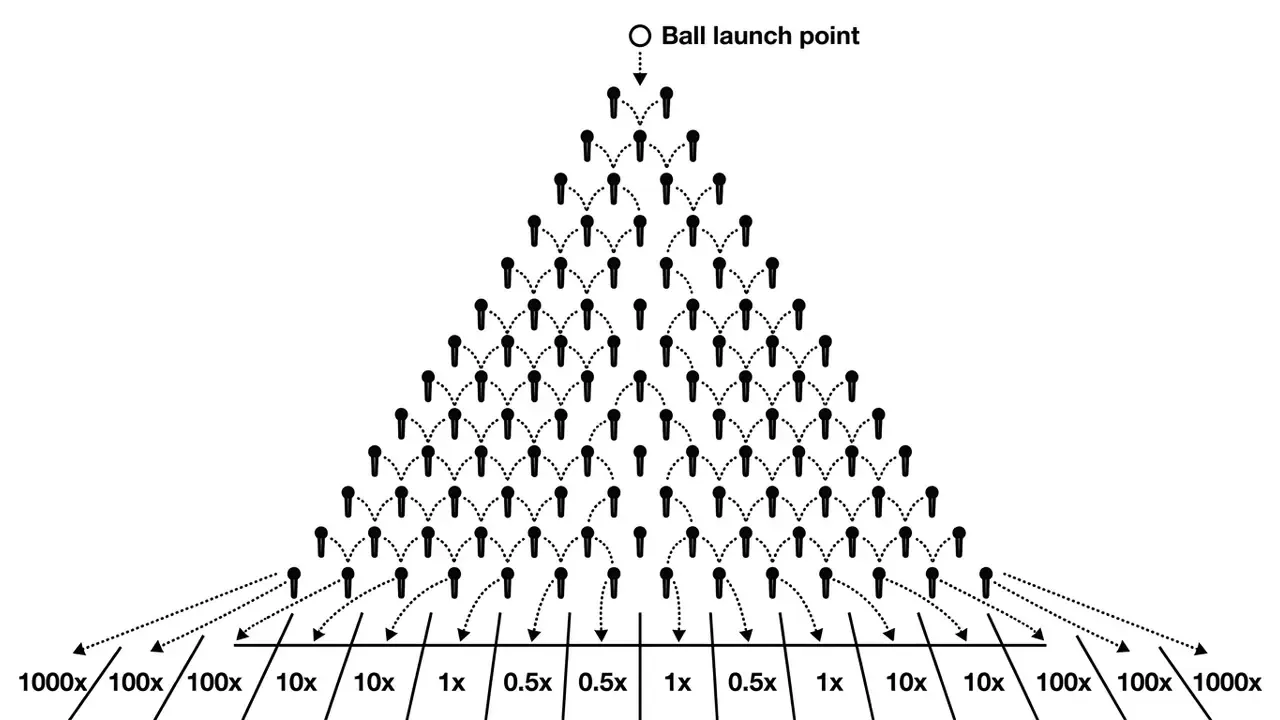
Plinko board layout: launch point, peg grid, bounce paths and bottom multiplier slots

In standard online builds such as Spribe's Plinko or BGaming's Plinko, the player picks a stake, configures the board, then triggers the drop. As the ball descends, every peg contact is an independent binary decision: left or right, with equal probability in an unbiased game state. The cumulative sequence of those deflections decides the final cell and the multiplier applied to the bet. Nothing in the animation is a physics simulation you can read; the landing slot is already determined the moment the bet resolves.

2 Plinko board rows, cells and

[2] Plinko board: rows, cells and multipliers

The layout of a Plinko board governs its statistical variance and its payout range. Most online versions let players adjust the number of peg rows, usually between 8 and 16.
  • Row configuration:more rows means more bottom slots and a broader spread of possible paths. An 8-row board typically exposes 9 winning slots; a 16-row board exposes up to 17.
  • Multiplier distribution:payout multipliers sit symmetrically along the bottom row. Central slots, which the ball reaches most often, carry the lowest multipliers (frequently below 1x or close to 1x). Edge slots demand a run of deflections in one direction, so they carry the headline values.
  • Payout calculation:the return for a round equals the wager multiplied by the landed slot value. A $10 bet into a 5x cell returns $50.

Technical specifications from game providers describe a math model built on binomial expansion, which assigns a probability weight to each slot. Adding rows increases the total number of paths exponentially ($2^n$, where $n$ is the number of rows). That is how developers can advertise huge edge multipliers while keeping the overall expected value negative for the player. The headline number and the realistic outcome live in different postcodes.

3 Randomness of results and game

[3] Randomness of results and game fairness

Every ball drop is random, independent of previous drops, and impossible to predict or steer through betting patterns. Modern digital Plinko titles rely either on certified Random Number Generators audited by independent testing laboratories such as iTech Labs, eCOGRA or GLI, or on Provably Fair cryptographic hash systems.

Under a Provably Fair mechanism, each round is generated from three inputs:

  1. Server seed: supplied by the operator and published in hashed form before the round.
  2. Client seed: supplied by the player's browser or device, which prevents the operator from pre-determining the result.
  3. Nonce: a sequential counter that increments with every wager placed.

These parameters run through a cryptographic algorithm, usually HMAC-SHA256, to produce the exact left-or-right bounce sequence. Players can then verify that the disclosed server seed matches the published hash, which proves the trajectory was not altered after the bet. In practice, self-verification means taking the revealed server seed, your known client seed and the round nonce, recomputing the hash output, then comparing it with the displayed result. A mismatch points to tampering or, more often, an implementation error.

Independent laboratories assess these systems against recognised technical frameworks: GLI-19 for interactive gaming systems and GLI-11 for gaming devices, with labs such as iTech Labs accredited under ISO/IEC 17025 for RNG and game-fairness testing. There is no Plinko-specific certification standard. The game is judged on its randomness source, its game logic and its payout behaviour.

EXPERT NOTE The Gambler's Fallacy of

[⚠️ EXPERT NOTE: The Gambler's Fallacy of 'Hot/Cold' Tracker Stats] Some modern Plinko builds, including BGaming's live statistics interface and the in-game "record table" that logs recent results, display 'Hot' or 'Cold' RTP metrics from recent round history. Reading those numbers as guidance is a textbook Gambler's Fallacy. Because each ball drop is a statistically independent event produced by a memoryless RNG, past performance carries zero correlation with the next trajectory. A slot that has not been hit for 200 drops is no more "due" than one hit twice in a row. The tracker is entertainment, not information.

[4] Plinko settings: risk, number of rows, bets and payouts

Plinko gives you adjustable settings that shape the volatility profile, the payout range and the row count. Changing those parameters changes the variance of outcomes per round. It does not change the long-term theoretical Return to Player.

Risk LevelRow CountCentral Slot PayoutEdge Slot Max MultiplierOutcome VolatilitySession Characteristics
Low8–12 rows0.8x – 0.9x5x – 10xLowFrequent small payouts; steadier balance over short sessions.
Medium10–14 rows0.4x – 0.7x15x – 100xModerateMix of moderate losses and occasional medium-tier multipliers.
High12–16 rows0.2x – 0.3x100x – 1000x+HighLong runs of below-stake returns, punctuated by rare edge hits.

Table text summary: moving Plinko settings from Low to High risk pushes payout weight out to the far edge slots. High risk offers the bigger maximum multipliers, but central landing slots then pay far less than the stake, which drains a bankroll quickly during non-edge sequences.

5 Risk levels low, medium and

[5] Risk levels: low, medium and high

Online Plinko titles generally offer three risk settings, Low, Medium and High, which rewrite the multiplier values on the bottom slots. Several builds colour-code them: green for low, yellow for medium, red for high.
  • Low risk:multipliers cluster tightly around 1x, roughly 0.8x to 5x. Most drops return a decent portion of the wager, so variance stays low. On an 8-row low-risk Hacksaw build, the worst available slot returns 0.9x, meaning 90% of the stake is retained on that particular cell.
  • Medium risk:payouts spread further apart. Central cells fall towards 0.5x while mid-edge multipliers climb into the 15x to 50x band.
  • High risk:central cells collapse to minimal returns near 0.2x, while edge cells expand to headline values of 500x to 1,000x and beyond.

High risk produces a profile closer to a high-variance pokie or a feature-heavy slot. The theoretical RTP stays identical across all three levels. Only the distribution around that average changes.

«Games with the same RTP can deliver fundamentally different player experiences depending on prize structure and volatility.» Source: Stevens & Roy Morgan Research, NSW 20 Game Survey of Gaming Machine Volatility (2023). https://www.gamblingresearch.org.au

6 Number of rows, RTP and

[6] Number of rows, RTP and payout logic

The number of peg rows, usually 8 to 16, sets the number of landing slots at the base of the board. More rows, more complex path distribution.

Expected Value (EV) Formula for a $1 Wager:
EV = ∑ (Slot Multiplier_i × Slot Probability_i) = $0.97 (for a 97% RTP game)

Technical documentation for Spribe's Plinko (97% RTP) and BGaming's Plinko (up to 99% RTP) shows what happens when the row count rises from 8 to 16: the binomial expansion tree widens. That extra width is precisely what allows a developer to hang a giant multiplier on the outermost cell, because the chance of the ball deflecting the same way across 16 consecutive pegs is 1 in $2^{15}$, or 1 in 32,768. Whether you select 8 rows or 16, the weighted theoretical return stays pinned to the advertised RTP over a statistically meaningful volume of play.

«The Return to Player of a game is the theoretical measurement of a game's payback to the player over the long term… over the lifetime of a game expressed as a percentage.» Source: Stevens & Roy Morgan Research (2023). https://www.gamblingresearch.org.au

Multiplier Distribution Reference Table (standard versus high-variance builds)

Ladders differ by provider. The matrix below reflects the multiplier bands documented across mainstream 8, 12 and 16-row builds, including Hacksaw Gaming's published payout ladders and the widely distributed Spribe and BGaming configurations.

RowsRisk LevelCentral Slots (High Probability)Mid-Wing SlotsEdge Slots (Low Probability)Max Multiplier
8 rowsLow0.9x – 1.2x1.4x – 2.5x4.0x – 5.6x5.6x
Medium0.4x – 0.7x0.9x – 5.0x12.6x – 29.0x29.0x
High0.2x – 0.4x0.9x – 3.3x27.1x – 29.0x29.0x
12 rowsLow0.8x – 1.0x1.2x – 3.0x10.0x – 47.5x47.5x
Medium0.4x – 0.7x1.0x – 5.5x33.0x – 133.3x133.3x
High0.2x – 0.3x0.6x – 4.5x25.0x – 295.5x295.5x
16 rowsLow0.8x – 1.0x1.1x – 5.2x32.7x – 501.3x501.3x
Medium0.4x – 0.8x1.5x – 15.0x100x – 1,718.7x1,718.7x
High0.2x – 0.5x0.9x – 32.0x238.9x – 3,843.3x3,843.3x
Table text summary in every configuration

Table text summary: in every configuration, the slots the ball is most likely to reach pay less than the stake at medium and high risk. Headline figures such as 501.3x, 1,718.7x or 3,843.3x sit on the outermost cells, and on a 16-row board the probability of a single-direction path approaches 1 in 32,768.

A useful cross-check before you drop a ball: on a 16-row Hacksaw-style board the documented ladders read Low: 0.9x, 1x, 1.1x, 2x, 5.2x, 32.7x, 501.3x; Medium: 0.7x, 0.8x, 0.9x, 1.5x, 3.1x, 15x, 100x, 1,718.7x; High: 0.3x, 0.5x, 0.9x, 2.1x, 6.8x, 32x, 238.9x, 3,843.3x. At 12 rows the High ladder compresses to 0.3x, 0.4x, 0.6x, 1.3x, 4.5x, 25x, 295.5x, and at 8 rows to 0.4x, 0.5x, 0.9x, 3.3x, 27.1x. If the in-game rules screen shows different numbers, trust the rules screen.

[7] How to play Plinko online: from demo mode to betting

To start playing Plinko online you pick a mode, risk-free demo or real money, set the stake and risk parameters, then trigger the drop. The flow is the same on desktop and in a mobile browser. Now that risk levels and row counts are on the table, the sequence below can be followed with full context.

``` [📋 CHECKLIST: Step-by-Step Guide to Starting Plinko]

1
Choose mode: select either 'Plinko Demo' (virtual credits) or 'Real Money' mode.
2
Set stake amount: enter your wager per ball drop within the allowed table limits, for example $0.10 to $100.
3
Configure board parameters: choose the number of rows (8 to 16) and the risk level (Low, Medium, High).
4
Select bet mode: Manual (one drop per click) or Auto (a pre-set number of drops with stop conditions).
5
Initiate drop: press 'Spin', 'Drop', or start the automated drop sequence.
6
Verify outcome: watch the landing slot, review the balance update, and check the Provably Fair hash if you wish.
```
8 Plinko demo and free mode

[8] Plinko demo and free mode: risk-free familiarisation

Plinko demo mode hands you a virtual balance so you can test mechanics, compare row configurations and watch volatility behave, without risking capital. The demo interface mirrors the real-money math model: same RTP algorithms, same multiplier layout, same RNG.

[▶️ HOW TO LAUNCH PLINKO DEMO IN ONE CLICK]
1. Open the provider's official game page, for example BGaming's or Spribe's Plinko page, then press 'Play Demo'. No registration, deposit or personal data required.
2. Alternatively, open the game inside a licensed casino lobby and switch the toggle from 'Real' to 'Demo'/'Fun' mode before the first drop.
3. Confirm the virtual balance appears, usually a fixed number of play credits. If the balance shows a currency symbol tied to your account, you are in real-money mode.
4. Run at least 100 drops on each risk level at 8 and 16 rows, and count how often the central 0.2x–0.5x slots land before an edge slot does.

Free play is the cheapest way to see the distribution with your own eyes. Test a high-risk 16-row setup in Plinko demo and the pattern becomes obvious fast: long chains of 0.2x to 0.5x results, then, eventually, one edge hit. That makes free mode useful for three things: learning the interface, confirming the exact multiplier ladder your operator has configured, and internalising that variance, not skill, decides the outcome.

There is a catch, though. Free play carries a documented behavioural risk, because virtual wins can inflate a sense of control that simply does not survive the switch to cash stakes.

«A NSW longitudinal study tracked 229 young people from ages 12–17 to 16–21: even low-stakes early engagement can escalate into persistent harmful behaviour.» Source: NSW Longitudinal Youth Gambling Study, GambleAware NSW (2024). https://www.gambleaware.nsw.gov.au

9 Plinko real money transitioning to

[9] Plinko real money: transitioning to real-money play

Playing Plinko for real money means every drop debits or credits your account balance directly. That requires an active account with a licensed operator, completed identity verification (KYC), and payment limits you have actually read.
  • Betting limits:real-money tables set a minimum and maximum per drop, commonly $0.10 up to $100 or more. Some Spribe builds document ranges with much higher ceilings.
  • Balance management:the pace is the hidden cost. Dozens of rounds can resolve inside a minute, which accelerates the house edge against you.
  • Cashout conditions:winnings are subject to withdrawal minimums, verification checks and any active bonus wagering requirement.

In comparative editorial analyses of iGaming platforms, such as the ones documented in our review case studies (iGaming Brand Review Standards), payment friction and withdrawal rules cause more complaints than game mechanics ever do. Read the payout rules before you deposit, not after your first win.

Payment methods and withdrawal reality for Australian players

Payment availability depends entirely on the operator and on your jurisdiction, so treat the table below as a starting point and verify the cashier before depositing.

MethodTypical Deposit SpeedTypical Withdrawal SpeedNotes for AU users
PayID / Osko bank transferNear-instant1–3 business daysCommonly offered by offshore operators; bank-level blocking may apply.
Cryptocurrency (BTC, ETH, USDT, LTC)10–60 minutesOften same-day after approvalFastest cash-out route in practice; exchange-rate and network fees apply.
Credit / debit card (Visa, Mastercard)InstantFrequently not supported for payoutsCredit-card gambling transactions are restricted in Australia; many banks decline.
Prepaid vouchers (for example Neosurf)InstantDeposit-onlyNo withdrawal channel, so another payout method must be nominated.
e-WalletsInstant24–48 hoursAvailability varies; some wallets exclude gambling merchants.
KYC CHECKLIST What operators usually request

[🪪 KYC CHECKLIST: What operators usually request before paying out Plinko winnings] • Photo ID: passport or driver's licence (front and back), clearly legible. • Proof of address: utility bill or bank statement issued within the last 3 months. • Proof of payment method: card photo with masked digits, or a wallet/bank screenshot showing the account name. • Source-of-funds documents: requested for larger cash-outs under AML obligations. Expect 24–72 hours for document review at established operators. First withdrawals almost always take longer than later ones. The name on the payment method and the name on the casino account must match, or the payout gets rejected.

10 Playing Plinko on mobile devices

[10] Playing Plinko on mobile devices

Mobile Plinko runs on HTML5 frameworks, so it executes smoothly in smartphone browsers and in dedicated casino apps on iOS and Android. Tap controls replace mouse clicks for adjusting stakes, selecting row counts and releasing the ball. A separate Plinko download is rarely necessary; if a site pushes an .apk file at you before you can play, treat that as a red flag rather than a convenience.

Mobile optimisation keeps the visuals workable: the triangular peg grid and the ball animation scale to smaller screens without losing the multiplier labels. The trade-off is friction, or rather the absence of it. A fast instant game sitting in your pocket at 1 am is a different proposition from the same game on a desktop.

«Young adults described mobile gambling as part of everyday digital life, often playing out of boredom.» Source: ACT Young Adults Gambling Online Report, Australian Gambling Research Centre (2024). https://www.agrc.org.au

«Players active after midnight were significantly more likely to be problem gamblers, with risk rising for each hour after 2:00 am.» Source: Roy Morgan Research, Impact of EGM Late Night Play on Player Behaviours, NSW (2023). https://www.gamblingresearch.org.au

Because Plinko rounds resolve in seconds and can be automated, pre-set deposit and session limits matter more on a phone than anywhere else. Late-night sessions deserve the strictest limits of all.

[11] Where to play Plinko casino and how to access the offer

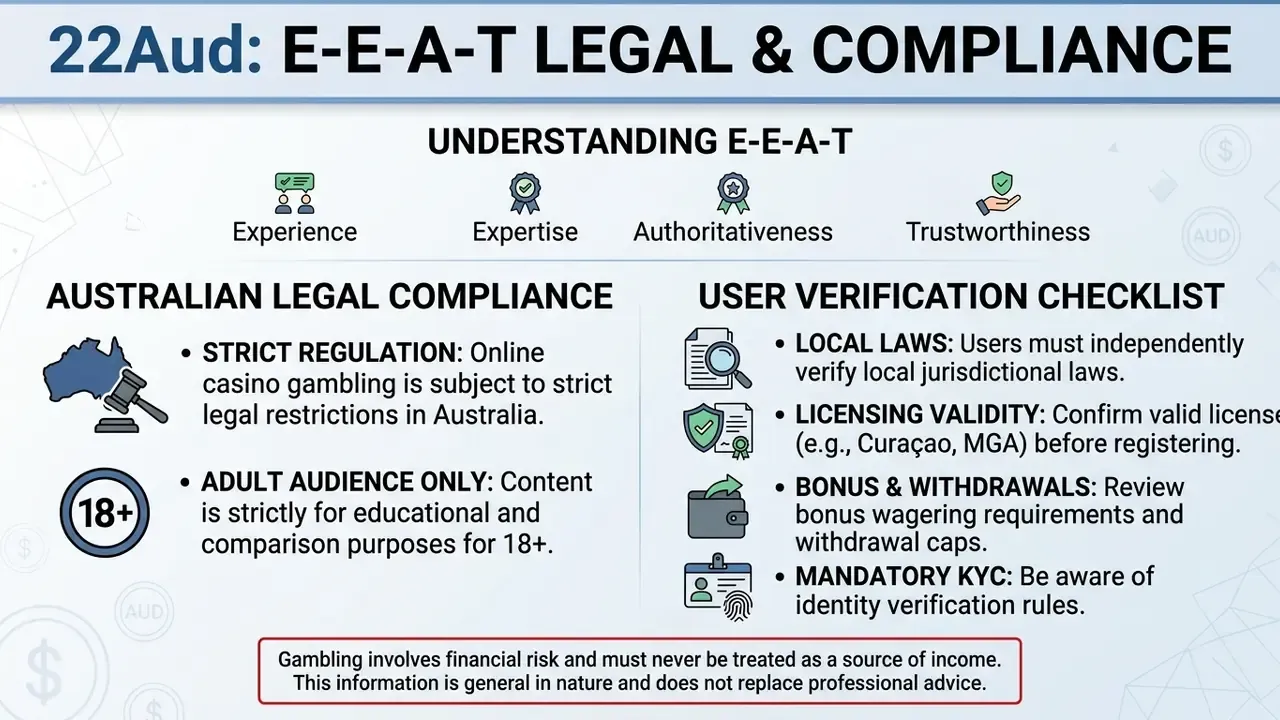
Choosing an online casino for Plinko comes down to four checks: licensing, software authenticity, payment processing terms and bonus conditions. Australia's interactive gambling rules (Interactive Gambling Act 2001) place real-money online casino services under complex legal restrictions, so adults researching options should inspect regulatory compliance and the terms of any offer before creating an account or depositing funds.

«A useful casino review or game guide starts with what can be verified in the fine print. Before you look at any headline bonus or payout multiplier, check the underlying house edge, withdrawal rules and risk configurations.» Claire Bennett, Senior Casino Content Editor.

VERIFICATION CHECKLIST Will this casino actually

[✅ VERIFICATION CHECKLIST: Will this casino actually pay out your Plinko winnings?]

  1. Licence: a licence number and issuing authority (for example MGA or Curaçao) are published in the footer and can be matched on the regulator's public register, not merely shown as a logo image.
  2. Original software: Plinko launches from the provider's own client (Spribe, BGaming, Hacksaw) with the provider's rules screen, RTP figure and Provably Fair seed panel intact.
  3. Withdrawal terms: minimum and maximum cash-out amounts, monthly payout caps and processing times are stated in the T&Cs before you deposit.
  4. Bonus fine print: game contribution for Plinko, maximum bet under bonus, and maximum cash-out from bonus winnings are all documented in writing.
  5. KYC policy: the operator states which documents are required and when. Vague verification rules are the most common cause of blocked payouts.
  6. Responsible-gambling tools: deposit limits, session limits, cooling-off periods and self-exclusion sit in account settings, not behind an email request.
  7. Support responsiveness: test live chat with a withdrawal-related question before you deposit a cent.

[🙋 WHO SHOULD SKIP PLINKO] • Players seeking a skill-based edge: Plinko offers no decision that changes expected value, unlike poker or advantage blackjack. • Anyone chasing losses or trying to "win back" a deficit.

Fractional 0.2x central slots make recovery mathematically hostile. • Players who dislike long dry runs. High-risk 16-row builds can deliver hundreds of below-stake drops between edge hits. • Anyone relying on bonus funds where Plinko contributes 0–10% to wagering, because the rollover becomes practically unachievable. • Anyone gambling with money allocated to rent, bills or credit repayments.

Readers comparing platforms can see how we assess operator transparency, payout policy and software authenticity in our editorial framework for licensed online casinos.

11.1 Sweepstakes versus real-money casino Plinko

[11.1] Sweepstakes versus real-money casino Plinko

In regions with legal casino restrictions, including several US states, sweepstakes Plinko platforms run a dual-currency system that lets players win redeemable prizes without a conventional wager:

  • Gold Coins (GC): virtual tokens for recreational play only, with no monetary value and no redemption pathway.
  • Sweeps Coins (SC): promotional credits obtained through bonuses, purchase bundles or postal requests. Sweeps Coins won during Plinko play can be redeemed for cash or gift cards once playthrough is met, typically 1x to 3x.

Sweepstakes platforms listing certified Plinko titles include Stake.us (an exclusive in-house Stake Originals Plinko with seed control and a 3x playthrough on Stake Cash), Sidepot.us (several variants including Classic Plinko and XY Plinko), Real Prize (Easter Plinko and Pine of Plinko Bonus), McLuck (Plinko-themed slot hybrids) and Jackpota (Plinko and Xmas Plinko by Gaming Corps).

Age gates differ by platform, 18+ or 21+, and availability is restricted in certain states, so check the eligibility clause before registering.

The mathematical substance does not change. Sweepstakes Plinko uses the same peg-grid probability model and the same negative expected value. What differs is the legal structure and the currency, not the odds.

[12] Plinko versions and game providers

Several leading studios build their own version of Plinko, each with its own parameters, RTP figure and visual style. The comparison matrix covers the builds you will actually meet in casino lobbies.

Game TitleDeveloperRTP (%)Max MultiplierRowsKey Distinctive Feature
PlinkoSpribe97.00%1,000x8–16Colour-coded risk (green/yellow/red), autoplay, seed inspection, integrated live chat.
PlinkoBGamingup to 99.00%1,000x8–16Manual/Auto bet modes, autoplay stop conditions, results record table, released Jan 2019.
PlinkoHacksaw Gaming94.00%3,843.3x8–16Highest documented payout ceiling; 9 slots at 8 rows, 17 slots at 16 rows.
Plinko XSmartSoft Gaming97.00%10,000x8–16Random ball-multiplier features and mobile-first presentation.
Plinko RushBetsoft96.27%888x8–16Fast-drop mechanic optimised for portrait-mode mobile play.
Plinko XYBGaming99.00%up to 1,000x8–16Dark-mode UI variant for low-light sessions.
Easter PlinkoBGaming98.91–99.16%1,000x8–16Seasonal reskin with customised peg triggers.
Pine of PlinkoPrint Studios / Relax96.48%10,000xFixed gridBonus feature round layered onto a standard Plinko grid.
Wild PlinkoWinGo98.91%1,000x8–16Wild-symbol styled multiplier cells.
Golden PlinkoBelatra96.60%2,000x8–16Mid-range volatility with a compressed multiplier ladder.
Neon PlinkoDarwin Gaming99.00%1,000x8–16Neon visual theme with high advertised RTP.
Olympus PlinkoBetsoft98.32%Progressive jackpot8–16Jackpot layer stacked on the base Plinko model.

Table text summary: RTP across mainstream Plinko builds spans roughly 94% to 99%. That five-percentage-point spread matters far more over a long session than any risk setting you choose. Notice the inverse relationship in several titles: the builds advertising the biggest headline multipliers (10,000x) are not the ones with the highest RTP.

Notable provider distinctions:

22Aud heading-banner
  • Spribe Plinko:fixed 97.00% RTP, 8 to 16 selectable rows, three colour-coded risk levels, autoplay, a wide stake range and a 1,000x ceiling. Includes social chat and Provably Fair seed inspection.
  • BGaming Plinko:adjustable RTP up to 99.00%, row counts from 8 to 16, Low/Normal/High risk toggles, Manual and Auto bet modes, autoplay stop conditions, a results record board and a peak win cap of 1,000x stake. BGaming also licenses white-label rebrands, so operator-specific versions may run a modified RTP or feature set.
  • Hacksaw Gaming:released its Plinko in 2023 within a crash-game library alongside Mines, Boxes and Coins. Documented RTP is 94.00% with a maximum payout of 3,843.3x at 16 rows on high risk. That is the highest documented ceiling among standard grid builds, paired with the lowest RTP in this table. Worth sitting with for a moment.
  • SmartSoft Gaming, Betsoft, Print Studios, Belatra and Pragmatic Play:high-volatility instant-game variants with reworked themes, custom multiplier ladders, bonus rounds and variable payout caps. Specifications depend on the individual build and sometimes on the operator's configured RTP band.

Open the software provider's game rules through the in-game information menu to confirm the exact RTP and volatility build your casino has configured. Because some providers ship multiple RTP configurations of the same title, the in-game rules screen, not a third-party listing, is the authoritative figure.

13 Bonuses and offer conditions for

[13] Bonuses and offer conditions for real-money play

Casino promotions such as welcome deposit matches, free spins or cashback usually carry fine print that hits instant-win titles like Plinko harder than pokies.
  • Wagering contribution (game weighting):online slots often contribute 100% towards rollover, while instant games are frequently restricted or weighted at 5% to 10%, or excluded entirely at 0%.
  • Maximum bet limits:bonus terms typically cap the stake per round, often around $5 per drop. Go over it and the bonus funds plus attached winnings can be voided.
  • Max cashout caps:no-deposit and promotional bonuses commonly cap how much of the bonus-derived winnings you may withdraw.
Calculate the total wagering obligation bonus

Calculate the total wagering obligation (bonus × multiplier) and confirm Plinko's eligible contribution percentage in the terms and conditions before you claim anything.

[🧮 WORKED EXAMPLE: Why game weighting decides everything]
Scenario: you claim a $100 bonus with a 30x wagering requirement.
• If Plinko contributed 100%: required turnover = $100 × 30 = $3,000.
• If Plinko contributes 10%: every $1 wagered counts as $0.10, so required turnover = $3,000 ÷ 0.10 = $30,000.
• If Plinko contributes 0%: no amount of Plinko play will ever clear the bonus, and playing it may breach the terms outright.
At 97% RTP, turning over $30,000 carries an expected theoretical loss of roughly $900, which is nine times the value of the bonus itself. Divide the rollover by the contribution percentage before accepting any offer.

One more caution, and it concerns promotional pressure rather than maths. Controlled Australian research has measured a direct behavioural effect from operator marketing:

«Each additional direct message from an operator significantly increased the number of bets placed, expenditure, and short-term harm indicators among participants.» Source: Gambling Research Australia, Direct and Affiliate Wagering Marketing and Gambling-Related Harm (2024). https://www.gamblingresearch.org.au

Switching off marketing consent in your account settings is therefore a practical risk control, not just an inbox preference.

[14] Plinko strategy: what actually affects gameplay

No betting system, drop-timing trick or pattern-spotting method overcomes the house edge in Plinko. Every drop is an independent trial. That is the whole story, and the rest is bankroll discipline.

[🚨 ALERT BOX: IMPORTANT STRATEGY WARNING]
Critical expectation check: progressive betting systems such as Martingale or Anti-Martingale, and changes to the row configuration, DO NOT alter the game's mathematical expectation. Past drop outcomes have zero influence on future bounces. No 'flawless' or 'guaranteed win' Plinko strategy exists.
Deconstructing popular betting systems. 1. Martingale
  1. Martingale (doubling after losses): doubling after every non-winning or low-multiplier drop aims to recover losses in one hit. In Plinko, where central cells pay fractional returns such as 0.2x, exponential stake growth runs into table limits or empties the bankroll during an ordinary cold run. Several third-party guides openly recommend a "Plinko Martingale" at maximum risk on 16 rows. Mathematically, that is the single most hostile configuration for the system, because the highest-probability slots return a fraction of the stake rather than a clean loss or a clean win.
  2. Anti-Martingale (increasing after wins): raising stakes after a win rides positive streaks and limits damage during cold runs. One drop into a central low-payout cell, though, hands back the accumulated gains.
  3. Fixed stake flat betting: wagering a constant small share of the bankroll, say 1% to 2% per drop, does not change the negative expected value of $0.97 per $1 staked. It does slow the rate of depletion and reduce the risk of ruin compared with progressive systems.
  4. Mix-and-match experimentation: alternating between 8 and 16 rows, or cycling risk levels, changes the shape of the outcome distribution and the feel of a session. The weighted return stays anchored to the provider's fixed RTP.

Session length, not system choice, is the variable most strongly associated with harm:

[15] Responsible gambling when playing Plinko for real money

[ℹ️ NOTE] This information is general in nature and does not replace advice from a qualified problem-gambling professional or financial counsellor.

Playing Plinko safely means managing financial risk and keeping control of both session length and betting behaviour. Instant-win drops resolve within seconds and can be automated, so hundreds of rounds can pass quickly, compounding the house edge in a very short window.

Essential responsible gambling controls

Essential responsible gambling controls

  • Deposit limits:set daily, weekly or monthly caps in the casino account settings before you start playing.
  • Session time limits:set a firm boundary, for example 30 minutes, to avoid long fatigue-driven sessions.
  • Loss limits:decide a stop-loss for the session. Once it is reached, stop, whatever the last few drops did.
  • Autoplay discipline:configure stop-on-loss and stop-on-win conditions before starting an automated sequence, because autoplay removes the natural pause between decisions.
  • Marketing opt-out:disable promotional emails, SMS and push notifications, which measurably increase betting frequency and spend.
  • Self-exclusion tools:use platform-level or national self-exclusion registers to block access if play stops being recreational.

Research from the Australian National University and the Australian Gambling Research Centre shows that regular online bettors carry elevated rates of gambling-related harm when play goes unmonitored, and the scale is quantified:

«More than 70% of regular online bettors met criteria for gambling-related harm risk; 21.4% were classified as high-risk gamblers.» Source: Australian Gambling Research Centre, NGTS Regular Online Bettors Snapshot (2023). https://www.agrc.org.au

Treating Plinko as paid entertainment with

Treating Plinko as paid entertainment with a fixed cost, rather than an income stream, is the whole safety framing. A practical version: decide in advance what you are prepared to spend for the entertainment, budget it the way you would a concert ticket, and treat any return as incidental.

If gambling is causing financial stress or emotional distress, confidential support is available 24/7 in Australia through Gambling Help Online (1800 858 858) or at gamblinghelponline.org.au. International readers can contact GamCare or BeGambleAware in the United Kingdom for equivalent free support.

[16] FAQ: Plinko questions Australian players ask

Editorial verdict in short. Plinko is

Editorial verdict in short

Plinko is a transparent game with an opaque marketing layer. The mechanics are honest, the certifications are real, and the ceiling figures are technically achievable. The catch sits in the probability weighting: the cells you reach most often pay less than you staked at medium and high risk.

So the practical order of operations looks like this. Confirm the RTP in the in-game rules, not in a listing. Test the ladder in demo mode first. Read the bonus contribution percentage before claiming an offer. Check the withdrawal caps and KYC policy before depositing. Then set a deposit limit and a session limit, and treat the spend as the price of entertainment.

If any of those steps feels like too much homework, that is useful information too. Take your time, compare a few licensed options, and only play with money you have already written off. 18+. Support is available at any hour through Gambling Help Online on 1800 858 858.