Aviator Game: How to Play Online Free and for Real Money

Last reviewed and updated: March 2026 · Reviewed by Claire Bennett, Senior Casino Content Editor · 18+ only

Aviator is a social multiplayer crash game built by Spribe in 2019. An ascending plane icon drives a continuously growing multiplier from 1.00x upward until an unpredictable crash ends the round. Your only job is to lock in a payout through cash out before the plane flies away, which makes timing and risk management the defining mechanics of the whole experience.

Provider

Spribe

RTP

97.00%

Volatility

Medium

Min bet

$0.10

Max bet

$100

Max win

$10,000

Aviator Game How to Play Online

"Before you look at promotional claims or headline multipliers, check the underlying mechanics, payout rules and withdrawal conditions. A useful review starts with terms, legal context and verified risk factors, so players read the fine print before placing a single bet." Claire Bennett, Senior Casino Content Editor.

Key Takeaways in 30 Seconds

Key Takeaways in 30 Seconds

  • What it is:a crash game by Spribe, released in 2019. A multiplier climbs from 1.00x and the round ends at a random, cryptographically pre-committed crash point.
  • The one control you have:the cash out button. Your payout equals stake × multiplier at the millisecond of execution. Miss it, and the whole stake is gone.
  • The maths:the chance of reaching any target multiplier m is P(m) = 0.97 / m. Expected value sits at minus $0.03 per $1 wagered at every target, from 1.20x right through to 100x.
  • The hidden risk:roughly 3% of rounds crash instantly at 1.00x, before any cash out can be triggered. That is the mechanism that enforces the 3% house edge.
  • No strategy beats it:Martingale, dual bets and low-multiplier grinding change variance, not expected value. "Aviator Predictor" apps, Telegram signals and pattern bots are scams.
  • Demo first:free-play mode replicates the interface with virtual credits, but winning in demo predicts nothing about real-money results.
  • Australian context:interactive online casino games sit under the Interactive Gambling Act 2001 and ACMA enforcement. Verify legality in your jurisdiction, expect KYC checks before any withdrawal, and check whether PayID, Neosurf or crypto rails are supported.
  • Harm is documented:gambling harm in Australia was costed at $26.8 billion in 2023, and more than 70% of regular online bettors experience harm or sit in an at-risk group.
What Is Aviator Game and Why

What Is Aviator Game and Why It Is a Crash Game

In short: Aviator is a crash product where a shared multiplier rises in real time until a random collapse point wipes out every wager that has not been cashed out. Rounds are short, usually 8 to 30 seconds, which is exactly what makes the format both engaging and behaviourally risky.

Aviator is a modern crash gambling product where each round centres on a rising curve, drawn on screen as a climbing airplane beside a numerical multiplier. It counts as a crash game because the outcome is governed by a random collapse point, the "crash", which instantly forfeits every un-cashed wager in that specific round.

Crash games differ from most casino verticals in one structural respect. The player is not choosing an outcome before the event; they are choosing an exit moment during the event. That single design decision turns a game of pure chance into something that feels like a game of skill. And that feeling is precisely what researchers examine when they study fast, high-frequency wagering products.

«Among NSW residents who bet on sport at least monthly, 26.5% fall into the moderate-risk or high-risk gambling harm category.» NSW Gambling Survey 2024, NSW Responsible Gambling Fund (N = 10,000; telephone interviews conducted March to May 2024).

The methodology matters here. A sample of 10,000 adults, screened with standardised harm instruments, gives population-level prevalence rather than operator-supplied engagement data. Fast-paced online wagering and casino-style products keep showing elevated participation and elevated harm indicators among younger adult cohorts in Australia.

How the Plane, the Multiplier and

How the Plane, the Multiplier and the End of a Round Work

The plane's movement is a visual proxy for a mathematical multiplier. It begins at 1.00x at the start of every round and climbs continuously in real time. The round terminates the instant the crash algorithm triggers: the plane flies away, and any active wager without a completed cash out is extinguished.

The relationship between flight duration, multiplier growth and crash point is dictated entirely by a random number generator (RNG) combined with cryptographic seed protocols. If a player initiates a cash out while the plane is still on screen, the return is calculated as the initial stake multiplied by the visible coefficient at that exact millisecond. If the crash lands before the cash out confirmation, the stake is lost in full.

Round length is not fixed. A round can end in under a second, or it can run past 100x on rare occasions. Fractional payouts are usually rounded down to two decimal places by the game engine, which is worth knowing if you are staking small amounts.

⚠️ The 1.00x instant crash, roughly 3% of all rounds Statistically, around 3% of Aviator rounds (about 1 in 33) end instantly at a multiplier of 1.00x, before anyone can trigger a cash out. In those rounds the operator retains 100% of every stake placed. This immediate collapse is not a glitch and not a "rigged" round: it is the fundamental mechanical driver that secures the 3% house margin baked into the game's probability distribution. Every round's outcome is mathematically independent of the ones before it, so a streak of low crashes does not make a high multiplier "due". Believing otherwise is the gambler's fallacy, and it is expensive.

How Aviator Differs from Other Casino

How Aviator Differs from Other Casino Games

Aviator differs from classic casino games such as slots, roulette or blackjack by moving the primary decision point away from pre-spin outcome selection and into real-time exit timing inside a live round. Online slots resolve instantly on the click of a button. Aviator instead runs a continuous shared multiplier that every active participant watches at the same moment.

Unlike blackjack, where player choice involves genuine rule-based decisions against the house (hit, stand, split), Aviator offers no card tactics at all. Payouts depend purely on when you decide to leave, relative to an unpredictable crash point. Aviator also layers in active social mechanics: live in-game chat, a shared real-time bet feed and live leaderboards. That is a very different atmosphere from the solitary rhythm of a standard slot machine.

Comparison factorAviator (crash)Online slotsRouletteBlackjack
Decision pointExit timing mid-roundStake size onlyBet selection pre-spinIn-hand decisions (hit/stand/split)
Outcome generationServer RNG plus seed hashRNG at spinPhysical or virtual wheelCard shoe plus player choices
Skill influence on EVNoneNoneNoneLimited (rule-dependent)
Social visibilityHigh (shared feed, chat)NoneTable-levelTable-level
Round durationAbout 8 to 30 seconds2 to 5 seconds30 to 60 seconds30 to 90 seconds
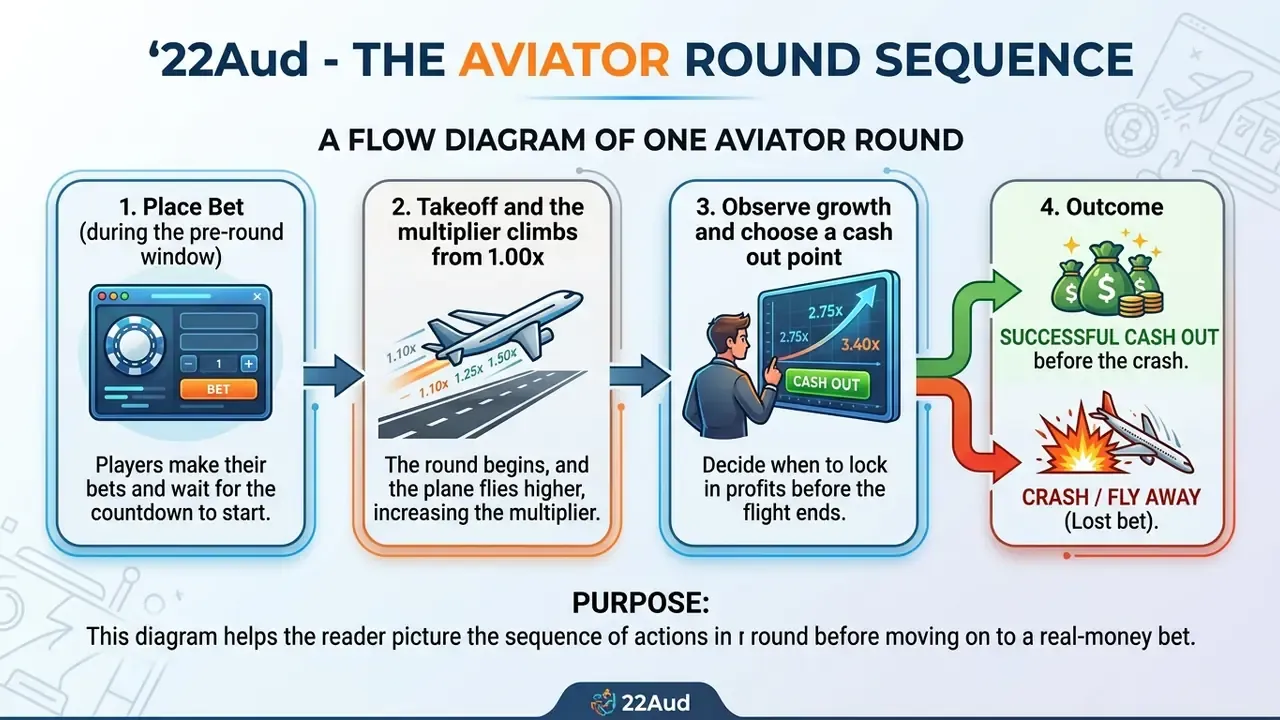
Stages of a single round: from placing a bet to locking in a multiplier or crashing
How to Play Aviator Online Bets

How to Play Aviator Online: Bets and Cash Out

In short: you set a stake during the short pre-round window, then decide when to exit while the multiplier climbs. Automated betting and auto-cashout exist to enforce discipline, not to improve your odds.

To play Aviator online you select a stake during the brief preparation interval before takeoff, then watch the rising multiplier through the live round. The one meaningful control is cash out, which closes that specific wager and secures the displayed multiplier.

The window between rounds is short, usually about five seconds. That is why most regular players pre-set a stake or lean on automated betting rather than typing figures under time pressure. Fumbling the keypad while the countdown runs is a classic beginner tax.

«The presence of a cash-out option increased average bet size by 23.6% to 34.8%, a medium-to-large effect (Cohen's d = 0.75).» Journal of Behavioral Decision Making (2024), controlled cash-out experiment, N = 240.

This is the single most important behavioural finding for anyone approaching a crash game. The cash-out mechanic is not a neutral convenience. In a controlled setting with 240 participants, simply offering an in-round exit pushed people to stake materially more than they otherwise would. Perceived ability to bail out lowers perceived risk, and lower perceived risk raises stake size.

How to Place a Bet Before

How to Place a Bet Before the Round Starts

To place a bet in Aviator, choose your stake with the panel controls below the main display while the "Next Round" countdown is running. Aviator lets you place a single bet or two independent bets on the same round.

Each bet panel works on its own, so you can set different stake amounts and target different cash out points. Once the preparation window closes, the plane takes off, active wagers lock in, and nothing can be adjusted until the next preparation phase.

If a round is already in progress when you open the game, just wait for the plane to fly away. Bets are only accepted during the pause that follows each round.

Configuring automated betting (Auto Play) properly. In the Auto tab, define exact risk-stop parameters instead of leaving the system running unattended. Most builds allow between 10 and 100 automated rounds, with three programmatic stop triggers:

  1. Stop if cash decreases by: halts auto-play once your session bankroll drops by a pre-set amount. This is your hard loss limit, and it should always be set.
  2. Stop if cash increases by: locks in profit and ends the automated loop as soon as your target session gain arrives.
  3. Stop if a single win exceeds: pauses execution when one high-multiplier payout lands, so a large win is not recycled straight back into the next rounds.

Auto Cash Out is a separate toggle. You nominate a multiplier at which the stake is withdrawn automatically, capped in most builds at 100x. It removes reaction-time error. It does not change the probability of reaching your chosen target, and no setting ever will.

The side menu also shows other participants' bets and wins across "All Bets", "My Bets" and "Top" tabs, while the hamburger menu holds rules, bet limits, betting history, sound settings and the Provably Fair verification tool. Treat that statistics panel as decoration. It has no predictive value whatsoever.


When to Use Cash Out in Aviator

Use cash out when the multiplier reaches a level that matches your personal risk tolerance and your pre-planned exit. Executing it closes the active wager and credits your balance with stake multiplied by the coefficient at that precise moment.

«Participants with access to cash-out were more likely to select the gambling task and played for longer (β = 0.65, p = 0.005, N = 377).» Naturalistic betting experiment, preprint (2024).

Put plainly the feature that feels

Put plainly: the feature that feels like a safety valve measurably extends session length and increases task selection. That is a causal finding from a naturalistic design with 377 participants, not an editorial opinion.

Waiting for higher multipliers raises the chance of a crash landing before your cash out request even reaches the game server. High coefficients such as 50x or 100x arrive far less often, so holding out for them carries a substantial risk of losing the entire stake. Actually, let me be more precise: at 100x the target lands under 1% of the time, which we quantify in the odds table further down.

Practical guidance. Decide your exit multiplier before the round starts, and where possible enforce it with Auto Cash Out rather than manual reflex. Latency, distraction and hesitation all work against manual exits in a game where a round can be over in under a second.

Aviator Demo and Aviator Free: Trying the Game Without Risk

In short: demo mode is the right place to learn the interface and the tempo of rounds. It is also where players build unrealistic confidence, so treat it as a controls tutorial rather than a performance forecast.

The Aviator demo is a free-play version that runs the full interface on virtual credits instead of real money. It gives you a risk-free environment to learn game speed, test interface responsiveness and watch multiplier behaviour before committing any funds.

What Demo Mode Actually Gives You

What Demo Mode Actually Gives You

Aviator free play replicates the visuals, crash mechanics and control set of the real-money game, minus the financial exposure. You can practise timing manual cash-out requests, test the dual-betting panel, and configure automated bet and auto-cashout limits.

Time in the free environment also shows you how quickly rounds cycle and how often low-multiplier crashes appear. That familiarity removes operational errors, the misclicks and the "which button was that again" moments, before you move into a live casino lobby.

Concretely, demo mode is useful for four things:

  • Learning where the bet, Auto and Cash Out controls sit on your specific screen size.
  • Watching how often rounds terminate below 1.50x, the single most under-estimated risk for new players.
  • Testing whether your device and connection add noticeable latency to manual cash-outs.
  • Rehearsing the three Auto Play stop conditions before real funds are involved.

How Demo Differs From Real-Money Play

The essential distinction between Aviator demo and Aviator real money sits in the stakes and the psychology. Demo credits carry no monetary value, so winnings cannot be withdrawn and losses cost nothing.

Real-money play ties every round to your actual casino balance. That brings genuine financial exposure, emotional pressure and a real need for bankroll discipline. Demo play allows unlimited experimentation; real money brings account verification (KYC), deposit limits and the operator's withdrawal rules into the picture.

Comparison parameterAviator demo (free play)Aviator real money
Stake currencyVirtual demo creditsActual funds (AUD or crypto)
Financial riskNoneHigh (the full deposit can be lost)
Withdrawing winningsNot possiblePossible after KYC verification
Primary purposeLearning the interface and mechanicsPlaying for real outcomes
Psychological pressureMinimal or absentHigh (requires strict self-control)
Limits and toolsNot applicableDeposit, loss, session and self-exclusion tools apply

Both modes run identical structural logic and RNG mechanics from Spribe. But never read demo success as a forecast of monetary profit. A run of profitable demo rounds is a sample of random outcomes, nothing more.

«Engagement with simulated gambling, particularly social casino purchases, is consistently associated with problem gambling and internet gaming disorder.» Australian Gambling Research Centre, submission on computer game classification, simulated gambling and loot boxes (2023 to 2025).

That association is why we do not present demo mode as harmless fun. Free-play and simulated gambling formats are a documented pathway into monetised play, especially among players under 34.

Aviator Fairness: Provably Fair, RTP and Round Randomness

In short: each round's outcome is cryptographically committed before bets lock, and you can recalculate it afterwards. Verifiable fairness is not the same thing as favourable odds.

Aviator relies on Provably Fair cryptography so round results can be verified independently. The system means neither the casino nor the developer can alter the outcome of a round after bets are placed.

How Provably Fair Verification Works, Step

How Provably Fair Verification Works, Step by Step

The mechanism combines a Server Seed supplied by the provider with Client Seeds contributed by the first three players who bet in that round.

  1. Before the round starts, the server generates a random Server Seed (commonly a 16-character string) and publishes its encrypted SHA-256 hash. That published hash is a commitment which cannot be changed later.
  2. During the pause between rounds, inputs from the first three bettors are combined into the client-side seed component.
  3. The combined seed string is hashed to produce the crash multiplier for that round. The outcome is derived through a hash chain of the form SHA-512(Server Seed + Client Seed 1 + Client Seed 2 + Client Seed 3), and the resulting hexadecimal string is then converted mathematically into the final decimal crash point.
  4. Once the round ends, the unencrypted seeds appear in the game history panel. Any player can recalculate the hash and confirm that the pre-round commitment matches the actual result.

Most players never run this check. The point is that anyone with a SHA-256 or SHA-512 calculator can, and that verifiability is what keeps operators honest. It is the same hashing family used in Bitcoin's blockchain.

Critically, verification works backwards, never forwards. You can prove a finished round was untampered with. You cannot compute a future round, because the next server seed stays secret until after that round resolves. Every predictor pitch collapses on that one sentence.

What RTP Tells You, and What

What RTP Tells You, and What It Does Not Promise

Spribe publishes Aviator with a stated theoretical Return to Player (RTP) of 97%, which corresponds to a 3% house edge. This figure is developer-supplied. It is a long-run theoretical model, and independent laboratory certification of a particular casino's deployment is not automatic, so if a certificate matters to you, ask the operator for the game's testing-lab report.

Read correctly, a 97% RTP means the game returns an average of $97 for every $100 wagered across the whole player base over millions of rounds, with 3% retained as house margin.

RTP is an average across an extended distance, not a promise about your session. Over short runs, variance dominates. You might lose quickly to early crashes, or catch a high multiplier that flatters your judgement. The 97% figure never promises that you personally recover 97% of a specific deposit, and because rounds are independent, past results carry zero information about the next one.

Disclaimer: information about RTP and Provably Fair is general in nature and based on developer-published data. Independent auditing of a specific operator's implementation is not guaranteed. Nothing here is financial, legal or gambling advice.

Aviator Strategies What You Can Control

Aviator Strategies: What You Can Control and What You Cannot

In short: you control stake size, exit target, session length and bankroll allocation. You cannot control, influence or predict the crash point, and no configuration of the controllable variables changes expected value.

Any honest discussion of Aviator strategy centres on wager sizing, automated exit thresholds and bankroll allocation, not on influencing the outcome. Because crash games run on random algorithms, no progression, pattern or software tool can predict or shift the crash point of the next round.

Our editorial position at 22aud-bet.com iGaming is deliberately unglamorous. We replace "winning trick" framing with plain explanations of volatility, house edge and expected value, because the arithmetic of a 3% margin is not negotiable by any betting pattern.

Betting Approaches and Multiplier Targets. Players

Betting Approaches and Multiplier Targets

Players commonly use structured approaches to manage exposure during a session:
  • Low-multiplier approach (low risk):auto-cashout set at 1.20x to 1.50x. Win frequency is high, payouts are small. Variance drops, but a single instant crash at 1.00x can erase several small gains.
  • Dual-bet approach (balanced risk):two wagers on the same round. Bet 1 auto-cashes at a lower coefficient, say 1.50x, to cover the combined stake, while Bet 2 chases 3.00x or 5.00x for upside.
  • Martingale system (extreme risk):doubling the stake after every loss to recover everything on the first win. Severe risk. Consecutive losses hit table limits or drain the bankroll fast. After ten losses in a row, the required stake is 1,024 times the original, and at higher targets that sequence is entirely ordinary.

None of these change the underlying expectation or the house edge. They only reshape the distribution of outcomes across a session. What you are actually selecting is a variance profile:

Variance profileTypical targetApproximate win rateWhat it feels likeExpected value
Low variance1.30x to 1.50xAbout 65% to 75% of roundsSmall frequent wins; instant busts sting moreMinus $0.03 per $1
Medium variance2.00x to 3.00xAbout 32% to 48% of roundsRoughly a coin flip at 2x; balanced swingsMinus $0.03 per $1
High variance5.00x and aboveUnder 20% of roundsLong losing runs broken by large winsMinus $0.03 per $1

Session budgeting example. Stake $5 per round across 100 rounds and turnover is $500. Expected loss is $500 × 3% = $15. That $15 is an entertainment cost, not an investment. Decide the figure before you start, and when it is gone, the session is finished. No exceptions, no "one more round to get it back".

Why Aviator Predictor Software Cannot Guarantee Results

Programs, mobile apps and Telegram bots marketed as "Aviator Predictors" or signal generators are fraudulent. They cannot forecast round outcomes.

«Customisable stakes and cash-out features create an illusion of control, although outcomes remain governed by fixed probabilities and the operator's margin.» Structural analysis of online sports betting characteristics (2023 to 2025).

That illusion of control is exactly

That illusion of control is exactly what predictor scams monetise. Aviator uses Provably Fair cryptography plus server-side random number generation, so each crash point is generated independently and sealed before the round opens.

Third-party software has no access to future server seeds or client seed combinations. Claims that round history, chart patterns, clock-based timing ("chase pinks at minute 38") or external tools reveal the next crash contradict both cryptography and basic probability. A tool with no access to the secret seed, the operator's source code or its logs has no technical channel through which prediction could happen.

⚠️ Alert: strategic limitations and predictor scams Past round history and prediction software give no insight into future Aviator crash points. Every round is mathematically independent. Betting progressions and third-party bots cannot overcome the house edge or guarantee returns. Anyone selling a predictor takes your money twice: once for the software, then again through the losses it encourages. Treat all prediction services as high-risk scams, avoid installing them (many are malware or credential harvesters), and treat Aviator strictly as paid entertainment.

Aviator Odds The Full Probability and

Aviator Odds: The Full Probability and Expected Value Table

In short: one formula governs the entire game. Once it clicks, every "system" marketed around Aviator becomes transparently unworkable.

The probability of the plane reaching a specific multiplier m before crashing follows the RTP-derived formula:

P(reaching m) = RTP / m = 0.97 / m

That is not an approximation. It is a mathematical property of the crash distribution at a 97% theoretical return. Whether you cash out at 1.20x or 50x, expected value per $1 wagered stays identical at minus $0.03. The house edge lives inside the probability curve itself, which is why changing your target only changes how the ride feels.

Target multiplierWin probabilityReturn per $1 betPayout on $10 stakeExpected value (EV) per $1
1.20x80.8%$1.20$12.00Minus $0.03
1.50x64.7%$1.50$15.00Minus $0.03
2.00x48.5%$2.00$20.00Minus $0.03
3.00x32.3%$3.00$30.00Minus $0.03
5.00x19.4%$5.00$50.00Minus $0.03
10.0x9.7%$10.00$100.00Minus $0.03
20.0x4.85%$20.00$200.00Minus $0.03
50.0x1.94%$50.00$500.00Minus $0.03
100x0.97%$100.00$1,000.00Minus $0.03
Read the first row slowly. Even

Read the first row slowly. Even at the "safe" 1.20x target, about one round in five ends before you get paid, and each of those losses costs five times what a successful round gains. Now read the last row. A 100x target lands under 1% of the time, so a run of 200 losing rounds is an ordinary, expected event rather than bad luck or a rigged night.

One more note on ceilings. Some marketing materials advertise extreme theoretical maximums, for example "up to x1,000,000". In practice each operator applies its own maximum payout cap per round and per bet panel, so the effective ceiling comes from the casino's terms, not from promotional copy. Check the game's limits screen and the operator's payout cap before you assume a headline figure applies to you.

How to Choose a Casino to Play Aviator (Australian Checklist)

In short: verify licensing, software provenance, encryption, payout terms and safer-gambling tools before you deposit. In Australia, also verify the legal position that applies to you.

Choosing a reputable Aviator casino means evaluating licensing credentials, software authenticity, withdrawal rules and available player-protection controls. Because online casino operations are heavily restricted under Australian regulations, inspect operator transparency carefully before you open an account or fund it.

What to Check on a Site

What to Check on a Site Before Registering

Before registering at any online casino offering Aviator, verify five fundamental trust signals:

  1. Licensing and legal identity: look in the footer for an active gambling licence from a recognised regulator, with licence number, issuing jurisdiction and clear company registration details.
  2. Software authenticity: confirm the game loads from Spribe's official servers and is credited to Spribe in the game information panel, rather than an unverified clone.
  3. Data protection: check that the site uses SSL/TLS encryption (HTTPS) across registration, cashier and login pages, and that the privacy policy states what data is collected and shared.
  4. Transparent withdrawal terms: read payment rules, daily and monthly payout limits, fees, processing times and KYC requirements before depositing.
  5. Responsible gambling tools: confirm the platform offers accessible deposit limits, loss limits, session timers, reality checks and self-exclusion.
Australian Specifics Payments, KYC and the

Australian Specifics: Payments, KYC and the Regulatory Picture

Australian players face practical considerations that generic international guides tend to skip.

  • Regulatory framework. Interactive online casino services fall under the Interactive Gambling Act 2001, administered and enforced by the Australian Communications and Media Authority (ACMA). Confirming what is lawful in your state or territory is your responsibility, and access restrictions or site blocking may apply.
  • Payment rails commonly requested by AU players. Depending on the operator, deposits may run through PayID/Osko, Neosurf vouchers, Visa or Mastercard debit, e-wallets, or cryptocurrencies (Bitcoin, Ethereum, USDT). Credit-card gambling restrictions and bank-level blocks are common. Crypto withdrawals often clear faster than bank transfers, though they carry exchange-rate and volatility risk.
  • KYC verification before withdrawal. Expect to supply photo identification, proof of address and proof of payment ownership. Verification is usually requested at first withdrawal rather than at deposit, which is exactly why payout terms deserve a read before you fund an account. Unverified accounts do not get paid.
  • Withdrawal timing. Processing time runs on two separate clocks: the operator's internal review, often 24 to 72 hours, and the payment provider's settlement window. Ask about both, plus any weekly or monthly payout caps that could split a large win into instalments.
  • Currency and conversion. If the cashier is not denominated in AUD, conversion spreads apply on both the deposit and the withdrawal.

Before your first deposit, a four-step verification routine

  1. Licence check: find the licence number in the footer and confirm it resolves to a live entry on the regulator's register.
  2. Provider check: open Aviator's info panel, confirm Spribe is named as provider, and confirm the Provably Fair tool is present.
  3. Cashier check: read the withdrawal section for KYC requirements, minimum and maximum payouts, fees and processing windows, then screenshot them.
  4. Protection check: set a deposit limit and a loss limit before the deposit, not after your first losing session.
Why Aviator Conditions Differ Between Casinos

Why Aviator Conditions Differ Between Casinos

The underlying game logic and the 97% theoretical RTP stay uniform across legitimate deployments, but individual casinos set their own operational parameters. Minimum and maximum bet limits, maximum payout caps per round, supported deposit currencies, availability of demo mode and promotional eligibility all vary between sites.

Payment method availability, whether that is e-wallets, cards, PayID or crypto, and withdrawal speeds also differ by platform. Some casinos restrict Aviator wagers from contributing toward bonus wagering requirements, and a fair few exclude crash games from bonus play entirely. That single clause can turn an attractive welcome offer into a dead end, so read it before you claim anything.

Fact check and operator verification: Before registering at any casino site offering Aviator, verify that the operator publishes valid licensing details, uses HTTPS encryption, provides genuine Spribe software and embeds explicit responsible gambling controls. In Australia, interactive online casino services operate inside strict legislative boundaries, so inspect jurisdiction rules and term restrictions before depositing real funds.

Disclaimer: this information is general in nature and does not replace legal advice. The availability and legality of online casino services are determined by the legislation of your jurisdiction.

Aviator Mobile and Download: Playing in a Browser or an App

In short: Aviator is an HTML5 product, so a mobile browser is enough. Native casino apps add convenience and biometrics, along with storage cost, push-notification pressure and download-source risk.

Aviator is built in HTML5, which makes it fully responsive and playable straight through standard mobile browsers on iOS and Android, with no dedicated software required. There is no official standalone Aviator app from Spribe. The game reaches players only through licensed casino platforms.

Playing Aviator Through a Mobile Browser

Mobile browser play gives you immediate access to Aviator online by opening an authorised casino site in Chrome, Safari, Firefox or Edge. The HTML5 build scales the interface, bet controls, live chat and graphics to phone and tablet screens automatically.

Browser play avoids third-party files, saves device storage and guarantees you are always on the current version of the game, served from the operator's own servers.

Mobile does involve concrete trade-offs against desktop, and operators rarely mention them:

22Aud heading-banner
  • Display constraints:on smaller phones, live bet feeds and historical multiplier bars can crowd or obscure the timing controls, and full statistics may be truncated.
  • Power and data consumption:continuous real-time WebSocket connections drain battery noticeably and use more memory during long sessions. A dropped connection mid-round can cost you a cash-out.
  • Behavioural triggers:push notifications from native casino apps prompt impulsive, unplanned sessions. This is one of the clearest mechanisms by which mobile access escalates play frequency.
  • Touch precision:a manual cash-out on a small target is less reliable than a mouse click, which is another argument for Auto Cash Out on a phone.

When You Need to Download a Casino App

Some licensed casinos offer native apps for Android (APK) or iOS. An Aviator download through a casino app can bring slightly faster loading, biometric login and steadier performance on slower connections.

Source those files strictly from the operator's official website or an official app store. Installing unverified standalone APK files from third-party blogs carries serious cybersecurity risk, including malware and credential theft.

✅ How not to install a malicious "Aviator" APK: quick checklist

  • Download only from the operator's official domain (check the URL character by character) or an official app store.
  • Reject any app promising guaranteed wins, "signals" or a working predictor. Those are the classic markers of fraudulent builds.
  • Refuse installs requesting unrelated permissions such as SMS, contacts, accessibility services or screen overlay.
  • Verify the developer name in the store listing matches the licensed operator, and scan the review history for sudden bulk five-star activity.
  • Keep your device OS and security patches current, use a unique strong password plus two-factor authentication, and never reuse your banking password.
  • If the "app" arrives via a Telegram link, a YouTube description or a forwarded message, treat it as hostile.
Comparison parameterMobile browser (HTML5)Native casino app
Download or installationNot required (direct URL access)Required (app store or APK)
Software updatesAutomatic, server-sideRequires periodic app updates
Device storageBrowser cache only (minimal)Requires free space on the device
ConvenienceUniversal access on any deviceFast biometric or PIN login
NotificationsLimitedUsually enabled (a behavioural risk)
Battery useModerate to highOften optimised, still high
Security profileBrowser sandbox and HTTPSDepends entirely on the download source

Whatever route you take, confirm the mobile application is distributed directly by the licensed operator before you install it or enter account details.

Responsible Gambling When Playing Aviator for

Responsible Gambling When Playing Aviator for Real Money

In short: crash games compress the loss cycle into seconds, which is precisely why pre-commitment limits matter more here than in slower formats.

Playing Aviator for real money calls for strict responsible gambling practice. Rounds are quick, so control over stakes, session duration and deposit limits is the difference between paid entertainment and financial harm.

A public policy report by the Grattan Institute (A better bet: how Australia should prevent gambling harm, 2026) notes that high-frequency online gambling products carry elevated risk profiles, and stresses the need for pre-commitment limits and clear consumer awareness.

«More than 70% of Australians who gamble online regularly experience harm or are at risk of harm, with players aged 18 to 34 most exposed.» National Gambling Trends Study 2023 / AIFS research snapshot, cited in Office of Impact Analysis (2026).

How to Set Personal Betting Limits

How to Set Personal Betting Limits

Use the account management tools that reputable casino sites provide, and set them before you start playing:
  • Deposit limits:daily, weekly or monthly caps that keep spend inside an entertainment budget.
  • Loss limits:a maximum monetary loss per session. Once it is reached, stop immediately.
  • Session timers:automated reminders, reality checks or time-outs that interrupt long continuous play.
  • Stake caps:restrict each round to a small fraction of your bankroll, typically 1% to 2%, so volatility does not wipe you out in ten minutes.
  • Auto Play stop rules:always populate the "stop if cash decreases by" field before running automated rounds.

Choosing licensed casinos with self-exclusion tools is the single most protective decision available to a player, because those controls are enforced at account level rather than by willpower mid-session.

When You Should Stop Playing

«Total gambling harm in Australia was costed at $26.8 billion in 2023, including $4.9 billion in psychological harm and $8.2 billion in health-related harm.» Office of Impact Analysis, A better bet: wagering advertising reform (2026).

Stop playing and step away from

Stop playing and step away from the platform if you notice signs of losing control, such as:

  • Chasing losses by increasing bet sizes after early crashes.
  • Gambling with money set aside for essentials, bills or rent.
  • Feeling distress, frustration or anxiety during or after rounds.
  • Hiding gambling activity from family or friends.
  • Playing while tired, stressed, intoxicated or distracted.
  • Pushing a session past a limit you had already set for yourself.

Licensed platforms provide self-exclusion and temporary cooling-off periods for extended breaks from real-money wagering. Setting those controls while you are calm is far easier than reaching for them halfway through a losing run. If you are unsure whether your play has shifted, ask someone you trust rather than your own scorecard.

Disclaimer, legal and risk notice: Gambling involves significant financial risk and can lead to addiction. Aviator real money play should be treated strictly as entertainment, never as income or an investment. Access to online casino services depends on local legislation and jurisdiction rules, including the Interactive Gambling Act 2001 and ACMA enforcement in Australia. Participation is prohibited for anyone under the age of 18 (18+). This article is general information only and is not financial, legal or medical advice. If gambling is causing you harm, contact free and confidential support services in your region.

Glossary of Aviator Terms

Glossary of Aviator Terms

  • Crash point:the multiplier at which the round ends and un-cashed stakes are forfeited.
  • Cash out:the action that closes an active wager and pays stake × current multiplier.
  • Auto Cash Out:an automated exit at a pre-set multiplier, capped in most builds at 100x.
  • Auto Play:scheduled automated betting across a set number of rounds, governed by stop conditions.
  • Dual bet:two independent wagers on the same round, each with its own stake and exit target.
  • RTP (Return to Player):the theoretical long-run share of turnover returned to players, 97% for Aviator per Spribe.
  • House edge:the complement of RTP; 3% of turnover retained by the operator over the long run.
  • Expected value (EV):the average result per unit wagered; minus $0.03 per $1 at every Aviator target.
  • Variance:the spread of outcomes around expected value, and the only variable your target multiplier genuinely changes.
  • Provably Fair:a commit and reveal scheme using SHA-256 or SHA-512 hashing that lets players verify completed rounds.
  • Server seed and client seed:the secret operator input and the player-contributed input combined to generate the round result.
  • KYC:Know Your Customer identity verification, mandatory before withdrawals at licensed operators.
  • Gambler's fallacy:the mistaken belief that past independent outcomes influence future ones.

FAQ: Frequently Asked Questions About Aviator Game