Blackjack Online: Rules, Demo Mode, and Real Money Play

Last reviewed: February 2026 · Reviewed by the editorial desk · 18+ only

Online blackjack takes a classic table game and delivers it through software. Australian players can open a free demo table, an automated version dealt by software, or a streamed studio table with a human dealer. Same card values, very different experiences. Before you place a single real money wager, it pays to know how the game rules, payout structures and random number generator (RNG) systems actually work.

«Clear decision-making at the blackjack table begins with examining the fine print, understanding table rules, and recognising that house edge applies regardless of format.» (Claire Bennett, Senior iGaming Content Editor)

Provider

Evolution

RTP

99.299.4%

Volatility

Low

Min bet

AU$5

Max bet

AU$20,000

Max win

Not applicable

Blackjack Online Rules, Demo Mode, and
Key takeaways

Key takeaways

  • Objective:beat the dealer's total without going over 21. A natural should pay 3:2. Skip 6:5 tables.
  • Formats:demo (virtual credits), RNG (software dealt), live dealer (streamed human dealer), plus real money play on either engine.
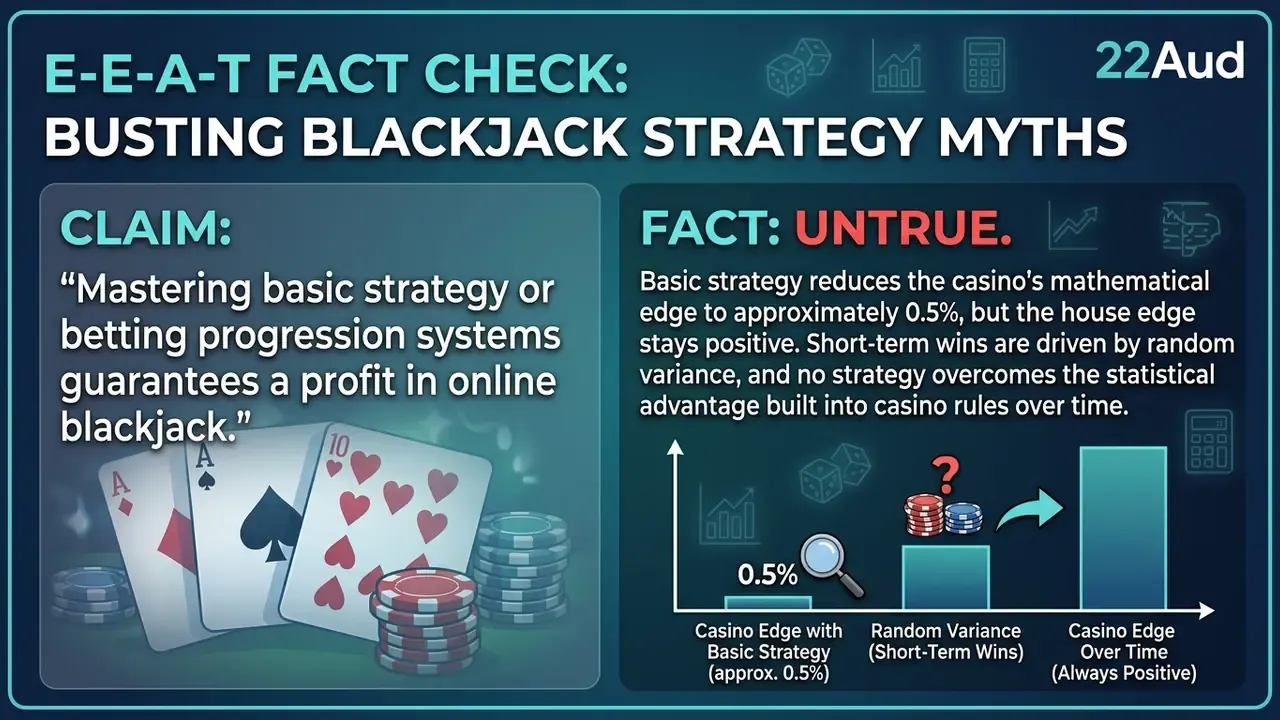
  • Strategy:perfect basic strategy trims the house edge to roughly 0.5% under favourable rules. It never removes it.
  • Card counting:mathematically ineffective online. RNG tables reshuffle every hand and live shoes use shallow penetration.
  • Bonuses:blackjack usually contributes only 0% to 10% toward wagering requirements, so slot-style bonus funds are rarely blackjack friendly.
  • Banking (AU):PayID, POLi, cards, Neosurf and crypto dominate. Crypto payouts are typically the fastest.
  • Safety:set deposit and session limits first. Free, confidential help: Gambling Help Online, 1800 858 858.
Blackjack rules game objective, card values

Blackjack rules: game objective, card values, and player actions

Blackjack is a card game where players compete directly against a dealer, aiming to build a hand total closer to 21 than the dealer's without exceeding that number. The core objective in any blackjack game is a higher score than the dealer's hand, capped at 21 points. Go over, and you bust. The round is lost immediately.

A standard deal begins with two cards to each player and two cards to the dealer, usually with one dealer card face up and one face down. The order matters more than beginners expect. Players complete every tactical action first, and only then does the dealer finish their hand according to fixed table rules. Because the player always acts first, the dealer holds a structural advantage: the house wins whenever a player busts, even if the dealer would have busted later in the same round.

Card values and blackjack totals. Card

Card values and blackjack totals

Card values in blackjack are refreshingly simple, and they stay identical across every variation:
  • Number cards (2 to 10):worth their exact face value, so a 7 card is worth 7 points.
  • Face cards (Jack, Queen, King):each face card is worth 10 points.
  • Ace:worth either 1 or 11 points, whichever value helps the hand total without busting.

A «natural», or classic Blackjack, occurs when an Ace is paired with any 10-value card (10, J, Q, K) on the initial two-card deal. At standard tables a natural pays 3:2, unless the dealer also holds a natural 21, which results in a tie known as a push. If an Ace can be counted as 11 without the hand exceeding 21, it is counted as 11. Otherwise it drops automatically to 1.

Hit, stand, double, and split. Once

Hit, stand, double, and split

Once the initial cards are dealt, players read their hand against the open dealer card and choose one of four primary actions:

  1. Hit: request another card to increase the hand total. You can hit repeatedly until you stand or bust.
  2. Stand: keep the current total and pass the turn to the next player or the dealer.
  3. Double Down: double the initial bet in exchange for exactly one more card, after which the hand stands automatically.
  4. Split: if the first two cards are of equal value, such as two 8s, place a second bet equal to the first and play them as two separate hands. Each card becomes the starting card for a new hand.

Two secondary options appear at many online tables. Insurance is offered when the dealer's upcard is an Ace, and surrender, where available, lets a player forfeit half the bet and exit the hand immediately. Some tables also permit double down after split (DAS), a rule that measurably favours the player when combined with correct pair splitting.

The dealer's turn and hand completion

The dealer's turn and hand completion

After every player has finalised their decisions, the dealer reveals the hidden card and completes their turn under mandatory house rules. Unlike players, the dealer has no freedom of choice at all.

At standard tables the dealer must hit on any total of 16 or lower and must stand on 17 or higher. Some variations require the dealer to hit on «Soft 17», a total of 17 containing an Ace counted as 11, which nudges the house edge upward. Once the dealer stops drawing, results are settled: hands closer to 21 than the dealer's win 1:1, tied totals push and the stake comes back, and hands over 21 or below the dealer's total lose the wager.

The soft-17 rule is the only genuine divergence in fixed dealer play. It is a house-rule variant, not a separate hand outcome. Confirm which version your table uses before the first deal, because live studio tables and RNG tables from the same provider often differ. Yes, from the same provider. It happens more than you would think.

Step-by-step flow of a single blackjack hand

StepActionWho acts
1Place the initial wager within table limitsPlayer
2Two cards dealt to the player, two to the dealer (one face up)Dealer / software
3Check for natural blackjack (Ace plus 10-value card)Both
4Choose hit, stand, double down, split, insurance or surrenderPlayer
5If the player's total exceeds 21, the hand busts and the wager is lostPlayer
6Dealer reveals the hole cardDealer
7Dealer draws until reaching 17 or higher (house soft-17 rule applies)Dealer
8Compare totals: win 1:1, natural 3:2, push, or lossBoth

[FLOWCHART: Step-by-step online blackjack hand algorithm. Caption: "Sequential flow of a single blackjack round from initial wager to payout resolution." Style: Clean vector flowchart]

  1. Player places initial bet -> 2. Two cards dealt to Player and Dealer (one dealer card face up) -> 3. Player checks for Natural Blackjack (21) -> 4. Player selects action: Hit, Stand, Double Down, or Split -> 5. If Player total > 21: Bust (Loss) -> 6. If Player Stands: Dealer reveals hidden card -> 7. Dealer draws until total >= 17 -> 8. Hand Comparison and Payout (Win 1:1, Push, or Loss).

Blackjack glossary: hard, soft, push, bust, insurance

Learning the table vocabulary removes most beginner hesitation, mainly because online interfaces label their buttons and side bets using exactly these words.

TermDefinitionPractical impact
Natural / BlackjackAce plus any 10-value card on the first two cardsPays 3:2 at standard tables; cannot be beaten, only pushed
Hard handA hand with no Ace, or one where the Ace must count as 1 (10-6 = Hard 16)High bust risk when hitting above 11
Soft handA hand containing an Ace counted as 11 (A-6 = Soft 17)Cannot bust on the next card; supports aggressive doubling
BustAny total above 21Instant loss, even if the dealer later busts
PushPlayer and dealer finish on equal totalsStake returned, no win or loss
InsuranceOptional side wager offered when the dealer shows an AcePays 2:1 but carries a heavy long-run negative expectation
SurrenderForfeiting half the stake to exit a hand earlyUseful only on Hard 15 to 16 against a strong dealer card
Shoe / penetrationThe multi-deck holder, and how deep dealing goes before a reshuffleDetermines whether card tracking has any theoretical value
DASDouble down after split permittedSlightly reduces the house edge
UpcardThe dealer's visible cardThe single most important input for every strategy decision

What is blackjack online and what game formats are available

In online casinos, blackjack games arrive in four main formats: free demo play, automated software RNG, streamed live dealer tables, and real money modes on either engine.

Card valuation and hand comparison stay uniform across all of them. The technology, the pace and the financial risk do not.

«Among casino table game participants, 19.2% experience moderate to high gambling risk, more than three times the general population average.» (NSW Gambling Survey 2024, Central Queensland University for the NSW Responsible Gambling Fund; internal report, public URL not published)

Comparative overview of online blackjack formats

FormatReal-money stakesDealer typeTypical paceSession dynamicsPrimary purpose
Blackjack demoNo (virtual credits)Automated software (RNG)Fast (30 to 45 hands/hr)Player-controlled speedLearning rules and basic mechanics
RNG blackjackYesAutomated software (RNG)Fast (30 to 50 hands/hr)Solo continuous playAutomated real money gambling
Live dealer blackjackYesHuman dealer (HD stream)Moderate (30 to 45 hands/hr)Real-time social tableAuthentic casino environment
Real money blackjackYesRNG or live dealerFormat-dependentVariable durationReal money wagering
Blackjack demo and free play. Blackjack

Blackjack demo and free play

Blackjack demo mode is a risk-free software version that lets you practise every table action using virtual credits. No deposit, no exposure. Cards are dealt by software algorithms, so you can test game options, absorb card values, and watch how hit, stand, double and split decisions behave in real time.

Demo tables give a clear technical overview of layouts and wagering controls. What they cannot reproduce is the psychological friction of a real balance moving in the wrong direction. Free play teaches rules well. It predicts nothing about money.

Two practical notes for Australian users. First, most RNG demo tables load straight in the browser without registration or identity checks, since account creation and KYC generally apply only once you deposit or request a withdrawal. Second, live dealer tables are almost never available in demo form, because studio streams carry real operating costs. To watch a live table you usually need a funded account, even if you sit out hands rather than bet.

Blackjack real money and live casino

Blackjack real money and live casino

Real money blackjack means depositing funds and staking money on each hand, with wins and losses landing directly in your account balance. You can choose single-player RNG tables or a blackjack live casino environment run by licensed casino operators, where human dealers handle physical cards streamed from dedicated studios.

According to technical benchmarks in industry reporting from Discovery Bay Glass (2024 to 2025), live dealer blackjack tables generally return roughly 99.2% to 99.4% under optimal basic strategy, while standard RNG tables average 98.5% to 98.7%.

«Live blackjack RTP rose from 99.0% in 2020 to 99.4% in 2024, while virtual tables recorded 98.3% to 98.7%.» (Discovery Bay Glass, live blackjack analytical review, 2024 to 2025; URL not published in source)

Real money blackjack play carries genuine financial exposure, and the data is blunt about who is affected. The NSW Gambling Survey 2024 found that 19.2% of people who play casino table games experience moderate to high gambling risk, rising to 50.1% among those playing at least monthly.

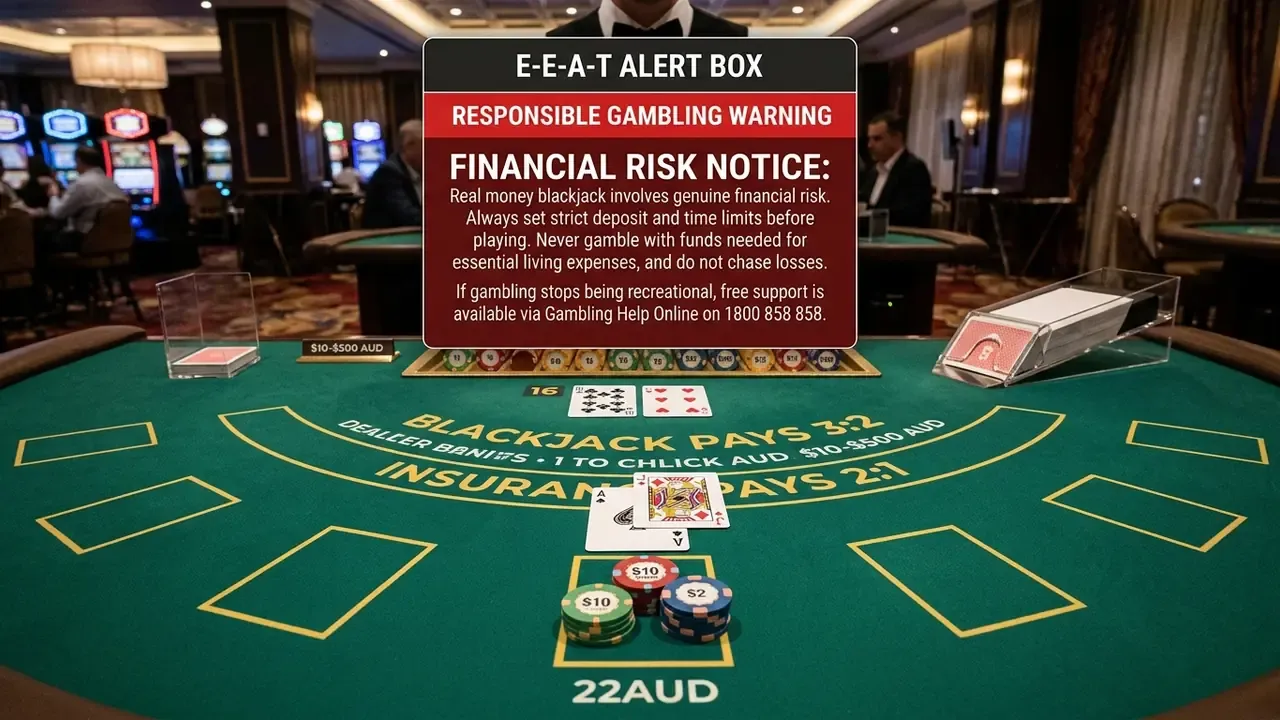
Disclaimer: this information is general in nature and does not replace professional advice. Gambling involves genuine financial risk. If gambling stops being fun, free and confidential support is available through Gambling Help Online, 1800 858 858.

Popular online blackjack variations and rule
Classic blackjack remains the benchmark, but online lobbies stack dozens of rule variants beside it, and several of them quietly change the house edge. Before joining an unfamiliar variant, open the in-game rules panel and confirm the natural payout, the dealer soft-17 rule and any tie-handling exceptions.
  • Double Exposure Blackjack:both dealer cards are dealt face up. To offset that information advantage, a natural pays 1:1 instead of 3:2, and the dealer wins all ties except when the player holds a natural.
  • Blackjack Switch:you play two hands at once and may switch the second card dealt to each hand. In exchange, a dealer total of 22 pushes against all non-busted player hands, and naturals typically pay 1:1.
  • 21 Burn Blackjack:lets you burn (discard) the second card for a fee and take a new random card, adding a tactical layer before you decide to hit or stand.
  • Blackjack Cashback / Early Surrender:offers a fixed cash-out value before the dealer draws final cards, which is useful for defusing volatile totals such as Hard 15 or Hard 16.
  • Blackjack with Gamble:a double-or-nothing decision after a winning hand. Entertaining, sure, though it converts a settled win into a coin flip. Use it sparingly, if at all.
  • European, Vegas Strip and Classic:European tables usually deal the dealer's second card only after players act (no hole card). Vegas Strip rules commonly allow doubling on any two cards and re-splitting. Classic multi-hand RNG tables let you play up to five boxes at once.
  • VIP and high-limit tables:these frequently keep the friendlier 3:2 natural payout with higher ceilings, for example AU$5 to AU$20,000 ranges, whereas some low-limit variants quietly downgrade naturals to 6:5.
  • Multiplier and side-bet tables, such as Gravity-style live formats: multipliers can boost selected wins, but volatility is far higher than standard blackjack. Never treat them as a bankroll plan.

Some operators advertise headline RTP figures like 99.9% on proprietary tables. Treat that with healthy suspicion. The realistic ceiling for standard multi-deck blackjack under perfect basic strategy sits near 99.5% to 99.6%, so anything higher needs external verification against the provider's published rule set and RTP certificate.

How to play blackjack online: from game selection to your first bet

To start playing blackjack online you need three things: a reputable blackjack casino, a table whose rules you have actually read, and betting limits that fit your budget rather than your mood. Moving from casual browsing to an active wager means weighing table limits, rules and variations first.

Checking those rules before you sit down keeps unexpected house conditions, such as a 6:5 payout reduction, from quietly eroding your expected return.

How to choose a blackjack game

How to choose a blackjack game and table

Selecting a table means looking past the graphics to the structural rules and wagering boundaries. Tables differ widely in minimum and maximum bets, side-bet availability and dealer software rules.

When you review table specifications, prioritise these criteria:

  • Blackjack payout ratio:confirm naturals pay 3:2. Cutting the natural payout to 6:5 reduces the return on a hand that appears roughly once every 21 deals. Standard blackjack mathematics puts the resulting shift at about +1.39 percentage points of house edge, so a 0.5% game becomes closer to 1.9%. Verify against your table's published RTP certificate, since the exact figure moves with deck count and soft-17 rules.
  • Dealer soft 17 rule:prefer tables where the dealer stands on all 17s rather than hitting Soft 17. That single rule is worth roughly 0.2% of edge.
  • Table limits:match stake size to a budget you set in advance. A widely repeated bankroll guideline, not an official standard, is to sit with at least 30 to 50 minimum bets so ordinary variance cannot end your session in a handful of hands. Treat it as a rule of thumb and set your own ceiling before depositing.
  • Side bets:optional wagers such as Perfect Pairs or 21+3 advertise bigger payout ratios and charge for the privilege. Published paytable analyses place most blackjack side bets well above the main game's edge, commonly in the low single digits and, on some paytables, into double digits. The number is paytable-specific, so check the game's own information panel rather than assuming.
  • Deck count and penetration:fewer decks generally favour the player, and the rules panel should state shoe size (single, six or eight deck) plus the reshuffle point.
  • Transparency of the rules panel:tables that display shoe size, soft-17 policy and RTP inside the game menu are safer picks than those burying conditions in generic site terms.
While assessing platform transparency, our editorial

While assessing platform transparency, our editorial team reviewed online casino table terms across several licensed operators to see how clearly rule conditions were published. Cross-referencing published RTP tables with live in-game rules for our iGaming analysis guide, we found that platforms listing exact shoe sizes and rule variations directly in the game menu offered a more predictable environment. During hands-on testing, one small detail stood out: lobbies that tag live-table RTP on the thumbnail, instead of hiding it in a help file, made it much faster to filter out 6:5 tables before committing a stake.

Side bets evaluation

Optional wagers like 21+3, which combines your two cards with the dealer upcard to form poker hands, and Perfect Pairs advertise payouts up to 100:1. The appeal is obvious. The maths is less flattering, because side bets settle independently of skill, so basic strategy cannot reduce their cost by a single cent. Treat them as secondary entertainment funded from a small fixed slice of your session budget, never as a replacement for the main hand.

When to transition from demo to real money

Move from blackjack demo to real stakes only once you genuinely understand game mechanics, card values and table rules. Demo mode builds the muscle memory. Real money adds the part demo cannot teach: bankroll discipline under pressure.

«Online gamblers are almost five times more likely to fall into the moderate or high-risk category than those who do not gamble online.» (NSW Gambling Survey 2024, GambleAware NSW harm factsheet; internal report, public URL not published)

Before placing real stakes, set clear

Before placing real stakes, set clear session limits and accept that no system guarantees a positive financial outcome.

Readiness checklist before your first real money hand:

  1. You can state the table's natural payout ratio, soft-17 rule and shoe size without looking again.
  2. You can apply basic strategy for hard totals, soft totals and pairs without freezing on the turn timer.
  3. Your deposit is money you can afford to lose entirely, kept separate from rent, bills and savings.
  4. You have set a loss limit, a win-stop point and a session clock, all before opening the table.
  5. You have completed identity verification, so a withdrawal will not stall later.
  6. You understand that a losing session does not prove your decisions were wrong, and a winning one does not prove a system works.

Real money banking and withdrawal speeds in Australia

Bankroll management depends heavily on the payment route you pick. Australian real money players generally use four main pathways, and the gap between them is measured in days, not minutes.

Payment methodAverage deposit timeAverage payout speedTypical limits (AUD)Key advantage
PayID / POLiInstantSame day (1 to 4 hrs)$20 to $4,000Direct bank link, zero fee
Cryptocurrency (BTC, ETH, LTC)Instant (1 to 3 mins)Fast (under 45 mins)$30 to no upper limitHighest privacy, ultra-fast payout
Credit/debit cards (Visa, Mastercard)Instant1 to 3 business days$10 to $2,500Universal availability
Prepaid vouchers (Neosurf)InstantNot available for payout$15 to $500Complete bank anonymity
E-wallets (Skrill, Neteller, MiFinity)Instant24 to 48 hrs$20 to $4,000Consolidated wallet history
Bank transfer1 to 2 business days3 to 5 business days$50 to $10,000+Suits large withdrawals
Points that matter specifically for blackjack

Points that matter specifically for blackjack players:

  • Payout tempo, not payout promise. Independent testing across offshore-facing brands regularly records crypto cashouts clearing inside an hour, while card and bank routes still take several business days. Choose your deposit method with the withdrawal in mind, because many cashiers force payouts back to the original method.
  • Minimum withdrawal thresholds. Some brands set higher floors on crypto, for example Bitcoin withdrawals starting from AU$90, or cap e-wallet deposits. Small balances can get stranded.
  • KYC before, not after, a big win. Verification usually needs photo ID, proof of address and a payment-method screenshot. Doing it while your balance is small avoids a delay at exactly the wrong moment.
  • Prepaid vouchers are deposit-only. Neosurf and similar vouchers protect banking privacy but cannot receive payouts, so nominate an alternative withdrawal method in advance.
  • Currency and fees. Check whether the cashier settles in AUD. Conversion at 1% to 3% quietly outweighs the entire 0.5% house edge of a well-chosen blackjack table. That is the part players notice last.

Blackjack bonuses and wagering rules

Casino bonus headlines are written for slot players. Not for you. Because blackjack carries one of the lowest house edges in the lobby, operators protect themselves by limiting how much it contributes to wagering requirements.

Bonus termTypical settingWhat it means for blackjack
Game weighting (contribution)0% to 10% for blackjack, versus 100% for slotsA 40x requirement on a $100 bonus at 10% weighting effectively becomes $40,000 in blackjack turnover
Wagering multiplier30x to 40x bonus, sometimes bonus plus depositCheck which base applies; «bonus plus deposit» doubles the workload
Max bet while bonus is activeAU$2 to AU$5 per handExceeding it can void winnings, even accidentally on a double or split
Excluded deposit methodsSkrill and Neteller commonly excludedDepositing with the wrong wallet can forfeit the offer entirely
Expiry window5 to 14 daysShort windows make low-weighting blackjack clearance practically impossible
Prohibited low-risk playCovering both sides, minimal-risk patternsIncludes hedging via side bets or simultaneous opposite wagers
Cashback offers5% to 15%, often weekly and live-dealer specificUsually the genuinely blackjack-friendly promotion, with no or low wagering

Practical rule: if blackjack is your game, decline the slots welcome package and look for live dealer cashback, table-game reload offers or wager-free rebates instead. A 10% weekly live blackjack cashback is worth more to a table player than a nominal AU$5,000 bonus that blackjack cannot clear. Read the game-weighting table before opting in, and note that it usually sits on a separate page from the headline terms.

Legal status and safety for Australian

Australia records one of the highest per-capita gambling participation rates in the world, and its online rules are unusual. Under the Interactive Gambling Act 2001 (Cth) and later amendments, it is an offence for operators to provide real-money online casino games, blackjack online included, to customers in Australia. The Act targets suppliers, not individual players, so Australians are not prosecuted for placing a bet. Licensed domestic online products are effectively limited to sports and race wagering plus lotteries.

The Australian Communications and Media Authority (ACMA) enforces the Act. It investigates complaints, publishes formal warnings and asks internet providers to block sites offering prohibited services. In practice, blackjack sites accepting Australian players are offshore, and access can be interrupted without notice.

That offshore environment offers no domestic consumer protection, which shifts the safety assessment onto you. Before depositing, check:

  • Licence and regulator. MGA (Malta) and UKGC-style regimes impose stricter obligations than Curaçao or Costa Rica registrations. Lighter licensing is not automatically unsafe, though dispute resolution is thin.
  • Game-level transparency. Published RTP tags, visible shoe sizes and clearly stated soft-17 rules are strong practical signals, often more informative than the licence badge itself.
  • Named software providers. Recognised live-dealer and RNG studios are independently tested. Anonymous in-house tables are not.
  • Encryption and account security. TLS encryption, two-factor authentication and documented data handling.
  • Withdrawal terms in writing. Stated limits, timelines and KYC requirements before you deposit, not after you win.
  • Responsible gambling tooling. Deposit limits, reality checks, cool-off periods and self-exclusion available inside the account, not only by emailing support.
  • Dispute pathway. A named alternative dispute resolution body plus a documented complaints process.

Legal disclaimer: this section is general information, not legal advice. Gambling law differs by state and territory and can change. Confirm your own position with a qualified professional or the relevant regulator before acting.

Live blackjack and RNG blackjack: what to choose

Choosing between live blackjack and automated RNG tables comes down to pace, social contact and how the cards are dealt. Both follow the same hand evaluation rules, yet they operate quite differently under the surface.

RNG blackjack uses computer algorithms to simulate deals and reshuffles the virtual deck after every hand. Live dealer blackjack streams a human dealer working a physical shoe, typically eight decks, with a cut card placed roughly halfway through before a reshuffle.

Comparison factorRNG blackjackLive dealer blackjack
Dealing mechanismCertified random number generatorHuman dealer, physical card shoe
Shuffle frequencyContinuous, every hand reshuffledShoe reshuffled at the cut card (about 50% penetration)
Game paceFast (30 to 50+ hands/hour, player-led)Moderate (30 to 45 hands/hour, timed turns)
Social layerSolo play, no interactionLive chat with the dealer and other players
Minimum stakesOften low (from $0.50 to $1.00)Typically higher (from $5.00 to $10.00+)
Beginner fitHigh, no turn clock pressureModerate, requires quick decisions
Typical RTP band98.5% to 98.7%99.2% to 99.4%
Demo availabilityUsually yesRarely, a funded account is generally required
Session length driverPlayer-controlled, easy to over-extendTable pacing and dealer rhythm

«Live dealer game revenue exceeded US$12 billion in 2024, and the average live blackjack session runs 35 to 45 minutes versus about 22 minutes for slots.» (MEXC News, «Live Dealer Casino 2026: Research, Data and Growth», 2026; URL not published in source)

As technical analyses from BlackjackReview.com (2026) point out, continuous reshuffling in RNG games makes deck memory or card tracking mathematically impossible.

«In RNG blackjack every hand is dealt from a freshly shuffled virtual deck, so card counting has no mathematical basis.» (BlackjackReview.com, «Live Dealer Blackjack vs. RNG Blackjack», 2026; URL not published in source)

Live tables do use physical shoes, but shallow penetration policies, reshuffling after roughly four decks, similarly flatten the value of traditional counting. The operational edge stays with the house either way.

«Moderate to high harm risk sits at 17.0% for sessions of 1 to 2 hours, 22.2% at 2 to 3 hours, and 34.3% for sessions beyond three hours.» (NSW Gambling Survey 2024, casino table games factsheet; internal report, public URL not published)

That session-length gradient feeds directly into

That session-length gradient feeds directly into the format decision. Live tables run longer sessions by design, while RNG tables run fewer minutes and far more hands per minute. Neither is inherently safer. What protects you is a pre-set session clock applied identically to both.

Practical selection guide:

  • Choose RNG blackjack for low minimums, unlimited thinking time while you learn the charts, and short controlled bursts of play.
  • Choose blackjack live dealer tables if you value the higher RTP band, transparent physical dealing and a social table, and you can decide inside the turn timer.
  • If your connection drops mid-hand, most studios auto-stand your hand at its current total under published table rules. The result is logged in your game history, which is the first place to look before you contact support.

Basic blackjack strategy: charts, decisions, and common mistakes

Basic blackjack strategy is a mathematically derived decision matrix. For every combination of player hand and dealer upcard, it names the statistically optimal move: hit, stand, double or split. Follow it accurately and the house edge drops to its floor, usually around 0.5% under favourable rules.

How to use hit, stand, double

How to use hit, stand, double, and split intentionally

Applying basic strategy means parking intuition and reading probabilities off the dealer's visible card:
  • Hard totals 12 to 16:stand against a weak upcard (2 through 6), since the dealer busts more often. Hit against a strong upcard (7 through Ace).
  • Hard totals 17 or higher:always stand. The bust probability outweighs any statistical gain.
  • Hard totals 10 or 11:double down when your total beats the dealer's upcard, for instance doubling 11 against a dealer 2 through 10.
  • Pair splitting:always split Aces and 8s. Never split 10-value cards or 5s.
Understanding hand classifications - Hard hands

Understanding hand classifications

  • Hard hands: any combination without an Ace, or where the Ace must count strictly as 1. So 10-6 is a Hard 16. Hard hands carry a high bust risk when hit above 11.
  • Soft hands: a hand containing an Ace counted as 11, so Ace-6 is a Soft 17. Soft hands support aggressive play, hitting or doubling, because one high card cannot bust you immediately.

Crucial pair-splitting rules

  • Always split Aces and 8s. Splitting Aces starts two hands pointed straight at 21. Splitting 8s breaks up Hard 16, statistically the weakest hand in blackjack.
  • Never split 10s or 5s. A pair of 10s already totals a winning 20. A pair of 5s is a Hard 10 and should be doubled against dealer 2 through 9.
  • The insurance trap. Never take insurance when the dealer shows an Ace. Its long-run house edge sits far above the base game, commonly cited around 6% to 7% on multi-deck shoes, which makes it a negative-expectation side bet rather than protection.
  • Never take «even money» on your natural against a dealer Ace. It is insurance wearing a friendlier label, and it hands back the 3:2 premium.

Basic strategy chart: hard totals

Your handDealer 2345678910A
8 or lessHHHHHHHHHH
9HDDDDHHHHH
10DDDDDDDDHH
11DDDDDDDDDH
12HHSSSHHHHH
13SSSSSHHHHH
14SSSSSHHHHH
15SSSSSHHHH*H
16SSSSSHHH*H*H*
17+SSSSSSSSSS

H = Hit, S = Stand, D = Double if allowed (otherwise Hit). * = surrender first if the table offers it.

Basic strategy chart: soft totals

Your handDealer 2345678910A
A,2 (Soft 13)HHHDDHHHHH
A,3 (Soft 14)HHHDDHHHHH
A,4 (Soft 15)HHDDDHHHHH
A,5 (Soft 16)HHDDDHHHHH
A,6 (Soft 17)HDDDDHHHHH
A,7 (Soft 18)SDDDDSSHHH
A,8 (Soft 19)SSSSSSSSSS
A,9 (Soft 20)SSSSSSSSSS

Basic strategy chart: pairs (splitting)

Your pairDealer 2345678910A
A,AYYYYYYYYYY
10,10NNNNNNNNNN
9,9YYYYYNYYNN
8,8YYYYYYYYYY
7,7YYYYYYNNNN
6,6YYYYYNNNNN
5,5N (double)N (double)N (double)N (double)N (double)N (double)N (double)N (double)NN
4,4NNNYYNNNNN
3,3YYYYYYNNNN
2,2YYYYYYNNNN

Y = Split, N = Do not split. Assumes a multi-deck shoe with double after split permitted; single-deck and hit-soft-17 tables carry minor deviations.

[INFOGRAPHIC: Basic Blackjack Strategy Summary Matrix.
Caption: "Core actions for hard totals versus dealer upcard under standard rules." Style: Modern minimalist table graphics]
- Hard 8 or less: Always Hit.
- Hard 9: Double vs dealer 3-6, otherwise Hit.
- Hard 10-11: Double vs dealer 2-9 / 2-10, otherwise Hit.
- Hard 12-16: Stand vs dealer 2-6, Hit vs dealer 7-A.
- Hard 17+: Always Stand.
- Pair A-A and 8-8: Always Split.
Common beginner mistakes. 1. Copying the

Common beginner mistakes

  1. Copying the dealer. Mimicking «always hit to 17» ignores the upcard entirely and costs roughly 5% in expected value.
  2. Standing on Hard 16 against a 10 because it feels safer, when the chart calls for a hit or surrender.
  3. Taking insurance on a strong hand, which turns a small edge into a guaranteed long-run loss.
  4. Splitting 10s to chase two 20s, breaking up the second-best hand in the game.
  5. Betting progressions after a loss. The Martingale and its relatives change bet size, not probability. They just compress the same expected loss into fewer, larger swings.
  6. Playing bonus funds at maximum stakes, breaching the max-bet clause and voiding the balance.
  7. Chasing losses at a faster table, which lifts hands per hour and therefore total exposure to the house edge.

Why strategy does not guarantee a win

Basic strategy optimises decisions. It does not delete the house edge, and it offers no shelter from short-term variance. In any single session, random card distribution can hand you a run of losing hands no matter how precisely you follow the chart. House edge is the built-in long-run advantage baked into the payout structure. Variance measures how far actual results drift from that expectation across a short run of hands.

The House of Representatives Standing Committee on Social Policy and Legal Affairs made a related point in its inquiry report You win some, you lose more (June 2023):

«Misconceptions about ‚winning systems' in online gambling systematically drive player overconfidence and financial loss.» (House of Representatives Standing Committee on Social Policy and Legal Affairs, You win some, you lose more, Parliament of Australia, 2023; parliamentary report, URL not published in source)

Basic strategy is a loss-minimisation framework. Not a profit mechanism.

Disclaimer: this information is general in nature and does not replace professional advice. No strategy guarantees a profit in gambling.

Who should skip online blackjack for

Who should skip online blackjack for now

Not every reader should be at a table, and a useful guide says so plainly. Consider stepping back if any of the following applies:

  • You are looking for income, or hoping to recover money already lost. Blackjack is priced as entertainment, not as a return.
  • You cannot name a loss limit for tonight, or you are unwilling to stop when you reach it.
  • You would be depositing money earmarked for rent, bills, groceries or debt repayments.
  • You are playing while stressed, sleep-deprived or drinking, because decision quality falls first and stake size usually rises second.
  • You have previously self-excluded from a gambling product, in which case honour that decision.
  • You are under 18. All Australian-facing gambling content and products are strictly 18+.

If any of these hit close, use the operator's cool-off tools or speak with Gambling Help Online on 1800 858 858. Free, confidential, and open around the clock.

Summary recommendations for Australian players

When you explore blackjack online, three habits matter most: transparency, rule verification and risk management.

  1. Verify table rules first. Confirm naturals pay 3:2 and check the dealer's soft-17 rule before you bet.
  2. Use demo mode for practice. Learn the controls and the strategy charts in free play before committing real capital.
  3. Set strict bankroll limits. Fix daily or session loss limits and hold them regardless of how the cards are running.

«Among those who played casino table games at least monthly, 50.1% experienced moderate to high gambling risk.» (NSW Gambling Survey 2024, casino table games factsheet; internal report, public URL not published)

4. Recognise the limits of strategy
  1. Recognise the limits of strategy. Treat basic strategy as a tool for consistent decisions, not a promise of financial return.
  2. Use responsible gambling tools. Deposit limits, time-out alerts and self-exclusion should be available inside the account.
  3. Read the game-weighting table before accepting any bonus. Blackjack often contributes 10% or less, and max-bet clauses apply to doubles and splits too.
  4. Plan the withdrawal before the deposit. Complete KYC early and pick a payout route whose speed you can live with.
  5. Cap session length, not just spend. Harm risk climbs sharply beyond two hours of continuous table play.
Pre-first-bet checklist. - Natural pays 3

Pre-first-bet checklist

  • Natural pays 3:2, confirmed in the rules panel
  • Dealer stands on all 17s, or the soft-17 rule is understood and accepted
  • Shoe size and reshuffle point visible
  • Table minimum fits a 30 to 50 bet session buffer
  • Side bets switched off, or funded from a fixed separate slice of budget
  • Basic strategy chart open in a second tab, or memorised
  • Deposit limit, loss limit and session timer set inside the account
  • Identity verification completed
  • Withdrawal method nominated and payout timeframe known
  • Support number saved: Gambling Help Online 1800 858 858

Blackjack FAQ

How we review blackjack tables and

How we review blackjack tables and casino brands

Transparency about method matters as much as the verdict, so here is what our desk checks before a table or brand appears in our recommendations.

  • Rules panel audit. We record the natural payout, dealer soft-17 policy, shoe size, reshuffle point, DAS and surrender availability for each table, then compare them against the provider's published RTP certificate.
  • Bonus terms read in full. Game weighting, wagering base, max bet, excluded payment methods, expiry and low-risk play clauses are logged in a table, not summarised from the landing page.
  • Payments tested end to end. Where possible we deposit, play and withdraw, timing each step and noting minimum thresholds, forced return-to-source rules and any currency conversion.
  • KYC friction. Which documents are requested, at what stage, and how long verification takes before a payout is released.
  • Complaint history. Public forum threads and dispute-body records are reviewed for repeat patterns around delayed withdrawals, voided bonuses or closed accounts.
  • Responsible gambling tools. Deposit limits, reality checks, cool-off and self-exclusion must be usable inside the account without emailing support.
  • Last-reviewed dating. Terms shift quietly, so every table and brand carries a review date, and we re-check the highest-traffic pages quarterly.

If a brand fails on withdrawal transparency or hides its game weighting, no bonus size compensates. That is the whole logic of the method.

Responsible gambling: 18+ only. Gambling involves real financial risk and no strategy changes that. Free, confidential support is available through Gambling Help Online on 1800 858 858, or via your operator's self-exclusion tools. Last reviewed: February 2026.