Mines Game Online: How to Play in Demo Mode and for Real Money

"Before evaluating headline multipliers or flash mechanics in Mines, players need to inspect the fine print: RNG transparency, demo payout discrepancies and real-money withdrawal terms." Claire Bennett, Senior iGaming Content Editor (editorial brief)

Last reviewed: February 2026 | Editorial standards: independently fact-checked against Australian legislation, classification rules and peer-reviewed gambling research. | 18+ only.

Grid games with instant cash-out buttons have spread fast across online casino lobbies. Among them, the Mines game online format stands out for its high volatility, player-set risk levels and immediate feedback after every click. That immediacy is the appeal. It is also the risk.

Choosing between a free simulated version and a real-money round is not just a preference. It requires a clear view of house edge, the regulatory position in Australia, and how much money you are genuinely prepared to lose.
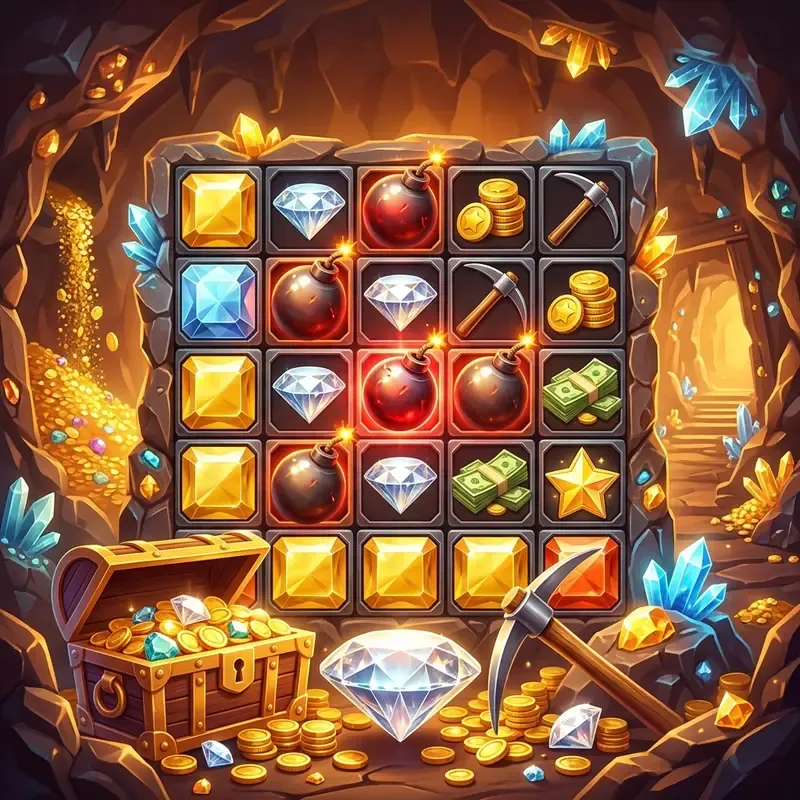
Provider

Turbo Games

RTP

95%

Volatility

High

Min bet

0.10

Max bet

1,000.00

Max win

×456660

Mines Game Online How to Play
Quick Verdict for Australian Players

Quick Verdict for Australian Players

  • What it is:a grid-based chance game (classically 5x5 = 25 tiles) where you reveal safe tiles for a rising multiplier and lose the stake the instant you uncover a mine.
  • RTP reality check:there is no single number. Audited returns range from roughly 94% (Hacksaw Gaming) to 99% (Stake Originals), with Spribe near 97% and Turbo Games around 95% to 96%. Read the in-game info panel before wagering.
  • Grid flexibility:modern builds are not locked to 5x5. Configurations run from 3x3 up to 9x9, with up to 80 active mines, which reshapes the multiplier curve completely.
  • Demo vs real money:demo and free modes carry zero financial risk, yet some use inflated payout behaviour. They do not reproduce real-money psychology or bankroll pressure.
  • Strategy truth:low-risk presets, 1:1 ratio play and Martingale change variance, not the house edge. Expected value stays negative in every configuration.
  • Mobile:no .apk or .exe download needed. HTML5 runs in Chrome, Safari, Firefox and Edge.
  • Australian context:real-money online casino services offered to Australian residents without local licensing are prohibited under the Interactive Gambling Act 2001. Simulated gambling games now attract mandatory R18+ classification.
  • Need help?Gambling Help Online: 1800 858 858 (24/7). National self-exclusion register: BetStop.
Who Should Skip Mines Entirely. Most

Who Should Skip Mines Entirely

Most guides never say this part out loud, so let's start here. Mines suits nobody who is chasing a loss, and the design makes chasing unusually easy: rounds last seconds, and the next click is always one tap away.

Give this format a wide berth if any of the following apply to you.

  • You are trying to win back money already lost this week. Fast-cycle products are the worst possible tool for recovery.
  • You dislike variance. A 20-mine single-pick shot loses roughly four times out of five, and no session length smooths that out.
  • You want a game you can genuinely "solve". Mine coordinates lock before your first click, so deduction has nowhere to work.
  • You are playing on an offshore site with no verifiable licence and no documented withdrawal terms. In that scenario your bigger risk is the cashier, not the grid.
  • You have an active BetStop registration, or you have set a self-exclusion with an operator. Respect it.

Still curious about the mechanics? Then the sections below explain how the grid, the multiplier ladder and the payment rails actually behave.

What is the Mines Game and

What is the Mines Game and How Does the Grid Mechanics Work?

Mines game is a chance-based casino game played on a concealed grid. Players reveal safe cells to accumulate payout multipliers while trying to avoid hidden mines. The whole loop balances incremental reward growth against the instant loss of the wager the moment a mine appears. Each safe cell opened lifts the payout multiplier applied to the initial stake, while hitting a mine ends the round and forfeits the entire stake.

In Australian gambling research, this mechanic sits inside the family of high-intensity, rapid-repeat betting products. According to the Australian/New Zealand Gaming Machine National Standard, chance-based casino mechanics must run on independent random outcomes, where past rounds do not influence future probability. Whether you play a standard 5x5 matrix or a custom layout, the underlying model relies on a fixed theoretical Return to Player (RTP) that holds a continuous house edge across extended play.

The scale of hidden states explains why no deductive method works here. On a 5x5 board seeded with five mines, the number of distinct mine placements equals C(25,5) = 53,130 combinations. The safe set simply cannot be identified at the start of a round by observation, memory or pattern reading. Not with skill, not with patience.

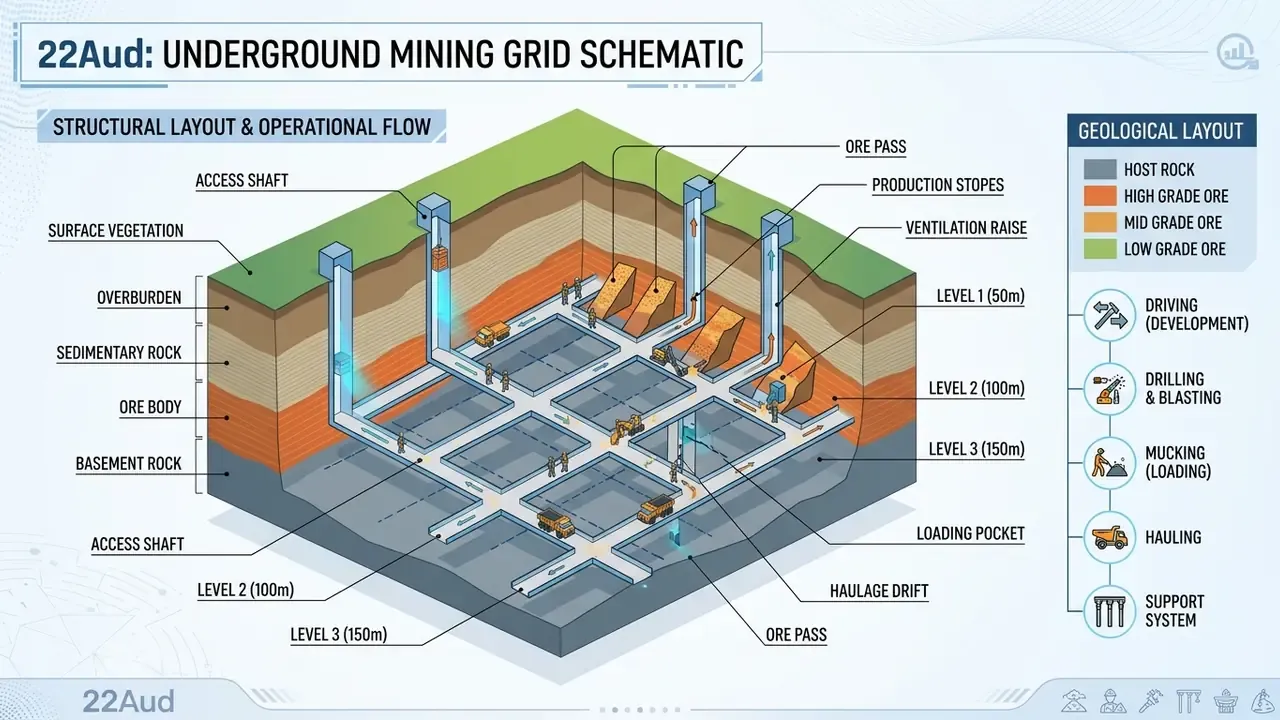
Annotated Mines grid showing closed tiles, a revealed safe tile, an exposed mine, the active mines counter, the stake field and the live multiplier
22Aud heading-banner
  • Type:visual diagram with annotations
  • Description:a detailed structural blueprint of the Mines game grid. Annotations point to unrevealed tiles, a revealed safe gem or diamond cell, an exposed mine icon, the active mines counter, the stake adjustment panel, and the real-time cash-out multiplier tracker.
  • Purpose:explains the interactive grid layout and core mechanics to players before a bet is placed.
  • Semantic markup:figure element with a figcaption containing descriptive text. Alt text: "mines game grid with closed cells, safe cell, mine, stake and multiplier".

Mines, Safe Tiles, and Multiplier Escalation

The ratio of mines to safe cells on the grid decides the payout escalation curve and the mathematical risk carried by every click.

"High-volatility games built on rapid, repeat betting create steep variance curves in which short winning streaks conceal long-run statistical loss." Australian Gambling Research Centre, Gambling Trends Study (2023 to 2024). https://aifs.gov.au/agrc/research/gambling-trends-study

When you set up a round

When you set up a round in Mines online, a higher mine count reduces the number of safe cells on the board, which sharply increases the multiplier step earned for every successful reveal.

Mathematically, if a grid holds $N$ cells and $M$ hidden mines, the probability of selecting a safe cell on the first attempt is $(N - M) / N$. With each consecutive safe pick $k$, the number of remaining concealed cells falls to $N - k$, so the concentration of remaining mines climbs. The multiplier schedule rises geometrically to offset that shrinking probability, yet the theoretical expectation stays bounded by the structural house edge.

Here is how most providers band the risk in practice:

Mine Count (5x5 grid)Safe Tiles RemainingMultiplier Step per PickVolatility Band
1 to 3 mines22 to 24Very small (about 1.03x to 1.13x)Low: long, slow sessions
5 to 10 mines15 to 20Moderate (about 1.25x to 1.60x)Balanced
15 to 24 mines1 to 10Steep (10x to 24x+ potential)Extreme: single-pick shots

More mines means fewer safe tiles, so each correct pick is statistically rarer and pays proportionally more. The trade-off is blunt: the chance of an instant first-click loss rises at the same time.

Wager Allocation and Cash-Out Decision Points

Wager Allocation and Cash-Out Decision Points

The cash out mechanism lets players lock in accrued winnings and end the round at any point before a mine is uncovered. Setting the initial stake (the bet amount) establishes the base monetary value that the active multiplier is applied to on cash out.

Deciding when to press cash out is the primary interactive choice when you play Mines. The temptation to open one more cell grows as the multiplier climbs, and every extra click adds fresh exposure. Updated: instant cash-out features in crash-style and grid games have been examined in peer-reviewed literature as design elements that manufacture a sense of agency, even though the mathematical expected value of continuing remains negative across all rounds.

One editorial observation worth sharing: in test sessions, the hardest moment is never the loss. It is the round at 2.4x when the balance says "one more tile".

"Behavioural markers of harm in online gambling include cognitive distortions, with the illusion of control and the gambler's fallacy as key indicators of risky engagement with games of chance." Behavioural Markers of Harm and Their Potential in Identifying Product Risk in Online Gambling, International Journal of Mental Health and Addiction (2023). https://link.springer.com/journal/11469

Mines Demo, Free-to-Play, and Real-Money Modes

Mines demo and Mines free modes are risk-free simulated formats built for practice. Mines real money involves actual financial wagers that can be lost in full. Simulated modes use virtual credits inside a closed-loop economy, which lets players test grid settings, multiplier pacing and the interface controls without depositing a cent.

Under the Australian Interactive Gambling Act 2001 (consolidated to June 2024), there is a firm legal line between real-money interactive casino services and non-monetary simulated gambling.

"Social casino games are not considered gambling under the IGA because they do not involve wagering money, although they replicate key characteristics of gambling." You win some, you lose more, House of Representatives Standing Committee on Social Policy and Legal Affairs (2023). https://www.aph.gov.au/Parliamentary_Business/Committees/House/Social_Policy_and_Legal_Affairs/OnlineGambling/Report

Real-money online casino operations offered to

Real-money online casino operations offered to Australian residents without local state licensing are prohibited under federal law. One nuance matters for readers: the Act regulates operators, not individual players. An Australian adult who opens an offshore Mines table is not the target of enforcement, but they also give up local consumer protections such as guaranteed dispute resolution, complaint escalation and payout enforcement. Updated classification rules also assign mandatory R18+ ratings to computer games containing simulated gambling elements, on the view that practice modes can normalise betting patterns.

"Computer games containing simulated gambling receive a mandatory R18+ classification, effective September 2024, directly restricting distribution to minors." New mandatory minimum classifications for gambling-like games, Australian Classification (2024). https://www.classification.gov.au/news/2024/new-mandatory-minimum-classifications-gambling-games

Comparison of Mines demo, Mines free and Mines real money play modes

Feature / CriterionMines Demo (Practice Mode)Mines Free (Social / App)Mines Real Money (Casino)
Primary objectiveExplore rules and grid settingsCasual entertainmentReal currency wagering
Stake typeVirtual credits (no value)Free or earned virtual coinsReal fiat or cryptocurrency
Cash out functionalityVirtual balance update onlyIn-game score accumulationWithdrawable monetary funds
RTP and payout behaviourMay feature inflated return ratesClosed-loop virtual economyAudited theoretical RTP (below 100%)
Registration / KYC requiredUsually none, instant browser launchOptional account for saving progressMandatory account plus full identity verification
Financial exposure riskZero monetary riskZero monetary risk (no purchases)Full loss of the wagered stake
Australian legal statusSimulated gambling (R18+ classification)Simulated gambling (R18+ classification)Interactive Gambling Act restricted
Read across the table and the

Read across the table and the summary is short: demo teaches you the interface, free play teaches you the rhythm, and only real money carries loss. The gap between the second and third column is where most misjudgements happen.

Does demo mode require KYC? In the overwhelming majority of certified builds, no. Demo Mines loads straight in the browser with a virtual credit balance, no deposit and frequently no registration at all. Identity verification becomes mandatory once a real-money account exists, and in practice it is enforced before the first withdrawal is released.

During an editorial review of casino game compliance frameworks, our research team analysed player transitions from free-play environments to cash-wagering platforms. By assessing brand verification standards across multiple operator reviews on our iGaming analysis platform, we found that clear bonus terms, transparent withdrawal limits and visible responsible gambling controls reduce player friction and misleading expectations. The same pattern shows up across online casinos with transparent conditions we have audited.

How to Access Mines Online Casinos

How to Access Mines Online Casinos and Launch Play Sessions

To reach Mines casino platforms and start a round safely, players verify brand licensing, pick demo or cash mode, configure round parameters, then launch the grid session. That order matters. Checking compliance and withdrawal rules before submitting personal details or funds is far easier than arguing about them later.

When assessing an online platform that hosts Mines play, adult users in Australia should favour sites with transparent terms, solid account verification (KYC) processes and accessible safer-gambling tools. Those are the same criteria we apply when reviewing platforms with transparent conditions and KYC. The setup itself is simple: adjust the stake, define the number of mines on the grid, then make decisions calmly during the round.

Safety Checklist How to Verify a

Safety Checklist: How to Verify a Mines Casino Before Depositing

  • Licence transparency. A verifiable licence number in the footer (Malta Gaming Authority, Curaçao Gaming Authority, Isle of Man) linked to an active regulator register, not a static image.
  • Game provider attribution. Certified Mines builds credit a named studio (Spribe, Hacksaw Gaming, Turbo Games, Stake Originals) and display RTP in the info panel. An unbranded clone with no RTP disclosure is a red flag for a scripted, non-audited copy.
  • Provably Fair or RNG audit. Look for a verification tool (server seed hash, client seed, nonce) or an independent testing-lab certificate from eCOGRA, GLI or iTech Labs.
  • Withdrawal terms in writing. Documented minimum and maximum withdrawal amounts, processing windows, and any monthly caps.
  • Responsible gambling controls. Deposit limits, session timers, loss limits, reality checks and one-click self-exclusion.
  • Red flags: RTP not disclosed anywhere; wagering requirements above 40x; "verification" demanded repeatedly after a big win; withdrawal caps below your accumulated balance; no complaints channel; pressure-marketing pop-ups during active play.
Configuring Stake Amounts and Mine Density

Configuring Stake Amounts and Mine Density

Setting the stake and choosing the number of mines are the two decisions made before every Mines round. The stake field specifies the exact monetary or virtual credit value committed to the round.

The mine selector usually runs from 1 up to 24 on a standard 5x5 grid of 25 cells. One mine gives a conservative layout with 24 safe cells and steady, modest multiplier increments. Ten or fifteen mines cuts the safe pool hard, producing aggressive multiplier jumps while raising the odds of losing on the very first selection. Neither setting is smarter than the other in expectation. They differ only in how quickly your balance moves.

Grid Customisation, First-Pick Protection, and Automation

Grid Customisation, First-Pick Protection, and Automation Features

Beyond the classic 5x5 layout, modern versions from providers such as Hacksaw Gaming let players resize the grid from 3x3 up to 9x9, holding as many as 80 active mines in a single session. Larger grids stretch multiplier escalation curves for consecutive safe reveals, because the payout ladder is calculated from grid size, completed picks and active mine count at the same time.

Several major implementations, including Spribe's Mines and a number of HTML5 builds, add a First-Pick Guarantee, so the first tile chosen in a fresh round never hides a mine. Worth confirming in the paytable, since it materially changes the practical risk of high-mine setups.

For structured testing, Auto Bet (Auto Play) tools handle automated tile sequences, fixed stakes, stop-loss boundaries and target cash-out thresholds across hands-free rounds. Automation removes manual clicking, and it also removes the natural pause between decisions. That is exactly why stop-loss and profit-stop values belong in the fields before the sequence starts.

Operational Workflow Uncovering Tiles vs Executing

Operational Workflow: Uncovering Tiles vs Executing Cash-Out

Once the round opens, the flow follows a simple decision tree: pick an unrevealed cell, or press cash out to lock in current earnings.

  1. Round launch: the player confirms the stake and mine count, which triggers the random placement generator.
  2. Cell selection: clicking a tile uncovers what sits beneath it. If a safe symbol appears (a gem or diamond), the active multiplier rises according to the payout scale.
  3. Risk evaluation: after a successful reveal, the player decides between another step on the grid and securing the payout.
  4. Cash out execution: clicking cash out ends the round instantly, multiplies the stake by the displayed coefficient, and credits the payout to the balance.
  5. Mine event: if the selected cell hides a mine, the round terminates, the full stake is forfeited, and every mine location on the grid is revealed.

Australian Payment Methods, KYC and Withdrawal Rules

Disclaimer: this information is general in nature and is not a substitute for professional advice. Payment availability, fees and processing times change frequently and vary by operator. Always confirm current terms in the cashier before transacting.

Real-money Mines play is only as reliable as the payment rails behind it. Australian players typically meet the following funding and payout options.

MethodTypical Deposit SpeedTypical Withdrawal SpeedFeesNotes for AU Players
PayID / OskoInstant0 to 24 hoursUsually noneFastest domestic rail; tied to your bank-verified name, which speeds up KYC matching.
Bank transfer (POLi-style / direct)0 to 2 hours1 to 5 business daysUsually noneReliable but slowest on payout; watch weekend cut-offs.
Debit card (Visa / Mastercard)Instant1 to 5 business daysPossible processor feeCredit-card funding of online wagering is restricted under Australian reform measures, so many operators accept debit only.
Prepaid vouchers (for example Neosurf)InstantNot supported for payoutsPurchase fee appliesDeposit only; a separate method must be nominated for withdrawals.
Cryptocurrency (BTC, ETH, USDT, LTC)5 to 60 minutes10 minutes to 24 hoursNetwork feeFastest payouts overall; exposes you to exchange-rate volatility and no chargeback rights.
e-Wallets (where offered)Instant0 to 24 hoursVariesAvailability for AU accounts is inconsistent; verify before depositing.
KYC in practice. Before releasing a

KYC in practice. Before releasing a first withdrawal, licensed operators run identity, address and payment-ownership checks. Prepare a government photo ID (passport or driver licence), a recent utility bill or bank statement no older than three months showing your residential address, and proof that the payment instrument belongs to you. Withdrawals paid to a method different from the deposit method are commonly refused under anti-money-laundering rules, so nominate one consistent rail from the start. Verification can take minutes when automated, or up to 72 hours under manual review.

Withdrawal terms to read before you play Mines for money: the minimum withdrawal amount, weekly and monthly payout ceilings, bonus wagering requirements that lock the balance, maximum cash-out caps on bonus funds, and whether pending withdrawals can be reversed back into the playable balance. That last feature is strongly linked with chasing losses. If the option exists, switch it off.

Risk Profile, RTP Discrepancies, and Win Probabilities

Disclaimer: this information is general in nature and is not a substitute for professional advice. Gambling carries a risk of financial loss. If gambling is causing you harm, contact Gambling Help Online on 1800 858 858 (free, 24/7).

The mathematical profile of Mines rests

The mathematical profile of Mines rests on three things: the Return to Player percentage, high volatility, and independent random outcome generation per round. Standard implementations from major developers such as Spribe, Turbo Games or Hacksaw Gaming usually land in the mid-to-high 90s. The honest answer, though, is that there is no single Mines RTP. The figure is set by the studio and, in some cases, by the operator configuration.

An RTP of 96% means that, across millions of simulated rounds, the game is programmed to retain roughly 4% of total turnover as house edge while returning 96% to the collective player pool.

"The National Standard defines RTP as the ratio of total wins to total turnover across a game cycle, and requires compliance with a minimum threshold (MINRTP)." Australian/New Zealand Gaming Machine National Standard, jurisdictional appendices. https://www.legislation.nsw.gov.au

Short sessions, of course, deviate wildly from that long-run average.

"High-volatility games built on rapid, repeat betting create steep variance curves in which short winning streaks conceal the long-run statistical inevitability of loss." Australian Gambling Research Centre, Gambling Trends Study (2023 to 2024). https://aifs.gov.au/agrc/research/gambling-trends-study

Updated: provider-by-provider comparison. Average crash and grid games hold a baseline return, yet theoretical RTP shifts noticeably with the software developer and the operator's chosen settings. The table below compares published return rates across major Mines providers.

Game Developer / VariantStandard RTPHouse EdgeCustom Grid OptionsKey Structural Feature
Stake Originals (Mines)99.00%1.00%5x5 (1 to 24 mines)Lowest house margin; Provably Fair API
Spribe (Mines)97.00%3.00%5x5 (1 to 20 mines)Guaranteed safe tile on the first pick
Turbo Games (Mines)95.00% to 96.00%4.00% to 5.00%3x3, 5x5, 7x7, 9x9Flexible matrix formatting
Hacksaw Gaming (Mines)94.00%6.00%Custom grids, 1 to 80 minesHigh maximum payout multipliers

A six-point spread in house edge is not cosmetic. On $1,000 of turnover, a 94% build is modelled to retain about $60, while a 99% build retains about $10. Same game name, six times the theoretical cost. Confirm the RTP inside the game's information panel, because identical titles ship with different certified return configurations across operators.

Fact check and regulatory verification: certified versions of Mines use Provably Fair cryptographic technology or independently audited Random Number Generators. Provably Fair mechanics combine server seeds, client seeds and cryptographic hashes, so players can verify after each round that mine placements were generated before the first click and were not altered mid-play. In practice the operator publishes a hashed server seed before the round, you supply or receive a client seed and nonce, and once the round ends the unhashed seed is released, letting the HMAC output, and therefore the mine coordinates, be recomputed independently.

Mines Strategy Framework: Bankroll Control and Risk Mitigation

Disclaimer: this information is general in nature and is not a substitute for professional advice. No strategy guarantees a win in gambling.

A Mines strategy is about structured bankroll management, stake sizing and volatility control. It never touches the underlying probabilities. Because each round runs on independent random generation with a fixed house edge, no betting system can guarantee a positive return or beat the house margin.

"Participants who played a practice mode with inflated payouts subsequently placed significantly larger bets in real play than control groups." Practice Makes Poorer: Practice Gambling Modes and Their Effects on Real-Play, Victorian Responsible Gambling Foundation synthesis (2023). https://responsiblegambling.vic.gov.au

Common betting strategies borrowed from traditional

Common betting strategies borrowed from traditional casino games, such as the Martingale system (doubling after a loss) or fixed-percentage bankroll allocation, only redistribute outcomes. Martingale improves short-term recovery odds, then exposes the player to exponential capital depletion during a losing run, and any table or balance ceiling pushes the long-run probability of ruin towards certainty. Fixed-percentage staking slows drawdown compared with flat betting, though with negative expected value it still compounds losses. Treat Mines strategies as tools for managing exposure and setting session boundaries. Nothing more.

The tactical matrix below matches common presets to risk appetite.

Strategy PresetGrid LayoutActive MinesTarget Picks Before Cash-OutMultiplier RangeRisk and Volatility Profile
1:1 Ratio Safety5x51 mine1 tileabout 1.03x to 1.04xUltra-low: high win frequency, minimal bankroll movement.
Balanced Sweet Spot5x53 to 5 mines2 to 3 tilesabout 1.40x to 2.10xModerate: the common beginner entry setup.
Pattern StreakCustom (5x5 to 7x7)5 minesFixed pattern, for example four cornersabout 3.00x+Medium-high: systematic spatial picks; no statistical advantage, faster round rhythm.
High-Variance Shot5x520+ mines1 tile10.00x to 24.00x+Extreme: very low hit rate; only viable at micro-stakes.
Mine Master (deep run)5x5 to 9x93 to 10 mines6+ tiles5.00x to 50.00x+High: each extra pick compounds ruin probability.

Note the caveat behind "Pattern Streak". Corners, diagonals and fixed sequences have no effect on outcome probability, since mine coordinates lock before your first click. A pattern works only as a discipline device that standardises how many tiles you open before cashing out. Useful for consistency, useless for odds.

Low-Risk Tactical Presets Low Mine Counts

Low-Risk Tactical Presets: Low Mine Counts and Early Cash-Out

Low risk play in Mines means configuring the board with a minimal mine count, usually 1 or 2, then cashing out after 1 to 3 safe cells.

That configuration maximises the probability of safe reveals on the opening clicks. On a 25-cell grid with 1 mine, the first cell is safe 24 times out of 25, or 96%. Cash out straight away and the multiplier is small, roughly 1.03x to 1.08x. The approach delivers frequent small wins and stretches playing time on a fixed bankroll, yet the house edge remains untouched: one unexpected loss at a raised stake wipes out a handful of accumulated micro-gains. I have watched that happen in a single click during testing, which is the whole argument for flat stakes.

Mathematical Bounds Why Strategies Cannot Overcome

Mathematical Bounds: Why Strategies Cannot Overcome the House Edge

No betting pattern or selection sequence can secure a guaranteed win in Mines online, because past outcomes carry zero information about future random events.

Every cell click is an independent probability event determined by the active seed hash or RNG. The mathematical expectation ($EV$) of any wager in a negative-edge casino game stays strictly negative:

$$EV = \sum (P_{\text{win}} \times \text{Payout}) - \text{Stake} < 0$$

Cognitive biases push players past their own limits. The gambler's fallacy whispers that a safe cell is "due" in a spot that previously held a mine. The illusion of control suggests that clicking tiles manually improves the odds. Both are common, and both cost money.

"Cognitive distortions, the gambler's fallacy and the illusion of control, are detectable in behavioural data through bet-placement patterns and loss chasing." Behavioural Markers of Harm and Their Potential in Identifying Product Risk in Online Gambling, International Journal of Mental Health and Addiction (2023). https://link.springer.com/journal/11469

"The NSW Gambling Survey 2024 seeks to identify who gambles, how gambling is changing, and the scale of gambling harm in New South Wales." NSW Gambling Survey 2024, GambleAware NSW and Central Queensland University. https://www.gambleaware.nsw.gov.au/research-and-resources/research/nsw-gambling-survey

Updated: the practical conclusion from this evidence base is straightforward. Product features that encourage continuous, rapid decision-making can accelerate loss chasing, which makes pre-commitment limits (deposit caps, loss caps and session timers set before play begins) the only boundary that reliably holds.

Mines Mobile Browser Performance vs Download

Mines Mobile: Browser Performance vs Download Requirements

Mines mobile runs inside modern mobile web browsers through cross-platform HTML5, so no third-party executable is needed at any point.

Players opening Mines online on smartphones or tablets running iOS or Android do not need standalone native app files such as .apk or .exe installers. There is no Mines download step, and that is a genuine security benefit. HTML5 frameworks let the 5x5 matrix, stake controls, mine counters and cash out triggers rescale automatically to touch screens and varied resolutions. Larger custom grids (7x7, 9x9) rescale too, though tile targets shrink, which is a practical reason to trial bigger matrices in demo before risking real stakes on a small screen. Mis-tapping a tile is a poor way to lose a stake.

Playing Mines mobile in browser mode keeps full feature parity with desktop, including Provably Fair verification tools, demo switching, Auto Bet configuration and live multiplier updates. The flip side of that convenience is availability: the game is always in your pocket. Built-in device limiters, browser timers and deposit caps become genuinely important safeguards rather than optional extras.

"Engagement with simulated gambling is associated with higher rates of problem gambling, even after accounting for demographics and impulsivity." Harms associated with loot boxes, simulated gambling and other in-game purchases, AGRC literature review, Australian Institute of Family Studies (2022). https://aifs.gov.au/agrc/publications/harms-associated-loot-boxes-simulated-gambling-and-other-game-purchases

Responsible Gambling Support in Australia. If

Responsible Gambling Support in Australia

If Mines, or any other casino product, has stopped being entertainment, free and confidential help is available nationally.
  • Gambling Help Online:1800 858 858, 24/7 phone and online counselling. https://www.gamblinghelponline.org.au
  • BetStop:the National Self-Exclusion Register, which lets Australians block themselves from all licensed interactive wagering services for a set period or permanently. https://www.betstop.gov.au
  • GambleAware NSW and state services:local counselling, financial counselling and family support programs.
  • Lifeline:13 11 14 for crisis support.

In-product safeguards worth activating before your next session: deposit limits, loss limits, session-time reminders, disabled withdrawal reversals, and marketing notifications switched off.

FAQ About the Mines Game

Next Steps

1
Open Mines in demo mode and run 20 rounds at 3 mines, cashing out after two safe picks, purely to learn the payout ladder. Keep in mind that inflated demo returns forecast nothing about real-money outcomes.
2
Compare the RTP disclosed in the game info panel against the provider table above, and treat any build without disclosed RTP as unverified.
3
If you decide to play for money, work through the safety checklist, set deposit and loss limits first, nominate one payment rail, and complete KYC early so withdrawals are not held up.
4
Save Gambling Help Online (1800 858 858) and BetStop before your first session, not after it.