Online Roulette Rules, Bets, Odds and

Online Roulette: Rules, Bets, Odds and Live Dealer Tables

Online roulette sits at the intersection of classical probability, digital simulation and real-time video streaming. Whether you reach it through random number generator (RNG) software or a live studio broadcast, the mechanics never change: a ball travels around a rotating wheel with numbered pockets, and players wager on where it stops. Simple enough. But understanding the structural differences between wheel variants, table layouts and bet categories matters a great deal before you assess any online operator or move money into an account.

«Before you inspect any promotional headline or place a wager, check the wheel format, withdrawal terms and house edge. A useful review prioritises verification over promotional hype.» - Claire Bennett, Editorial Content Director

Five things to take away. 1

Five things to take away

  1. Always choose single-zero wheels. European roulette carries a 2.70% house edge (97.30% RTP); American roulette doubles it to 5.26%. French roulette with la partage drops the even-money edge to just 1.35%, which is the best mathematical value available online.
  2. No bet is "best" by expectation. On a single-zero wheel every standard inside and outside bet shares the same 2.70% edge. Bet selection controls volatility, not profitability.
  3. No system beats the wheel. Martingale, Fibonacci and D'Alembert only redistribute wins and losses. Simulations of millions of spins converge to the same expected loss.
  4. Demo play teaches mechanics, not money management. Free games use identical certified RNGs, but they cannot reproduce the psychology of real financial exposure.
  5. Check the commercial fine print before depositing. Roulette typically contributes only 0-10% (sometimes 0%) toward bonus wagering requirements, and withdrawal speed, KYC and licensing matter more than the size of a welcome offer.
1 H2 What roulette is and

[1] H2: What roulette is and how the game works

Roulette is a classic casino banking game in which players try to predict which numbered compartment of a revolving wheel a small ball will settle in. Every round is decided by physical mechanics in live formats, or by certified Random Number Generator algorithms in virtual games. Either way, the odds attached to each wager are fixed and published.

The game environment has five primary components: the roulette wheel, the roulette table layout, the ball, wagering chips, and the dealer (or the digital game engine that replaces one). Players place bets by positioning chips on specific numbers or outer betting fields before the wagering window closes.

Once the ball comes to rest in a wheel pocket, winning wagers are paid according to a standardised payout schedule, while non-winning chips are collected by the house.

In the current Australian gambling landscape, table games like roulette occupy a distinct niche alongside mass-market products. According to the Australian National University's 2024 Gambling in Australia study, lotteries (46.8%) and electronic gaming machines (12.9%) draw the highest adult participation, while digital channels dominate specific product categories.

«Sports betting leads online participation at 94.2%, race betting at 67.9%, and lotteries at 45.0%.» - Australian National University, Gambling in Australia (2024)

That migration of established wagering products to digital channels is exactly what has widened the audience for online and live-streamed roulette formats over the past three years. Roulette did not become more popular because the maths improved. It became more visible because the delivery changed.

2 H3 The roulette wheel, ball
[2] H3: The roulette wheel, ball and table

The roulette wheel and the roulette table form the physical and structural foundation of the game, splitting numbers across alternating red and black colours and organised betting grids. In single-zero variants the wheel holds numbered pockets from 0 to 36, arranged in a deliberately non-sequential order that balances high, low, odd and even numbers around the rim.

The ball is spun along an outer track, against the direction of the wheel's rotation. As friction bleeds off its speed, the ball drops toward the centre and settles into one pocket, which fixes the result for that spin.

The adjacent roulette table carries a grid layout for inside bets (individual numbers 1-36 plus the zeros) and surrounding outside boxes for broader groups such as Red/Black, Even/Odd, Dozens and Columns.

Equipment glossary: the professional terminology

22Aud heading-banner
  • Ball (also called the "pill"):historically turned from ivory. Modern land-based and live studio wheels use balls made from phenolic resin, nylon or moulded acetal, typically 18-21 mm across, chosen so that bounce and scatter stay unpredictable.
  • Dolly (winning-number marker):a clear acrylic or brass marker the croupier places on the winning number. While the dolly sits on the table, players may not place new bets, touch chips already down, or collect winnings.
  • Rake:the long-handled tool with a wide head, used to sweep losing chips off the layout quickly and to push payouts toward winning positions.
  • Deflectors (also called diamonds):the diamond-shaped metal obstacles set into the ball track and wheel apron. They interrupt the ball's path so that landing position cannot be predicted from release speed alone.
  • Chips:round chips usually cover smaller denominations, rectangular plaques the larger amounts. In live studio roulette each seated player receives a distinct colour, so overlapping bets stay identifiable.
  • Table:the felt layout itself. The numbered grid is the "inside"; everything else, dozens, columns, red/black, odd/even, high/low, is the "outside".
3 H3 European, American and French
[3] H3: European, American and French roulette: the key differences

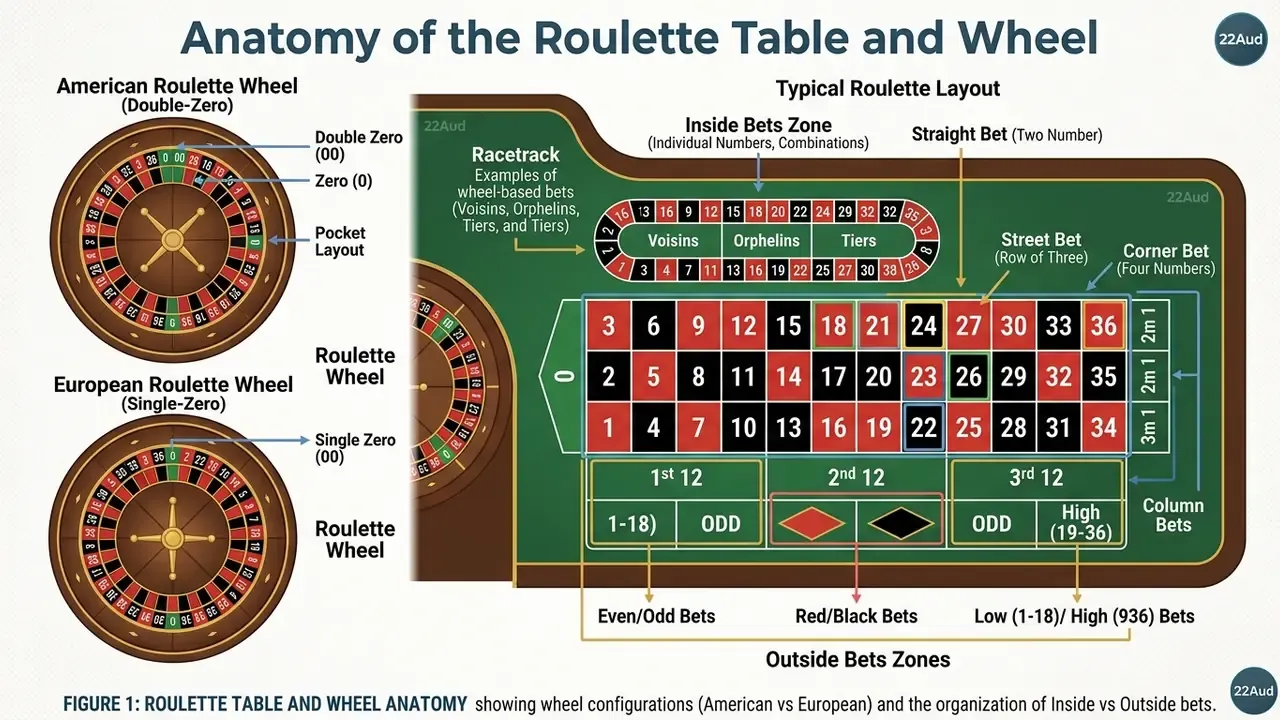
The primary difference between roulette variants comes down to green zero pockets. European and French roulette carry 37 pockets (1-36 plus a single 0), while American roulette carries 38 (1-36, a single 0 and a double 00). That one extra pocket doubles the standard house advantage from 2.70% on European wheels to 5.26% on American wheels.

French roulette uses exactly the same single-zero 37-pocket wheel as European roulette, then adds specialised rules for even-money outside bets: la partage or en prison. Under la partage, if the ball lands on zero you lose only half your even-money stake, which cuts the house edge on those wagers to 1.35%. Under en prison the stake is held for the next spin instead: win it and the stake is released, lose it and the whole wager is forfeited. French layouts also relabel the outside fields, Manque (low), Passe (high), Impair (odd) and Pair (even), and position them on both sides of the number grid rather than beneath it. Mathematically, the verdict is not close: single-zero wheels offer far better long-run value than double-zero configurations.

European and American roulette layouts showing betting zones, the zero sector, the racetrack and chip placement points
4 H2 Roulette rules how a

[4] H2: Roulette rules: how a game round unfolds

A single round of roulette follows a strict four-step sequence: the betting window opens, the wheel and ball are spun, the winning outcome is declared, and payouts are settled. That cycle stays consistent across land-based venues, RNG online games and live-dealer streams.

During an active round, players choose virtual or physical chips of varying denominations and place them on their chosen sectors of the roulette table before the dealer or the software signals the end of wagering. Once bets lock, the spin decides the winning compartment. Payouts are credited according to fixed multipliers, losing chips are cleared, and the next wagering window opens.

5 H3 How to choose chips
[5] H3: How to choose chips and place bets on the roulette table

Players select chips by clicking or tapping the desired denomination in the interface, then positioning them on specific grid lines or designated boxes on the roulette table layout. Table limits define both the minimum and the maximum wager, for individual positions and for aggregate bets per spin.

A single wager, say a Straight Up bet on number 17, concentrates risk on one outcome and offers a payout of 35:1. Alternatively, players can combine several wagers across inside grid intersections and outside fields in the same spin, spreading coverage across multiple numerical groups and adjusting total stake to fit their own risk tolerance.

Chip placement geometry is fixed and worth memorising, because a chip a few millimetres out of position becomes a different bet entirely.

Inside a number box it is a Straight Up; on the line between two numbers, a Split; on the outer boundary of a row of three, a Street; on the intersection where four numbers meet, a Corner; and on the boundary between two adjacent streets, a Six-Line.

6 H3 The spin and determination
[6] H3: The spin and determination of the result

After wagering closes, the dealer launches the ball along the outer rim of the spinning roulette wheel, or the RNG script calculates the landing pocket in software formats. As momentum declines, the ball strikes deflectors and settles into a numbered compartment.

In live dealer games, optical sensors and high-definition cameras capture the exact pocket, while software reconciles the result against digital bet placement records. Winning bets are paid automatically to player balances according to the official payout schedule, losing wagers are removed, and the table resets for the next round within 30 to 60 seconds. In a physical venue the croupier calls "no more bets", places the dolly on the winning number, sweeps losing chips with the rake, and only then pays winners. That is precisely why players must never touch chips while the dolly is on the felt.

7 H2 Types of roulette bets

[7] H2: Types of roulette bets: inside, outside and call bets

Roulette bets split into two structural categories: high-payout, low-probability inside bets placed within the numerical grid, and lower-payout, higher-probability outside bets placed on the surrounding boxes. Both categories carry identical house edges on standard wheels, yet their volatility profiles have almost nothing in common.

Inside bets let players wager on specific numbers or small adjacent groupings of up to six numbers. Outside bets cover broad characteristics instead, colour, parity or numerical range, delivering frequent small wins that steady short-term bankroll swings. A third family, the announced or call bets, sits on top of both: these are pre-set chip patterns built on wheel geometry rather than table geometry.

8 H3 Inside bets straight, split
[8] H3: Inside bets: straight, split, street and corner

Inside bets go directly on numbers or grid lines within the main 12-by-3 layout. A Straight Up bet places chips on one number, paying 35:1 with a hit probability of 2.70% on European wheels and 2.63% on American wheels.

A Split bet covers two adjacent numbers by sitting on the dividing line between them, paying 17:1. A Street bet covers three consecutive numbers in a horizontal row from the outer boundary line, paying 11:1. A Corner (or Square) bet covers four adjacent numbers sharing an intersection at 8:1, while a Six-Line (Double Street) covers six numbers across two adjacent rows at 5:1. On European layouts a First Four bet (0-1-2-3) sits on the corner between 0 and 1, or 0 and 3, and pays 8:1. Keep that in mind when you meet the American Top Line bet analysed further down; the two look similar and behave very differently.

9 H3 Outside bets red black
[9] H3: Outside bets: red/black, low/high, dozen and column

Outside bets sit in the large boxes surrounding the numerical grid and cover extensive sets of numbers. Even-money bets include Red/Black, Even/Odd and Low (1-18)/High (19-36), each covering 18 pockets and paying 1:1. On a European single-zero wheel these wagers win 48.65% of the time; on an American double-zero wheel that falls to 47.37%.

Dozen bets (1-12, 13-24, 25-36) and Column bets, each covering 12 numbers, pay 2:1, with a win probability of 32.43% on European wheels and 31.58% on American wheels. Because zero pockets are neither red nor black, odd nor even, high nor low, they are the mechanism that generates the casino's structural advantage across every outside wager. No hidden bias required. Just one green pocket doing quiet arithmetic.

Bet TypeCategoryNumbers CoveredPayout (to 1)European Win ProbabilityAmerican Win ProbabilityEuropean House EdgeAmerican House Edge
Straight UpInside135:12.70%2.63%2.70%5.26%
SplitInside217:15.41%5.26%2.70%5.26%
StreetInside311:18.11%7.89%2.70%5.26%
CornerInside48:110.81%10.53%2.70%5.26%
Six-LineInside65:116.22%15.79%2.70%5.26%
First Four (EU only)Inside4 (0-1-2-3)8:110.81%n/a2.70%n/a
Top Line / Basket (US only)Inside5 (0-00-1-2-3)6:1n/a13.16%n/a7.89%
Red / BlackOutside181:148.65%47.37%2.70%5.26%
Even / OddOutside181:148.65%47.37%2.70%5.26%
Low / HighOutside181:148.65%47.37%2.70%5.26%
DozenOutside122:132.43%31.58%2.70%5.26%
ColumnOutside122:132.43%31.58%2.70%5.26%
[9.1] H3: Call bets and announced bets on the racetrack

European and French roulette tables, plus almost every live-dealer studio table, include an extra oval betting field called the racetrack. It reproduces the numbers in their physical order on the wheel rather than their numerical order on the grid. One click on a racetrack segment places a whole pattern of chips at once. These wagers do not change the house edge; they simply cover wheel sectors efficiently.

22Aud heading-banner
  • Voisins du Zéro (neighbours of zero):a 9-chip bet covering the 17 numbers around the zero sector: 0, 2, 3, 4, 7, 12, 15, 18, 19, 21, 22, 25, 26, 28, 29, 32 and 35.
  • Tiers du Cylindre (third of the wheel):a 6-chip bet covering the 12 numbers opposite zero: 27, 13, 36, 11, 30, 8, 23, 10, 5, 24, 16 and 33.
  • Orphelins (orphans):a 5-chip bet covering the 8 numbers left out of the two series above: 1, 20, 14, 31, 9, 17, 34 and 6.
  • Jeu Zéro (zero game):a 4-chip bet on the tight cluster around zero: 12, 35, 3, 26, 0 and 32.
  • Neighbours:one chosen number plus the two numbers on each side of it on the wheel, so five numbers and five chips.
  • Finales:all numbers sharing a final digit, for example Finale 5 covering 5, 15, 25 and 35.

Because racetrack bets consume several chips per click, always check the total stake displayed before confirming. A 9-chip Voisins du Zéro at a $5 chip value commits $45 to a single spin, which is a very different session cost from the $5 a beginner might assume.

10 H2 Roulette odds, payouts and

[10] H2: Roulette odds, payouts and house edge

Mathematical expectation in roulette comes from one simple design choice: the casino pays slightly less than fair odds on every winning selection. That gap is the house edge, and it cannot be removed by anything the player does. On a single-zero European wheel it is 2.70%; on a double-zero American wheel it climbs to 5.26%.

The general formula for expected value $E[V]$ per unit wagered is:

$$E[V] = P(\text{win}) \times \text{net payout} - P(\text{lose}) \times 1$$

For a European Straight Up bet covering 1 pocket out of 37 at 35:1:

$$E[V] = \left(\frac{1}{37} \times 35\right) - \left(\frac{36}{37} \times 1\right) = -\frac{1}{37} \approx -2.70%$$

On an American wheel with 38 pockets and the same 35:1 payout, expectation drops:

$$E[V] = \left(\frac{1}{38} \times 35\right) - \left(\frac{37}{38} \times 1\right) = -\frac{2}{38} \approx -5.26%$$

[11] H3: Why European roulette is usually better value than American roulette

European roulette beats American roulette because it omits the double zero, cutting theoretical expected loss per wager almost in half, from 5.26% down to 2.70%. The extra green pocket on American wheels adds another losing outcome for standard wagers without lifting a single payout multiplier. Same prices, worse odds.

«Across 25,000 tracked spins, European roulette produced a realised house edge of 2.74%, almost exactly the theoretical 2.70%.» - GDM Empirical Study (2024), Monte Carlo-based spin tracking across physical and simulated wheels

Methodology note the study combined physical

Methodology note: the study combined physical wheel observation with algorithmic simulation of the same two wheel configurations. Realised edge varied sharply with sample length. In 100-spin sessions the measured edge was roughly 3.2% (European) and 6.8% (American); at 10,000+ spins the results settled to 2.7% and 5.26% respectively. Short sessions are dominated by variance, long ones by structure. And because the GDM figures come from a combined empirical-and-simulated dataset rather than a single audited land-based venue, treat them as directional confirmation of the theoretical model, not as an independent audit.

Across 10,000 spins at $10 per spin, expected cumulative loss on a European wheel comes to about $2,700, against roughly $5,260 on an American wheel. Choosing single-zero games preserves bankroll over long sessions without any strategy at all.

12 H3 Best bets by odds
[12] H3: Best bets by odds and payouts

From a pure expectation standpoint there is no "best" bet on a standard single-zero wheel, because every standard inside and outside wager shares the same 2.70% house edge. What actually differs between bet types is volatility, not expected return.

Players who want to minimise short-term bankroll swings should lean on outside even-money bets, Red/Black and Low/High, which win on roughly 48.65% of spins. Players chasing large single-spin wins accept high variance through inside Straight Up bets. The one genuine exception to the uniform edge is French roulette even-money betting under la partage, which drops the edge to 1.35% and makes it the mathematically optimal variant on the market.

Fact Check & Verification Note: All stated probabilities and payout figures are checked against established licensing standards set by authorities such as the UK Gambling Commission and independent testing labs (for example eCOGRA). On American layouts, the "Top Line" or "Basket" bet covering 0-00-1-2-3 carries a uniquely punitive house edge of 7.89%. The arithmetic: the bet pays 6:1 on five winning pockets out of 38, so $E[V] = (5/38 \times 6) - (33/38 \times 1) = 30/38 - 33/38 = -3/38 \approx -7.89%$. Sticking to European or French single-zero layouts avoids that penalty entirely.

16 H2 Online roulette popular game

Online casino libraries stock a wide spread of roulette variations, from traditional classic wheel layouts to digital modifications with multiple balls, extra wheels or smaller pocket counts. Each variation shifts gameplay speed, volatility or the published return-to-player (RTP) percentage.

Picking the right online variant means checking the game rules, pocket configuration and RTP disclosure inside the game info panel. That verification work sits alongside your choice of online operator, since two lobbies can list the same game name and stock different pocket configurations underneath it. Classic single-zero games remain the benchmark for standard play, while novel variants offer altered mechanics for players who want higher feature density or faster round pacing.

[17] H3: Classic roulette games: European, American and French

Classic online roulette games replicate physical table rules through software RNG engines. European Roulette runs 37 pockets at a 97.30% RTP (2.70% house edge) and serves as the baseline standard across online lobbies.

American Roulette runs 38 pockets at a 94.74% RTP (5.26% house edge), which makes it the weaker choice on every metric that matters. French Roulette keeps the 37-pocket single-zero wheel while applying la partage or en prison to even-money wagers, lifting the effective RTP on those bets to 98.65% (1.35% house edge).

18 H3 Multi ball, multi wheel
[18] H3: Multi ball, multi wheel and other roulette variations

Modified online variants introduce non-standard mechanics that reshape round dynamics. Multi-Ball Roulette spins up to three balls in a single wheel, and some software versions support as many as ten, dividing wagers across several outcomes per round. Because no two balls can settle in the same pocket, coverage per spin rises while individual payouts scale down. Multi-Wheel Roulette lets players apply one wager set across up to eight simultaneous spins, each resolving independently on a single-zero layout.

Mini Roulette uses a reduced 13-pocket wheel, numbers 1-12 plus a single 0. Unless special refund rules apply, Mini Roulette usually carries a high house edge of about 7.69%, since 0 represents one outcome in thirteen; versions that return half the stake on zero cut that figure to roughly 3.85%. Multiplier titles such as Lightning Roulette keep the European base wheel but reallocate payout structures to fund random multipliers up to 500x on Straight Up bets.

VariantPocket CountWheel / Ball FormatStandard RTPHouse EdgeUnique Rule / Feature
European Roulette37 (0-36)1 Wheel, 1 Ball97.30%2.70%Standard single-zero baseline
American Roulette38 (0, 00, 1-36)1 Wheel, 1 Ball94.74%5.26%Double-zero pocket added
French Roulette37 (0-36)1 Wheel, 1 Ball98.65%*1.35%*La Partage / En Prison on even-money
Mini Roulette13 (0-12)1 Small Wheel, 1 Ball92.31%7.69%Scaled-down grid; 3.85% with half-back on zero
Multi-Ball Roulette37 (0-36)1 Wheel, 2-3 Balls97.30%2.70%Multiple outcomes per spin, scaled payouts
Multi-Wheel Roulette37 (0-36)Up to 8 Wheels, 1 Ball each97.30%2.70%One bet set across parallel spins
Lightning Roulette37 (0-36)1 Live/RNG Wheel, 1 Ball97.10%-97.30%2.70%-2.90%RNG multipliers (50x-500x) on Straight Up

*Applies to even-money outside bets under la partage; other bets retain the 2.70% edge.

19 H2 Live dealer roulette what

[19] H2: Live dealer roulette: what changes in a live casino

Live dealer roulette closes the gap between a land-based floor and digital play by streaming high-definition video of human croupiers operating physical wheels in purpose-built studios. Unlike RNG games, live outcomes come from real ball dynamics, which is also why experienced players compare live casino platforms on stream quality, table limits and studio provider before committing funds.

Players interact through a digital interface overlay that superimposes wagering chips onto the live feed. The format gives you full operational visibility: you watch the ball spin, follow the wheel decelerating, and see the dealer manage the table in real time. For some players that transparency is the whole appeal.

20 H3 How a live roulette
[20] H3: How a live roulette round works

A live roulette round runs on a synchronised studio schedule. An on-screen timer shows the open betting window, usually 15 to 30 seconds, during which players place wagers through the overlay. Once the timer expires the dealer calls "No more bets" and spins the physical ball around the track.

High-definition cameras and sensor grids embedded in the wheel read the winning pocket automatically as the ball settles. The software calculates payouts, credits balances, and opens the next countdown while the dealer clears the table. The betting cut-off is software-enforced, so any chip not confirmed before the timer expires is returned rather than staked.

21 H3 Live dealer roulette variants
[21] H3: Live dealer roulette variants and their specifications

Tier-1 live casino providers such as Evolution, Playtech, Pragmatic Play and Authentic Gaming run a range of branded live roulette formats. The differences are measurable, not cosmetic:

  • Lightning Roulette & XXXtreme Lightning Roulette (Evolution): base RTP of 97.30% on outside bets. Before each spin, RNG lightning strikes assign multipliers from 50x to 500x to random Straight Up numbers; XXXtreme adds Chain Lightning for multipliers up to 2,000x. The trade-off is real: unboosted Straight Up wins pay 29:1 instead of 35:1.

    «Lightning Roulette outside bets retain 97.30% RTP, while straight-up bets carry a marginally higher edge due to reduced base payouts.» - Lightning Roulette RTP analysis (2024)

22Aud heading-banner
  • Speed Roulette (Evolution):the round cycle compresses to roughly 25 seconds, because the ball is launched while bets are still being accepted. There is effectively no idle time between spins, which suits experienced players and punishes hesitation.
  • Immersive Roulette (Evolution):streamed in Full HD with multiple camera angles and up to 200 frames per second, enabling slow-motion replay of the ball dropping into the pocket.
  • Quantum Roulette (Playtech):applies random Quantum Multipliers of 50x to 500x to as many as five numbers per spin.
  • Mega Roulette (Pragmatic Play):adds multipliers with a maximum win of 500x on a standard single-zero wheel.
  • Double Ball Roulette (Evolution):compressed air launches two balls into one physical wheel, roughly doubling hit frequency while halving even-money payouts.
  • Dual Play Roulette (Evolution):streams from a live land-based casino floor, so online players wager on the same wheel as seated venue guests.
  • Live French Roulette / La Partage tables (NetEnt, Evolution):the highest-RTP live format available, thanks to the half-stake refund on zero for even-money bets.
  • Live American Roulette:widely offered, rarely worth choosing. If a European or French table sits in the same lobby at similar limits, the double-zero wheel simply costs more per spin.
13 H2 Roulette demo and free

[13] H2: Roulette demo and free roulette games: how to play without real money

Roulette demo modes let players experience the full mechanics, the chip placement interface and outcome resolution using virtual credits, with no financial risk attached. Free-play software runs the same certified RNG algorithms as the real-money versions, so probability distributions are identical.

Free roulette games help beginners learn the table layout, watch how zero pockets behave, and see how different bet configurations perform across a few hundred spins. What demo play cannot do is replicate the psychology of managing real funds, or the way risk tolerance shifts once money is genuinely at stake.

Most reputable software libraries allow demo access without registration; where a lobby demands an account before free play, that is usually a licensing or geo-restriction requirement rather than a technical one, and no KYC document check is needed until you attempt a real-money deposit or withdrawal.

14 H3 What roulette demo gives
[14] H3: What roulette demo gives a beginner

Demo modes give you a sandbox for learning the rules and the layout geography without spending capital. You can test inside grid placements, experiment with racetrack call bets, and watch payout calculations resolve in real time.

Free play also lets you assess software stability, mobile interface responsiveness and table navigation before you register or deposit. Testing negative progression systems like Martingale in demo mode is instructive in a different way: extended losing streaks hit virtual bankroll caps or table limits fast, which is the risk lesson that no article can deliver as cleanly.

«At 1,000 simulated spins with a 250-unit bankroll, Martingale held up until an 8-10 loss streak, then bankrupted the account.» - JavaScript RNG simulator study (2024)

That is the whole lesson in one line. The system works right up until the moment it doesn't, and the moment it fails is the moment it costs the most.

[15] H3: When to move from free roulette to real-money roulette

Disclaimer: This information is general in nature and does not replace professional advice. Real-money gambling is restricted to persons aged 18 and over. If gambling is causing harm, contact Gambling Help Online on 1800 858 858 (Australia, 24/7).

Moving from free demo games to real-money wagering should only happen once you understand the house edge as a mathematical certainty, have set aside a dedicated entertainment budget, and have fixed strict deposit and loss limits in the account settings.

«Online availability and rapid play cycles can intensify problem behaviours among vulnerable gamblers.» - Australian National University, Gambling in Australia (2024)

Practical readiness criteria before a first

Practical readiness criteria before a first deposit: you are of legal age and able to complete identity verification; deposit, stake and session-time limits are already set; you know where the self-exclusion tool lives; and you can state the wheel type, RTP and table limits of the game you intend to play. Warning signs that the move should wait include chasing losses, extending sessions past planned limits, and betting money set aside for something else.

In our brand evaluations for Australian readers, where we analyse platform security and bonus terms, including our detailed iGaming reviews of licensed online casinos, we routinely check that licensed operators enforce age verification (18+) and provide accessible account-level responsible gambling tools. Approach real-money play with pre-set session limits and full awareness that no strategy reverses the mathematical house advantage.

Alert Box - Responsible Gaming Notice: Demo play uses virtual simulation credits with no financial consequence. Success or bankroll growth in demo mode reflects random short-term variance and does not predict profitability in real-money play. Strategies tested in free modes do not alter the fixed house edge built into roulette wheels. Demo balances have no cash value and cannot be withdrawn. Always play responsibly and set personal limits before depositing real funds.

Safety, bonuses, KYC and payouts: what Australian players should check

Disclaimer: The following is general information, not legal or financial advice. Rules change and vary by jurisdiction; confirm current requirements with the operator and with official regulators before you deposit.

The regulatory context in Australia. Under

The regulatory context in Australia

Under the Interactive Gambling Act 2001 (Cth), operators are prohibited from offering online casino-style games, including online roulette, to customers physically located in Australia. Licensed domestic online products are limited to sports and race wagering plus lotteries; the Australian Communications and Media Authority (ACMA) investigates complaints and can request the blocking of offending sites. The Act targets operators rather than individual players, but the practical consequence for consumers is significant. Any online roulette table available to an Australian player is offered from offshore and licensed elsewhere, commonly under Malta (MGA), Curaçao or Anjouan regimes. Dispute resolution, bonus enforcement and payout guarantees therefore rest on the standards of a foreign licence, not on Australian consumer protection.

Bonus wagering why roulette is usually

Bonus wagering: why roulette is usually the worst game to clear a bonus with

This is the single most common cause of confiscated winnings, and almost no roulette guide mentions it. Because roulette carries a low, predictable house edge and low variance on even-money bets, operators restrict it heavily inside bonus terms:
  • Contribution rates:roulette typically counts 0-10% toward wagering requirements, against 100% for pokies. A $1,000 turnover requirement at 10% contribution means $10,000 of roulette turnover.
  • Excluded games:many terms exclude live dealer tables from bonus play entirely.
  • Low-risk / hedge betting clauses:covering both red and black, or a large share of the layout, is commonly defined as "low-risk betting" and can void the bonus and any winnings derived from it.
  • Max bet caps:a maximum stake per spin, often $5-$10, usually applies while a bonus balance is active. One oversized spin can void the whole balance.

Practical rule: if your intention is to play roulette, consider declining the welcome bonus and depositing without it. A clean cash balance with no wagering requirement is usually worth more than a bonus you can only clear at 10% contribution.

Payments, KYC and withdrawal speed

Payments, KYC and withdrawal speed

  • Deposit methods commonly available to Australian players:Visa/Mastercard debit, PayID/Osko bank transfer, Neosurf vouchers, and cryptocurrency (BTC, ETH, USDT). Note that Australian banks may decline gambling-coded card transactions.
  • Withdrawal timing:crypto withdrawals are typically processed within 1-24 hours once approved; bank transfers commonly take 1-5 business days. Approval time, not transfer time, is where delays actually happen.
  • KYC verification:expect to supply photo ID, proof of address (a utility bill or bank statement) and, for card deposits, proof of payment method ownership. Complete verification before you have a win to withdraw. Doing it afterwards triggers the longest delays.
  • Limits to check in advance:minimum and maximum withdrawal per transaction, weekly and monthly caps, whether winnings from a bonus are capped, and whether a second withdrawal in the same month attracts a fee.
Operator verification checklist. 1. Licence stated

Operator verification checklist

  1. Licence: stated licence number visible in the footer and verifiable on the regulator's own register.
  2. Game auditing: RNG certification from an independent lab such as eCOGRA, iTech Labs or GLI, plus published RTP for each roulette title.
  3. Provider list: genuine studio names (Evolution, Playtech, Pragmatic Play, NetEnt, Authentic Gaming) rather than unbranded clones.
  4. Terms transparency: wagering contribution table, max bet under bonus and withdrawal limits, all findable in under two minutes.
  5. Payout reputation: documented processing times and no pattern of unexplained account closures or bonus non-payment.
  6. Responsible gambling tools: deposit, loss and session limits, reality checks, cooling-off and self-exclusion, all self-service from account settings.
  7. Support: live chat that answers a specific bonus or withdrawal question with a specific answer.

Red flags: wagering requirements above 50x, short clearing windows, no named licence, "instant withdrawal" claims without stated limits, and support that cannot explain how much roulette turnover counts toward a bonus.

[22] H2: Roulette strategy: how to approach betting with awareness

Disclaimer: The betting-system information below is educational. No staking system guarantees a profit or removes the casino's mathematical advantage.

A roulette strategy is a framework for managing wager sizing, progressions and bankroll allocation during play. That is all it is. No betting strategy or mathematical progression alters the fixed house edge built into the physical design or the software algorithm.

Because every spin in fair roulette is an independent event, previous outcomes carry zero influence over future results. The useful function of an informed roulette strategy is narrower than most guides suggest: manage short-term volatility, control session exposure, and keep wagering patterns inside your own risk boundaries.

23 H3 What roulette strategy can
[23] H3: What roulette strategy can and cannot change
Betting strategies can change the distribution and frequency of short-term wins and losses. They cannot create positive expectation or overcome the house edge. Progression systems are tools for shaping a bankroll trajectory across a finite session, nothing more.
  • Martingale System:double the wager after every loss on even-money bets, aiming to recover losses plus one unit of profit on the next win. It produces frequent small wins, then an extended losing streak of 8-10 spins drives stakes into exponential territory and hits table caps or empties the bankroll. From a $10 base, the tenth bet in a losing sequence is $5,120, staked to win back $10.
  • Fibonacci System:stakes rise along the Fibonacci sequence (1, 1, 2, 3, 5, 8, 13...) after losses. It escalates more gently than Martingale but stays exposed to sustained negative variance.
  • D'Alembert System:up one unit after a loss, down one unit after a win, giving a flatter risk curve that still leaves long-run expected loss untouched.

Monte Carlo simulations covering millions of virtual spins across progressive staking systems confirm that aggregate losses across extended volume converge on the house edge multiplied by total turnover.

«Thousands of independent sessions per system, Martingale, Fibonacci and D'Alembert, produced identical average loss per unit staked.» - Monte Carlo Gaming Analytics (2023)

Methodology note: starting bankroll, base stake and table limits were held identical across all tested systems, so the staking strategy was the only variable. That design is what makes the conclusion robust. The systems changed the shape of the results, never the average.

24 H3 How to choose bets
[24] H3: How to choose bets that suit your format

Choosing a wagering approach means matching bet types and stake sizing to your bankroll, your session goals and your tolerance for swings. An informed approach puts risk management ahead of profit expectations.

  1. Select the lowest house edge wheel: choose single-zero European or French layouts over double-zero American tables whenever both are available.
  2. Calibrate risk tolerance: outside even-money bets for low variance and longer sessions; inside Straight Up bets when you accept rapid bankroll depletion in exchange for a larger potential single-spin payout.
  3. Implement flat betting: wager a fixed, small percentage of bankroll, say 1% to 2%, per spin. Flat betting sidesteps the exponential escalation risk of negative progressions.
  4. Set session boundaries: fix stop-loss limits and deposit caps before play begins. Treat online roulette as paid entertainment and use the account-level responsible gambling tools whenever you need them.
  5. Watch round speed as a cost multiplier: the house edge applies per spin, not per hour. A 25-second Speed Roulette table can process 100+ spins per hour, so the same edge extracts several times more money than a 60-second table at identical stakes.
Common beginner mistakes and myths, debunked

Common beginner mistakes and myths, debunked with maths

Myth 1: "Covering every number guarantees a win." The rules allow it, and it guarantees a loss. Put $1 on each of the 37 numbers on a European wheel and you stake $37. One number must win, returning 35:1 plus your original chip: $35 + $1 = $36. Net result, a certain $1 loss every spin, which is exactly $37 × 2.70%. The wider the coverage, the more reliably the house edge is realised.

Myth 2: "Red is due after six blacks." The gambler's fallacy. Each spin is independent; the wheel has no memory and keeps no ledger. The probability of red stays 18/37 on every spin regardless of history, and the "hot and cold numbers" panel on the interface is a record, not a forecast.

Myth 3: "Doubling up always gets it back." It gets it back until it doesn't. Table maximums exist precisely to cap progression length, and the bankroll needed to survive a long streak is far larger than most players assume.

Myth 4: "Live roulette is riggable, RNG roulette is fair, or the other way round." Both are auditable. Live outcomes come from a physical wheel filmed from several angles and read by optical sensors; RNG outcomes come from certified algorithms tested by independent labs. Neither format changes the published house edge.

Other frequent errors: ignoring table minimums and maximums before sitting down; touching chips while the dolly is on the layout; chasing losses after a bad run; playing American wheels when a European table is available in the same lobby; and playing roulette with an active bonus that contributes 0-10% to wagering.

Who should skip this format: if you dislike a pattern of sustained small losses punctuated by occasional wins, if you want a game where skill affects the outcome, or if you are trying to clear a wagering requirement quickly, roulette is a poor fit. Skill-influenced games or high-contribution titles suit those goals better.


FAQ

Responsible gambling: gambling should be treated as paid entertainment, never as income. Set deposit, loss and time limits before you play. Free, confidential support is available 24/7 in Australia via Gambling Help Online on 1800 858 858 or gamblinghelponline.org.au. Real-money gambling is for adults aged 18+.

Last reviewed: 2026.